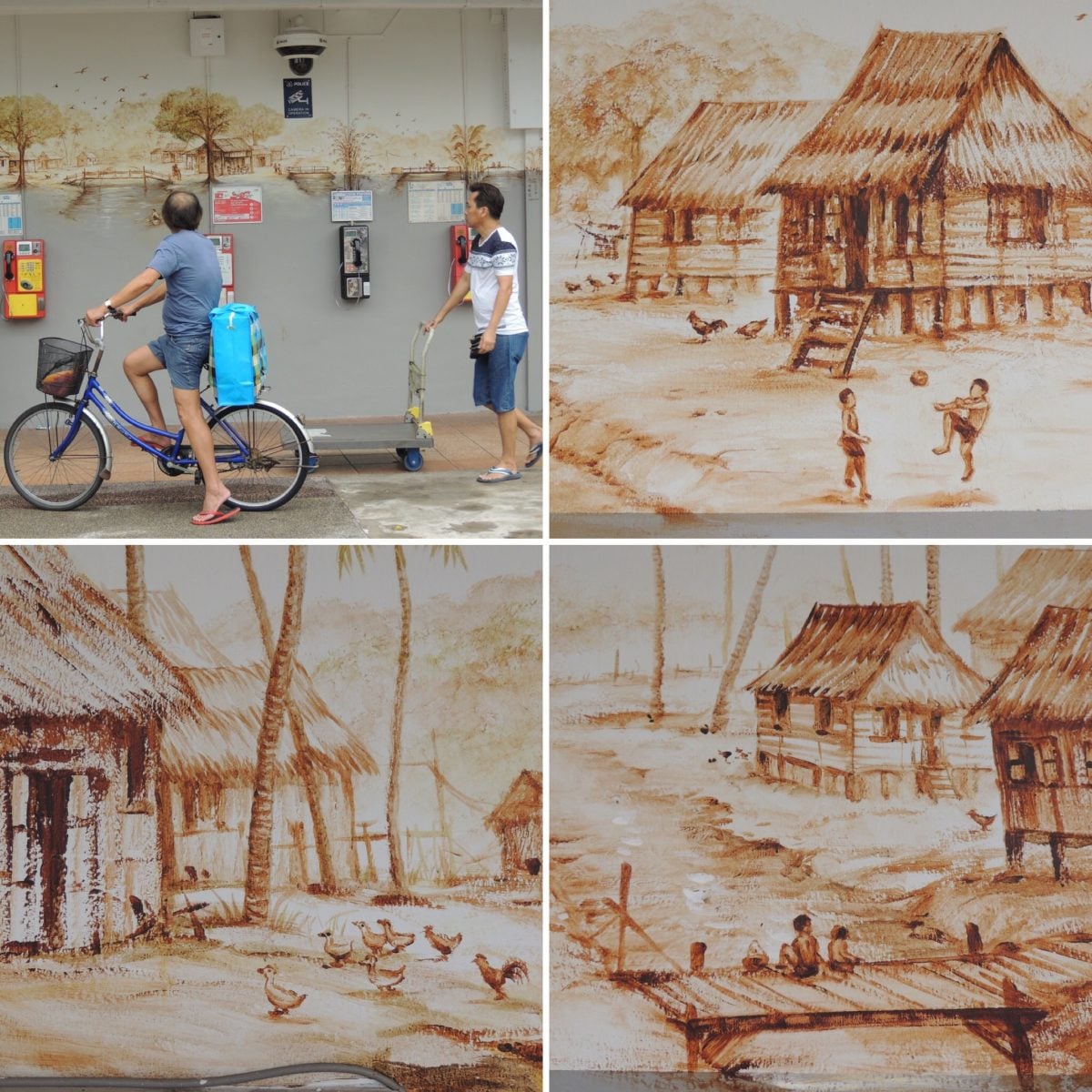
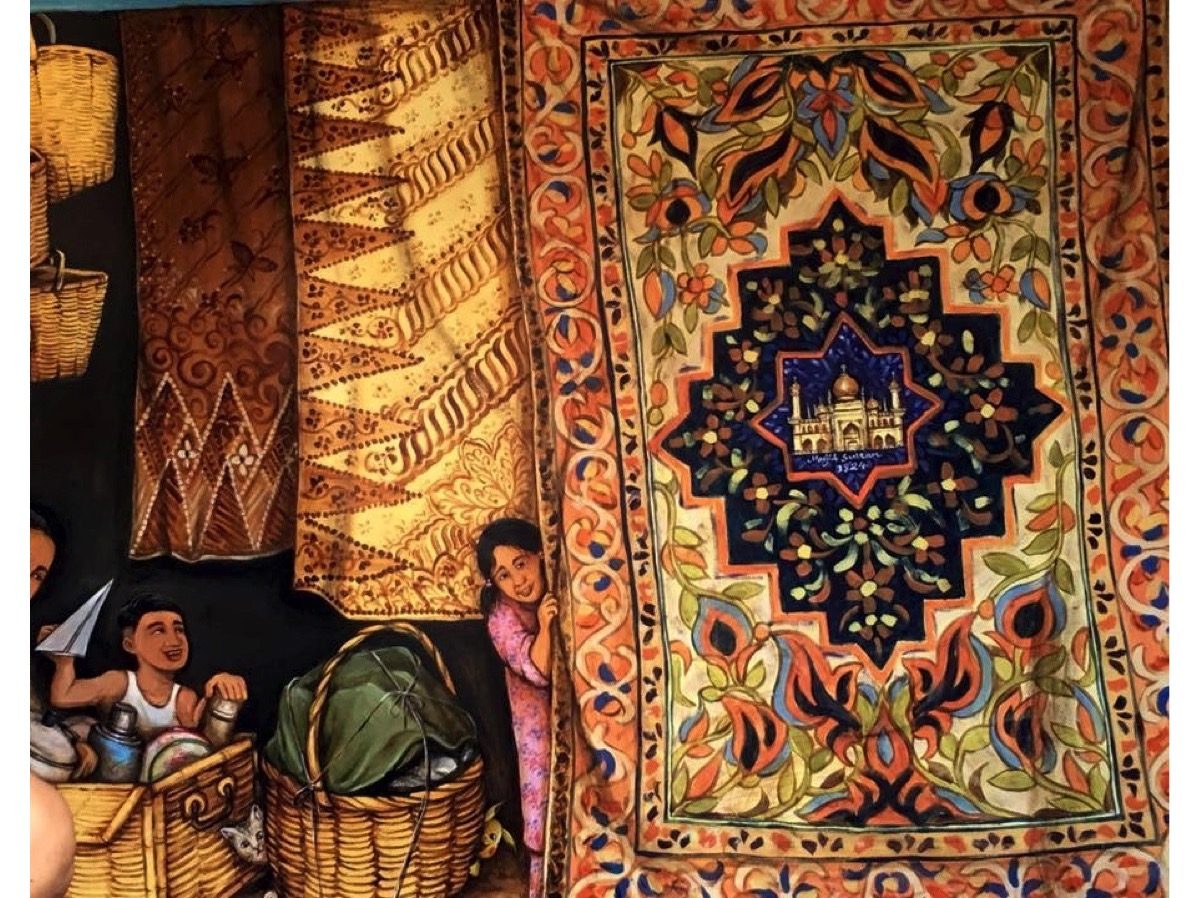
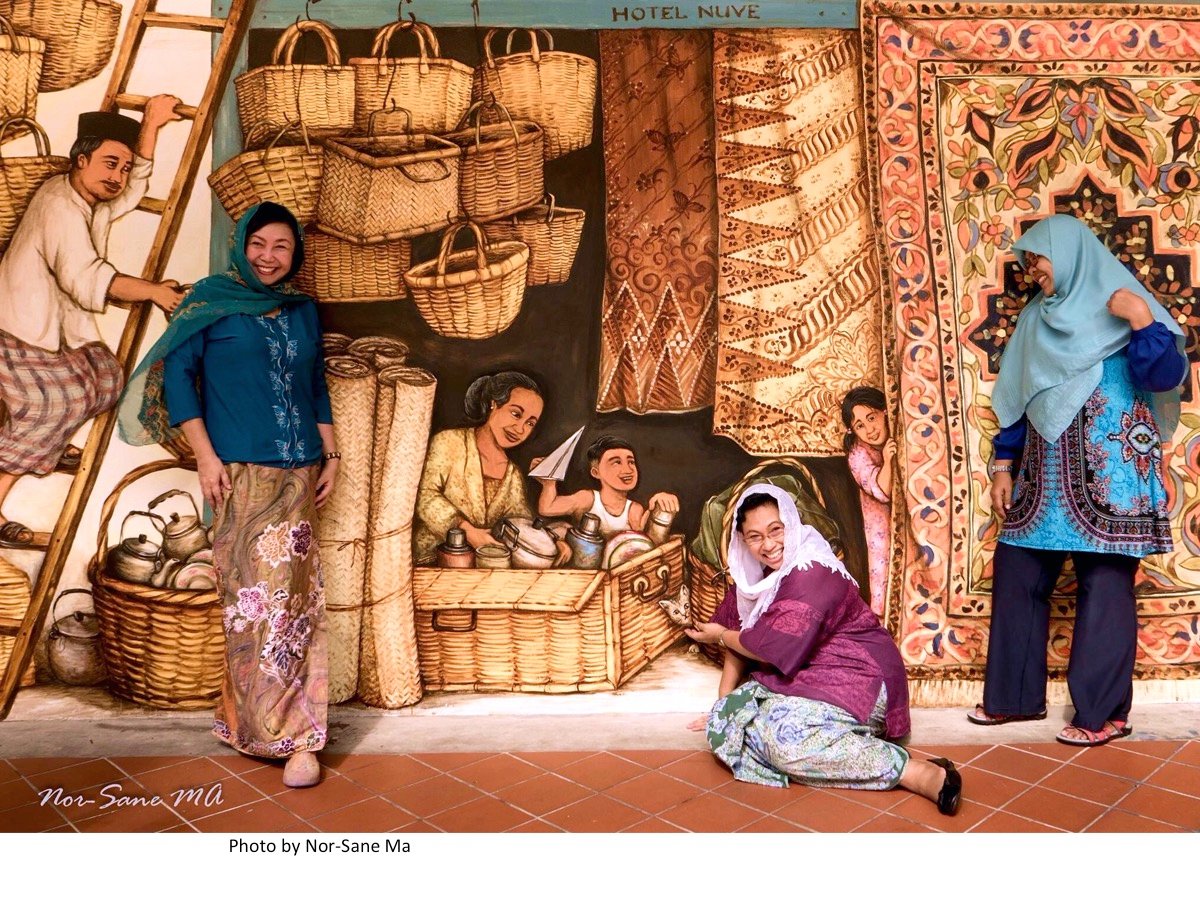
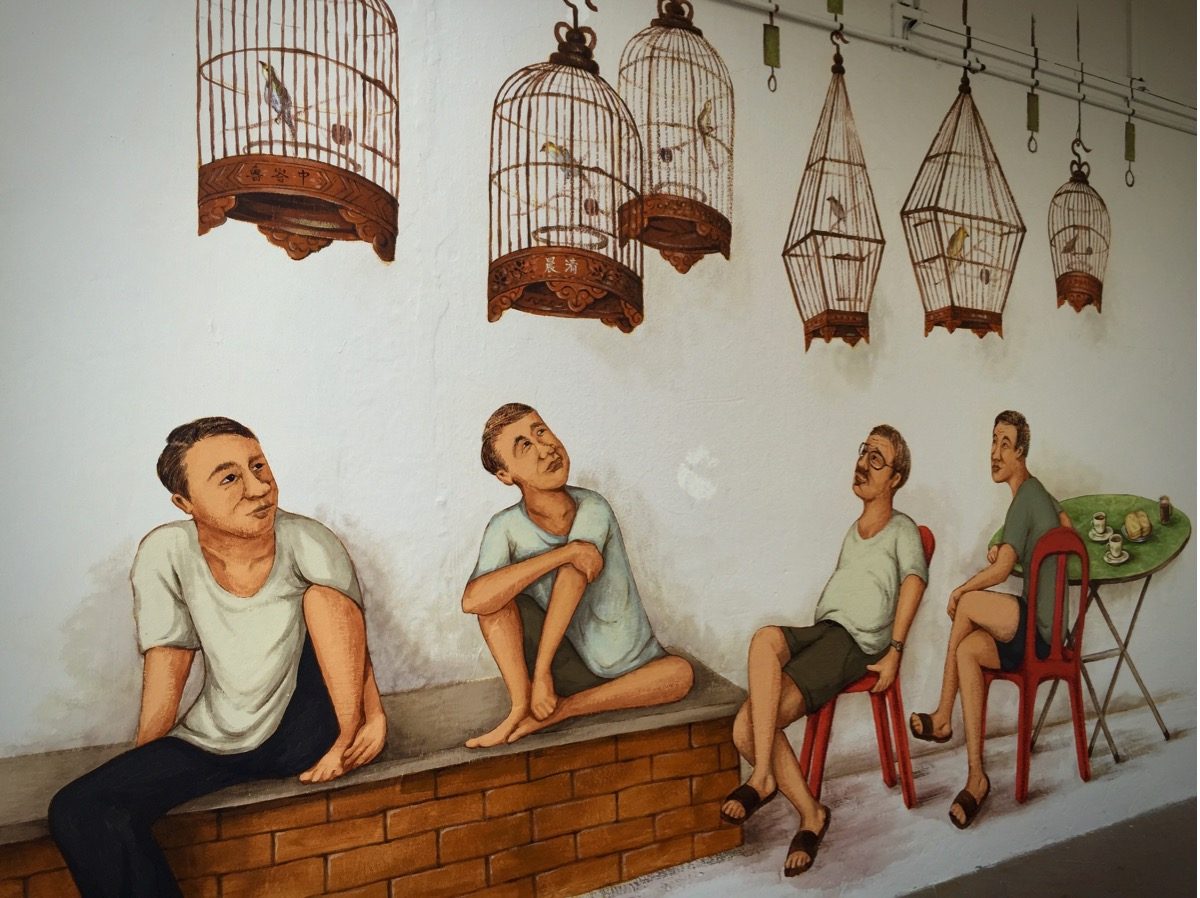
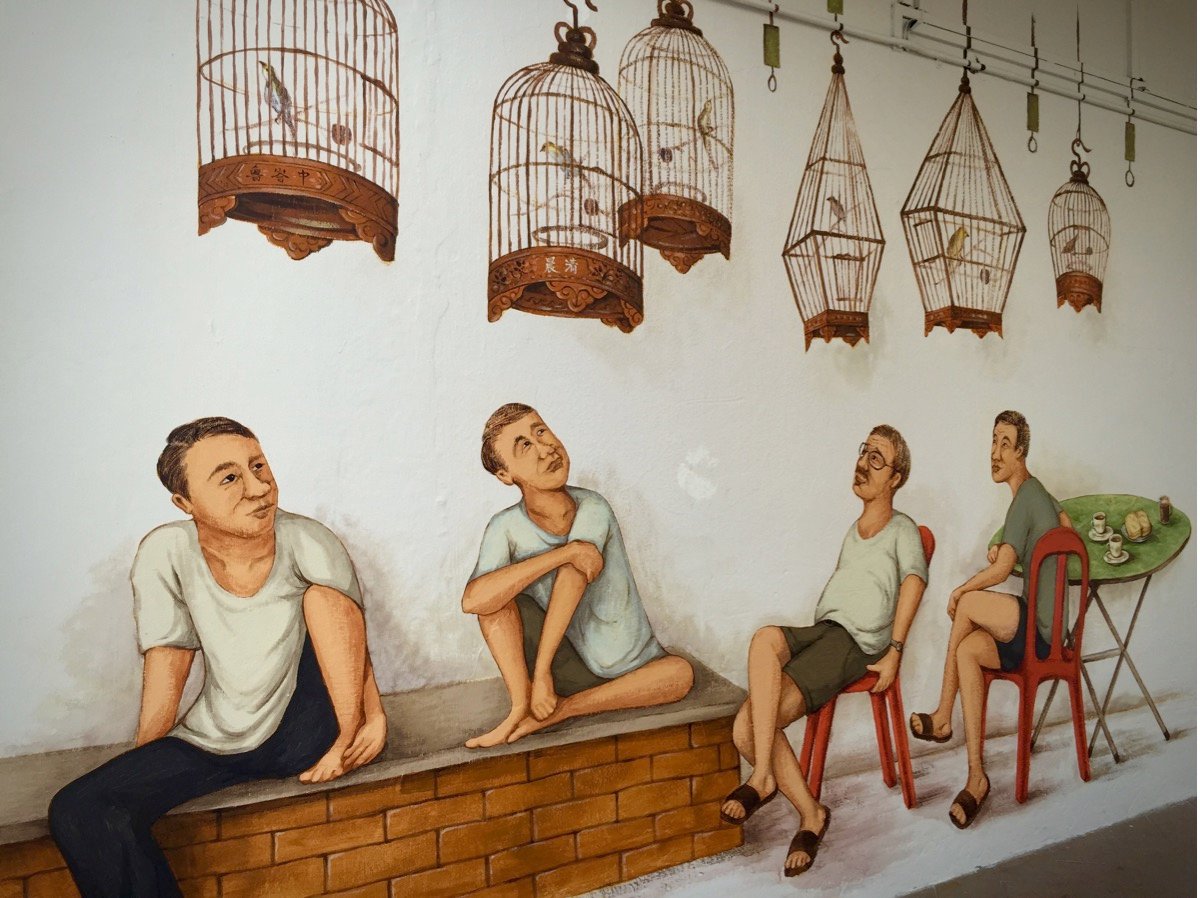
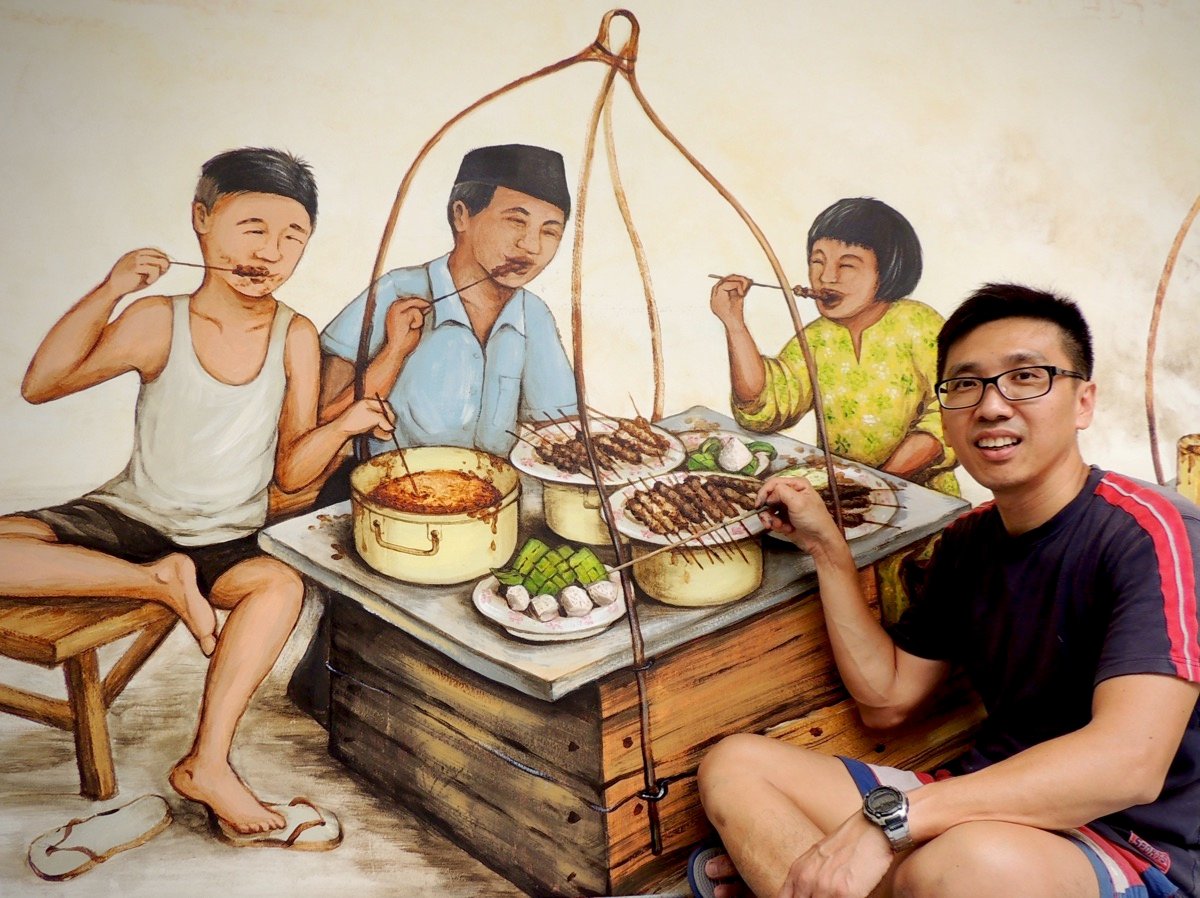
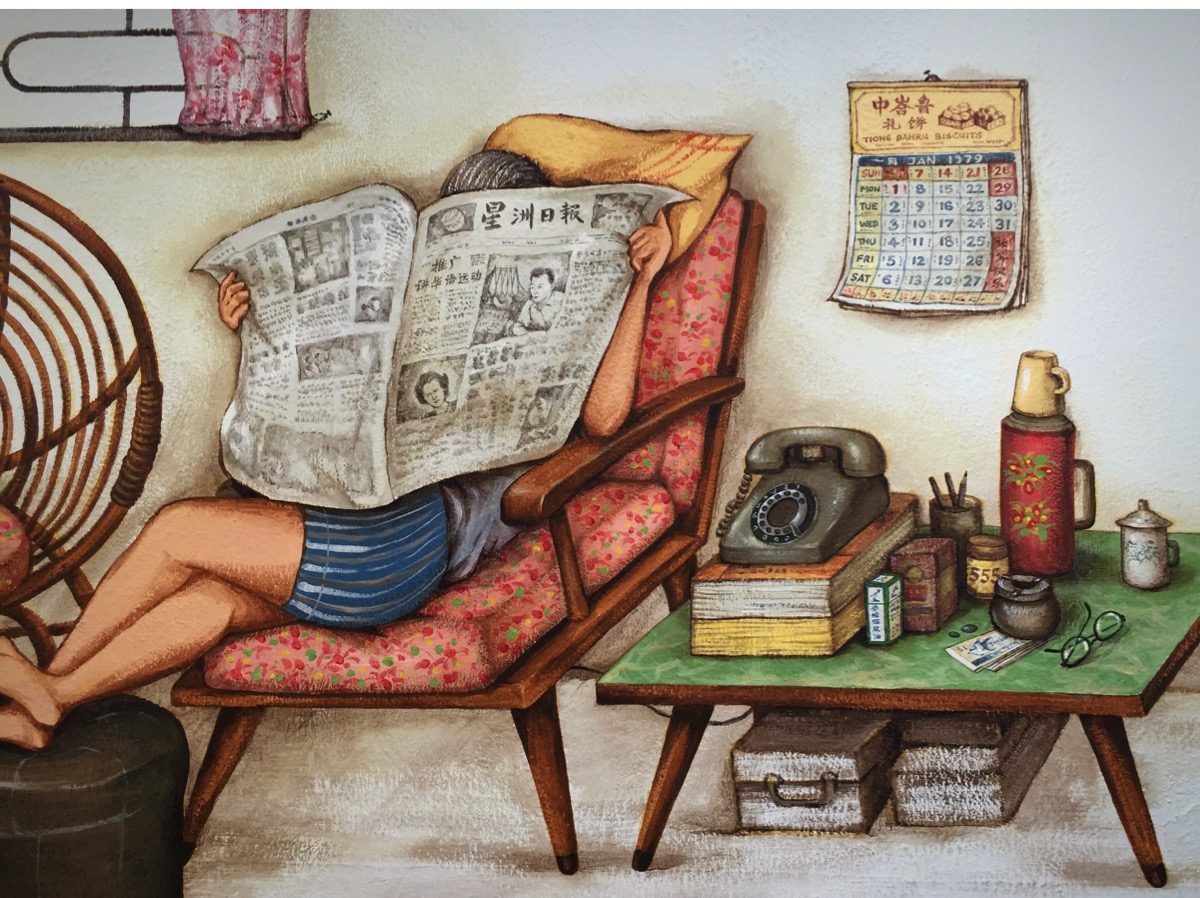
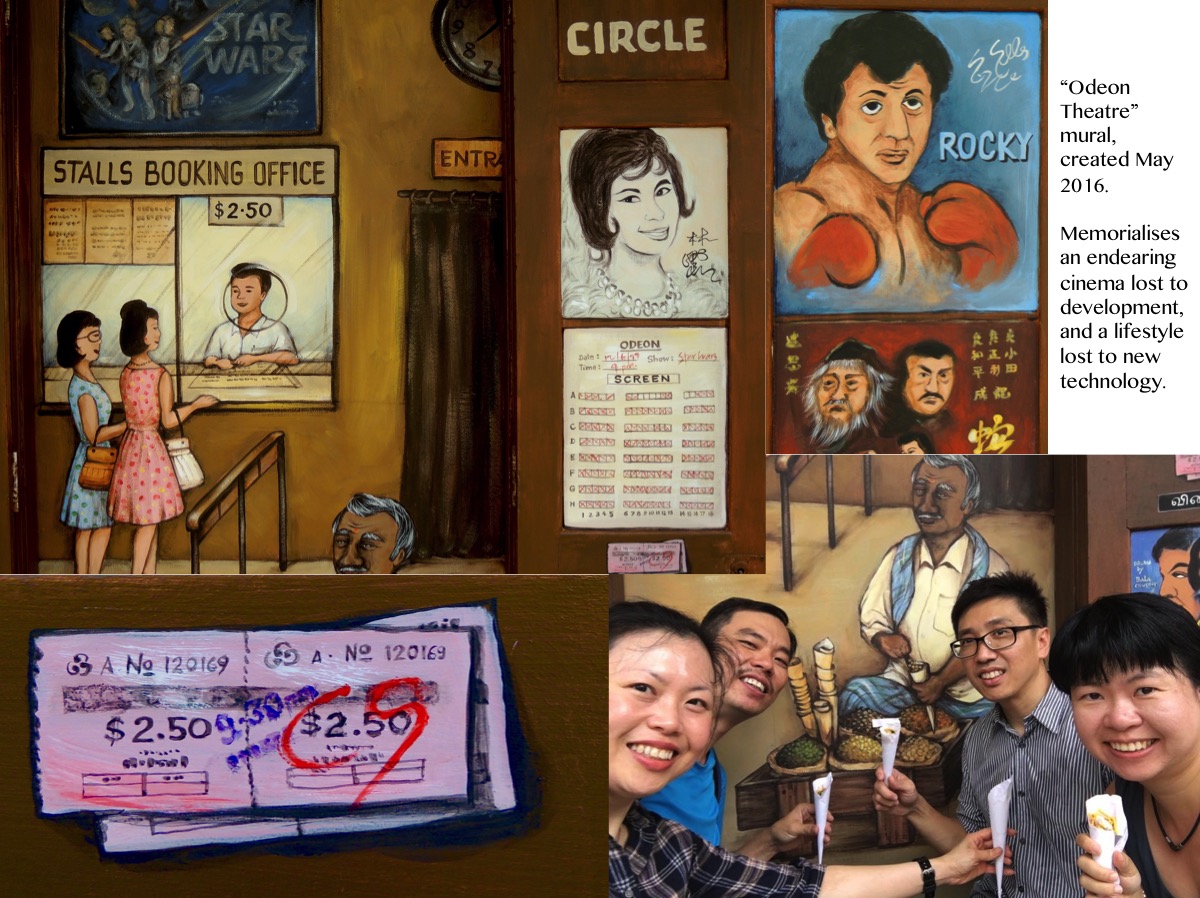
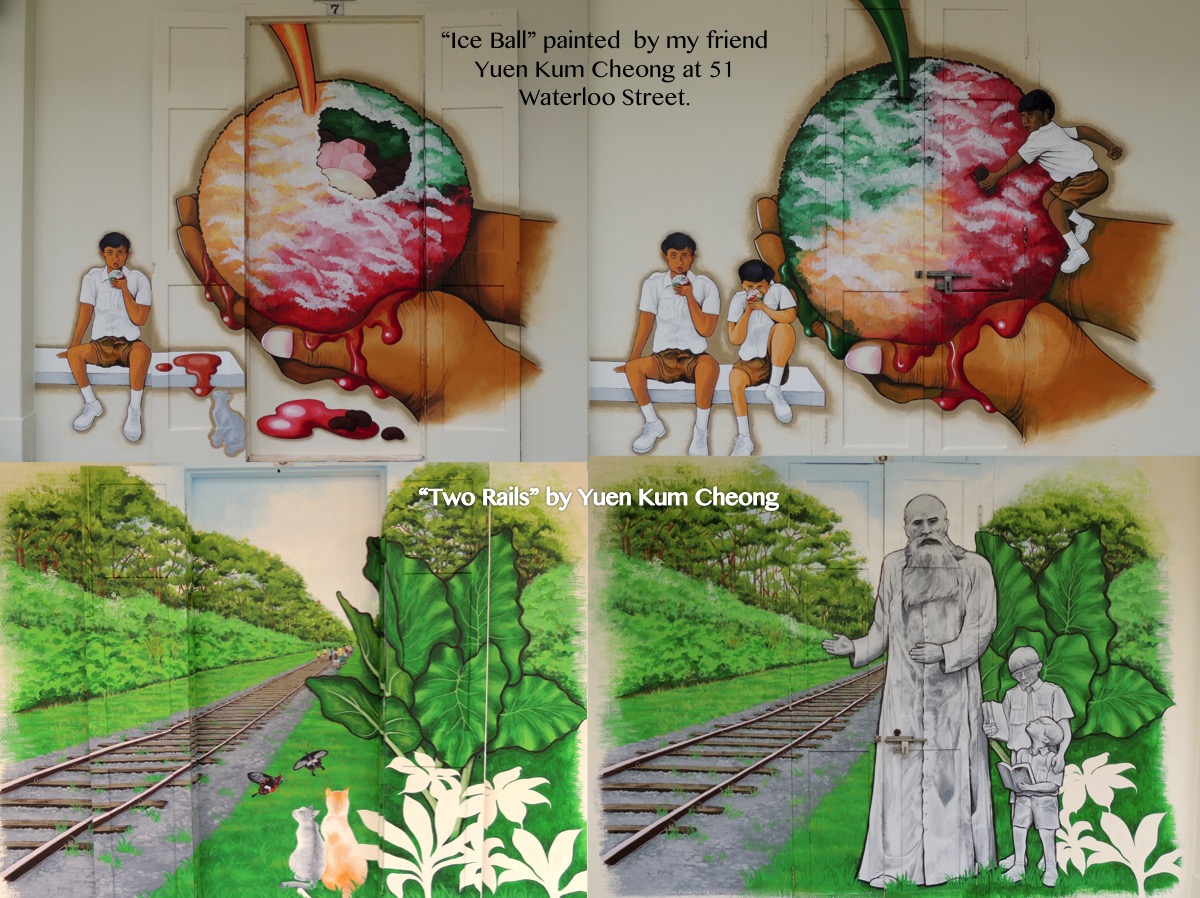
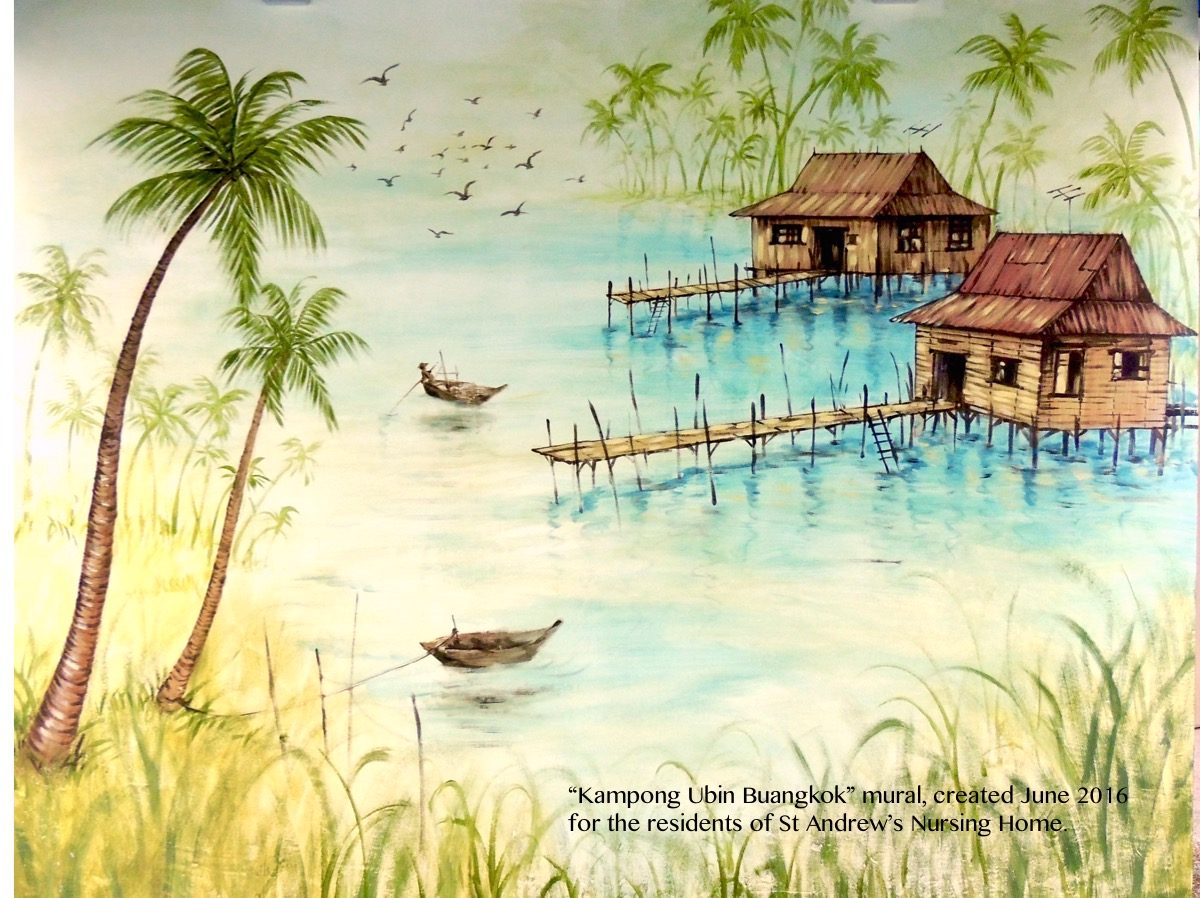
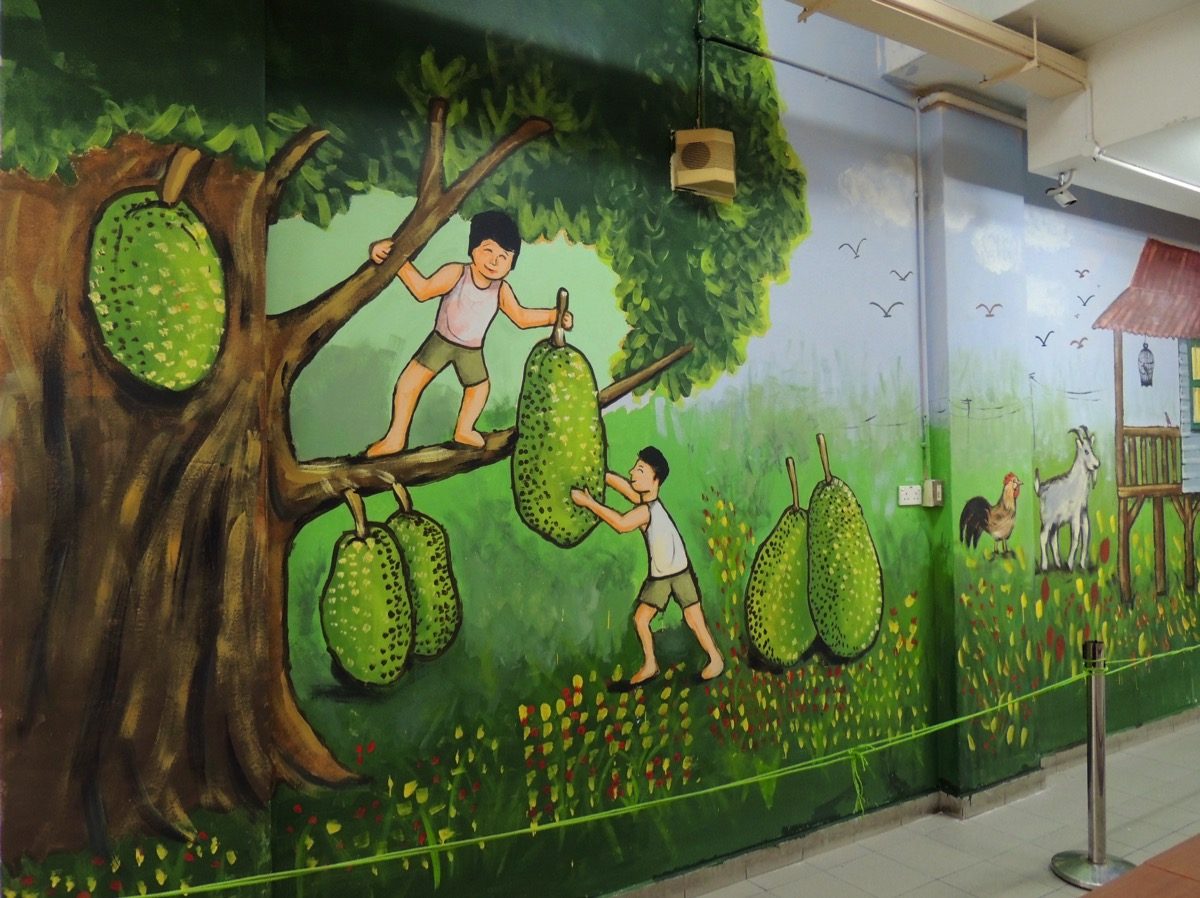
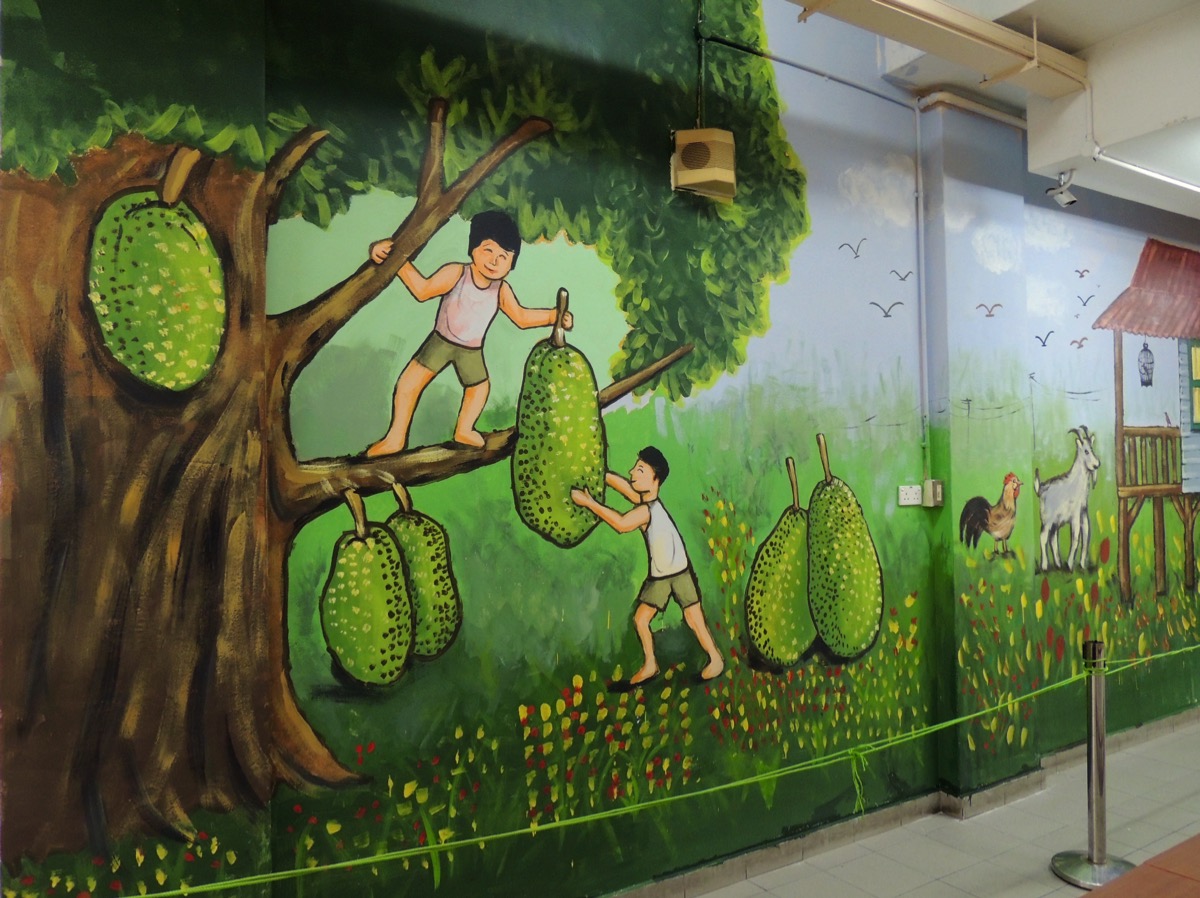
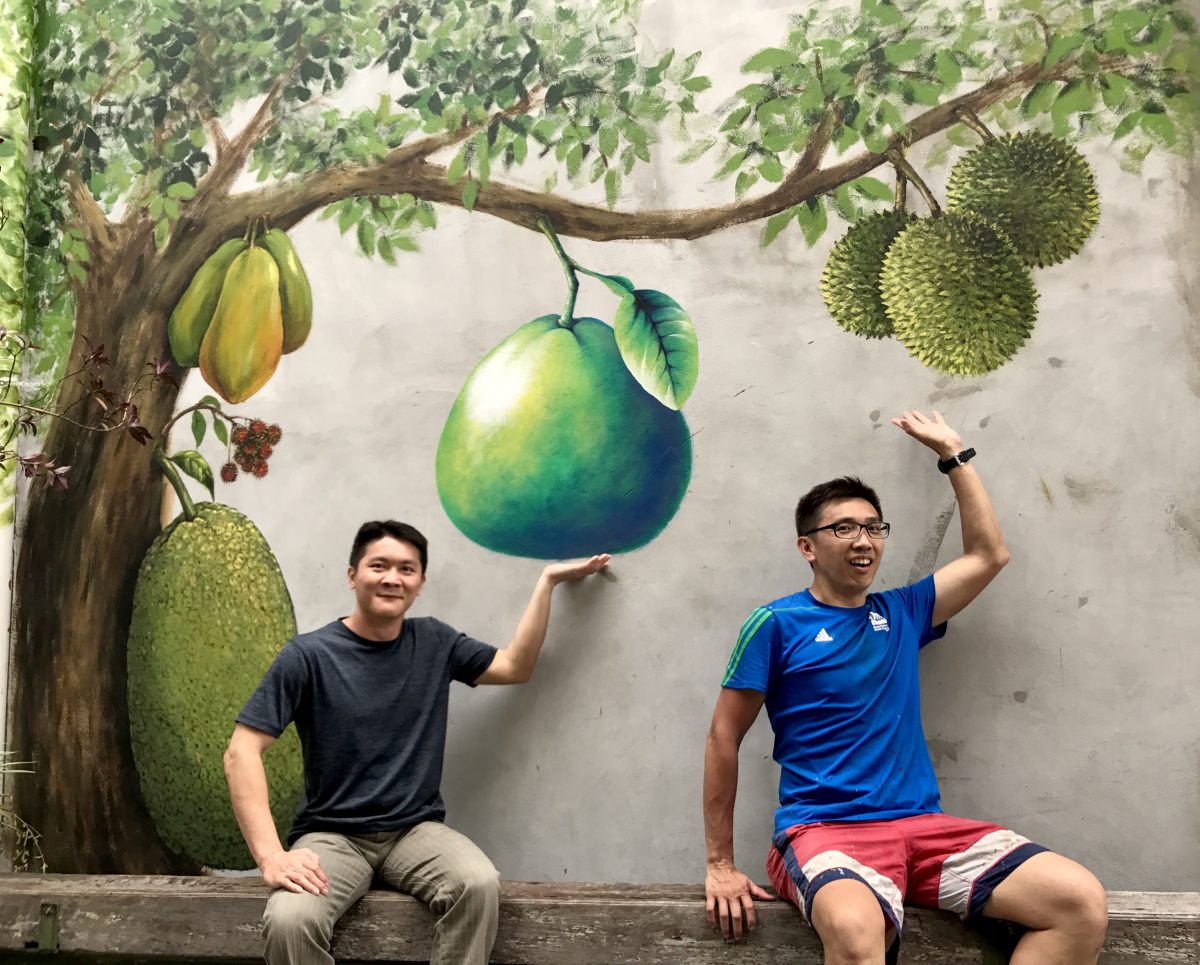
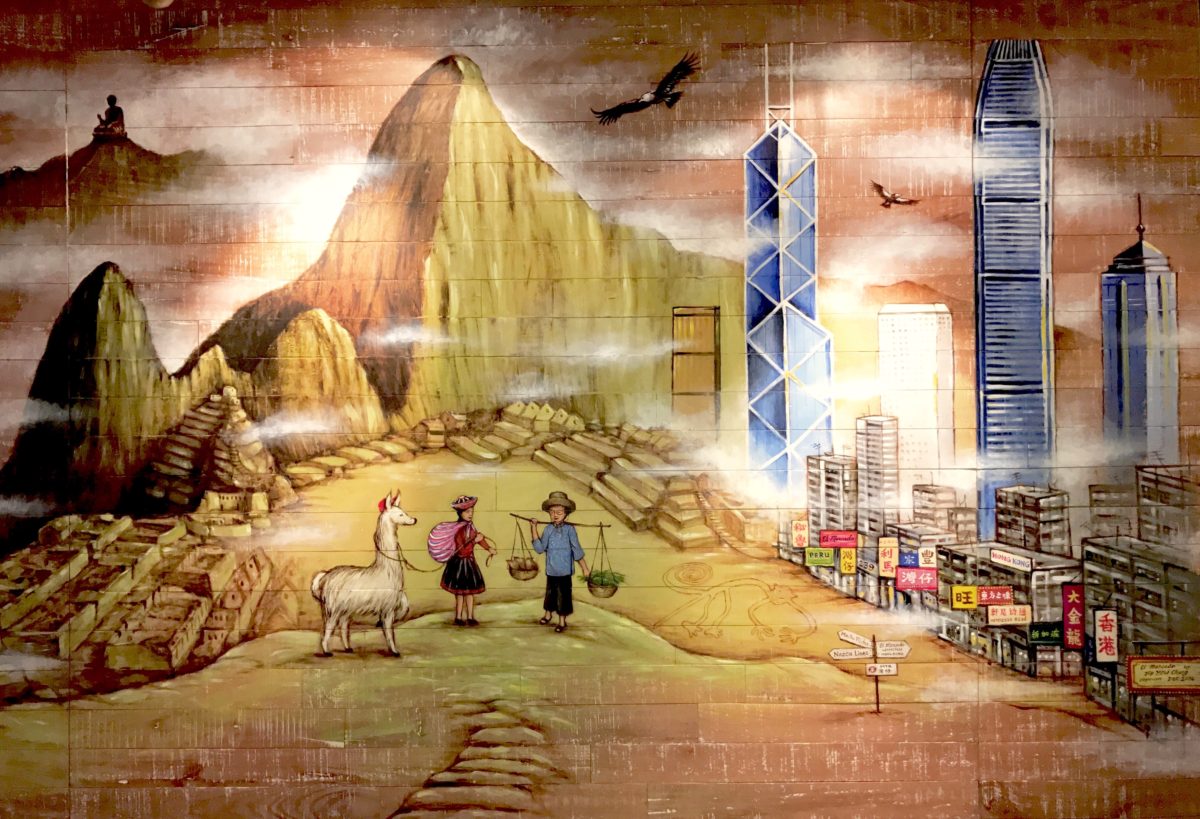
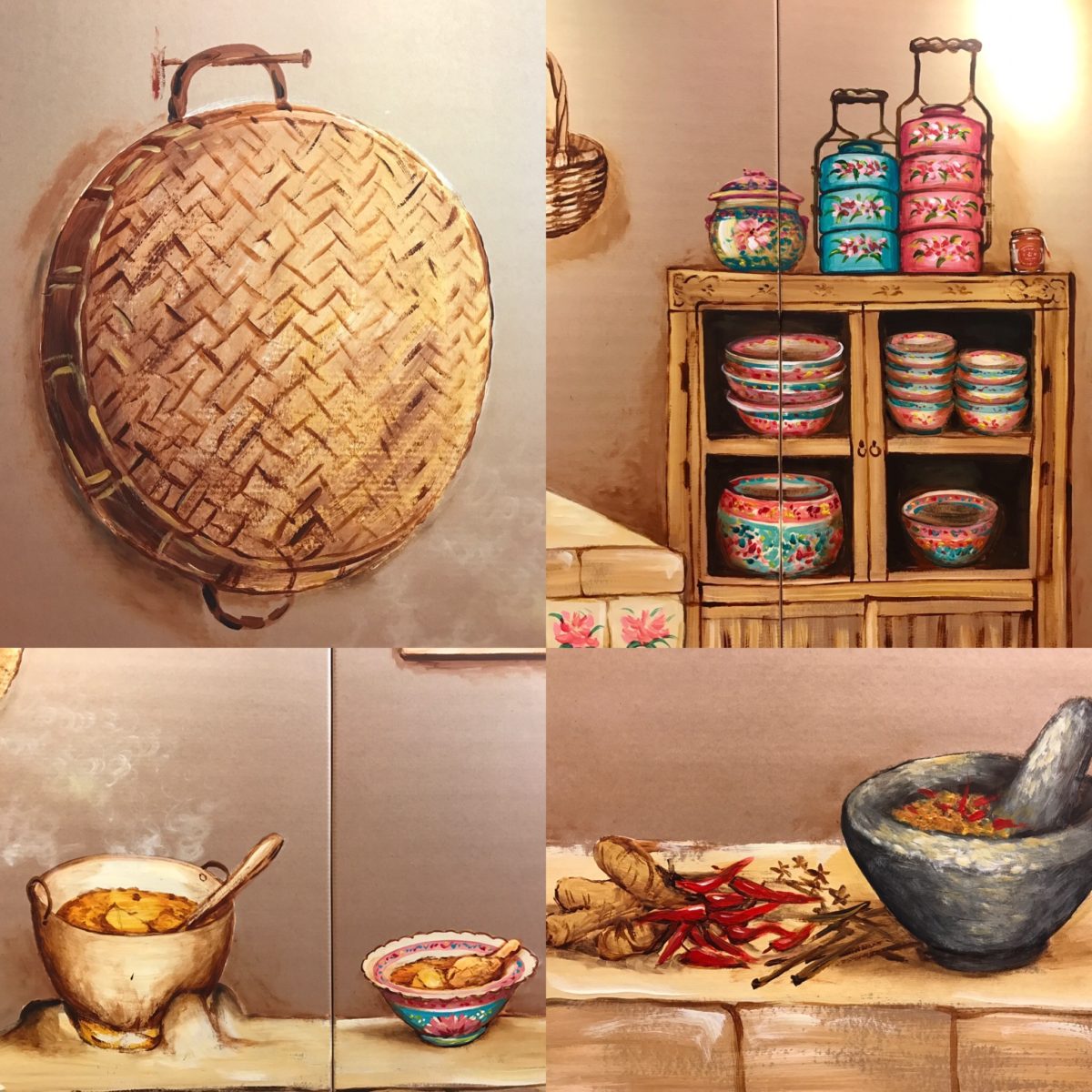
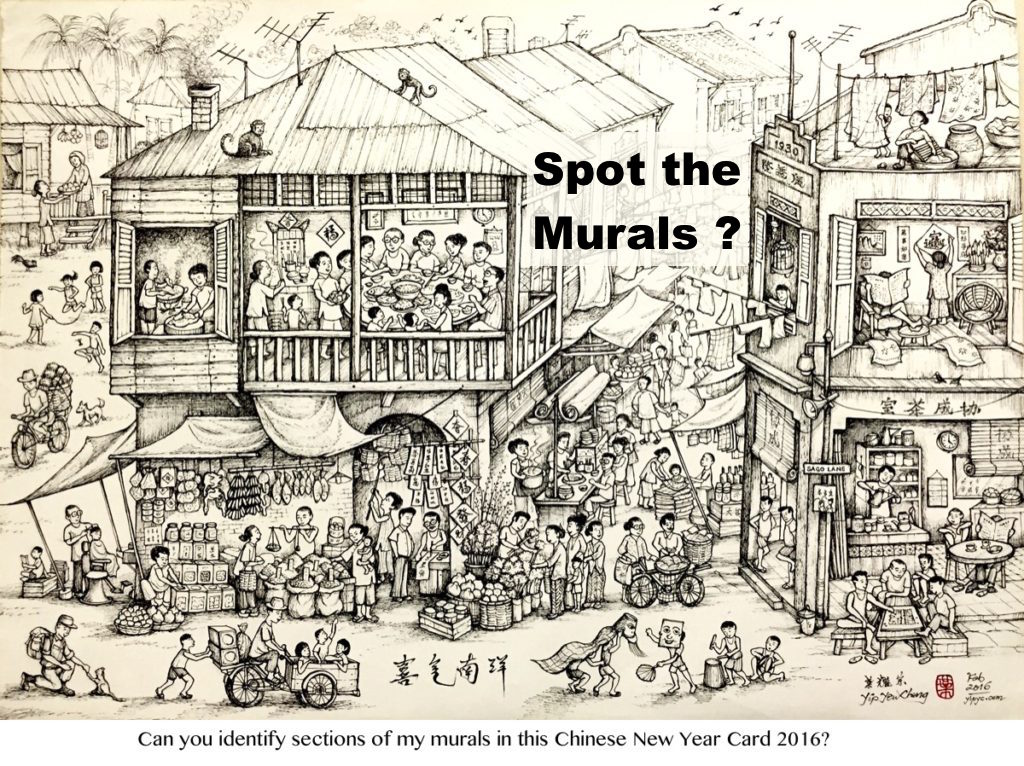
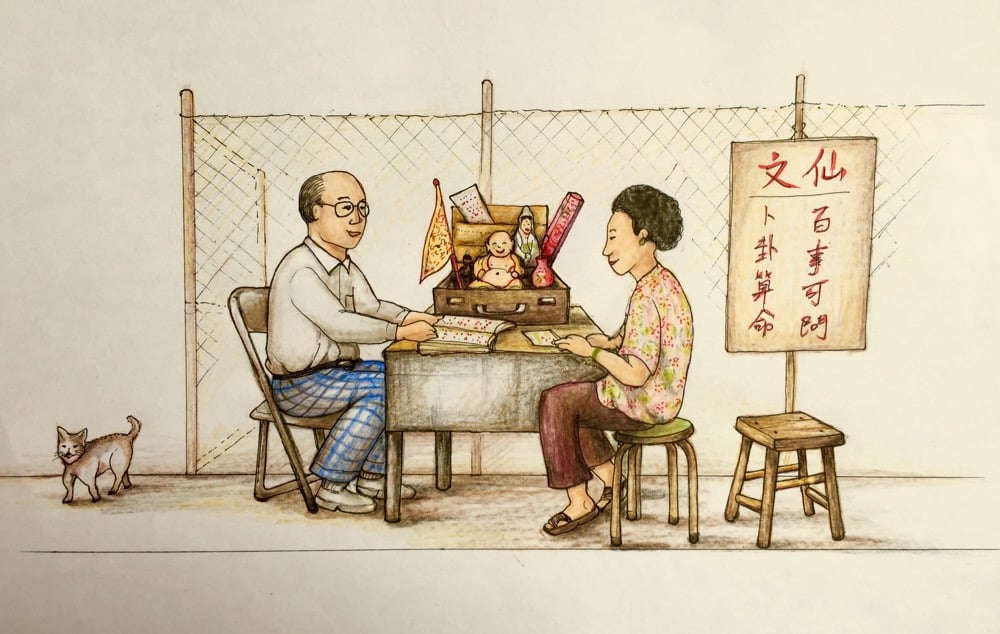
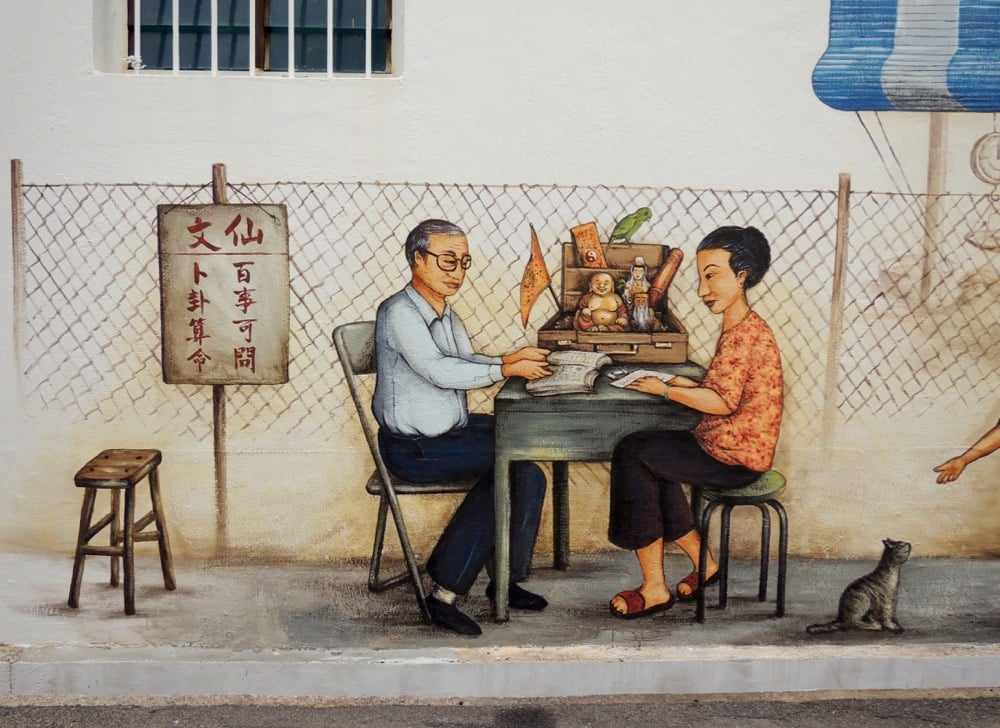
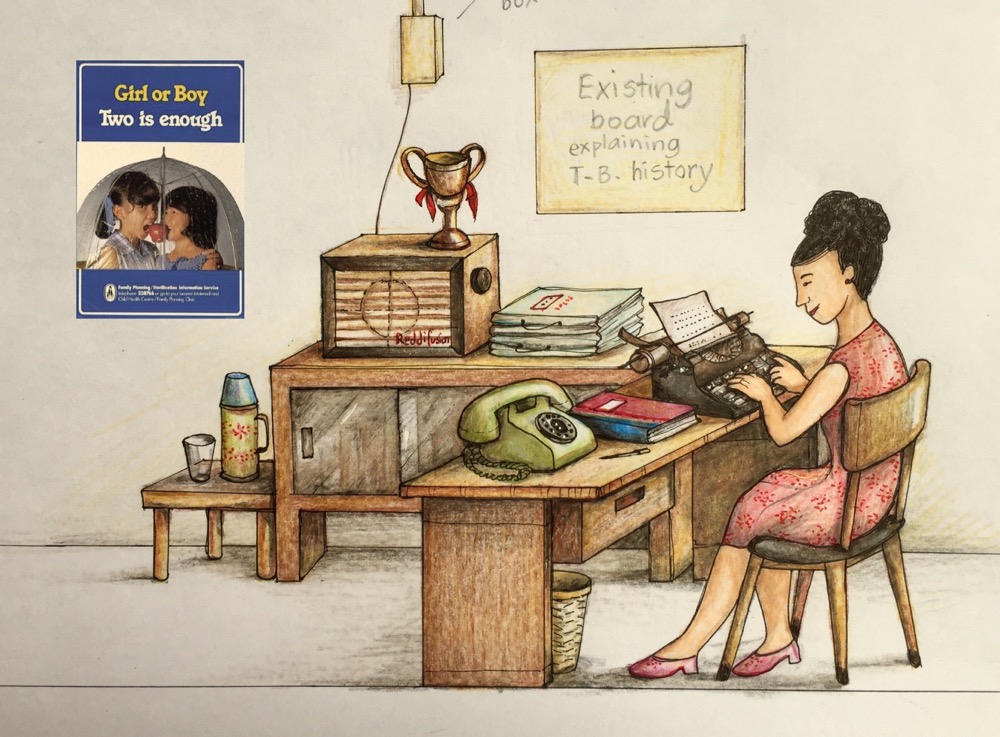
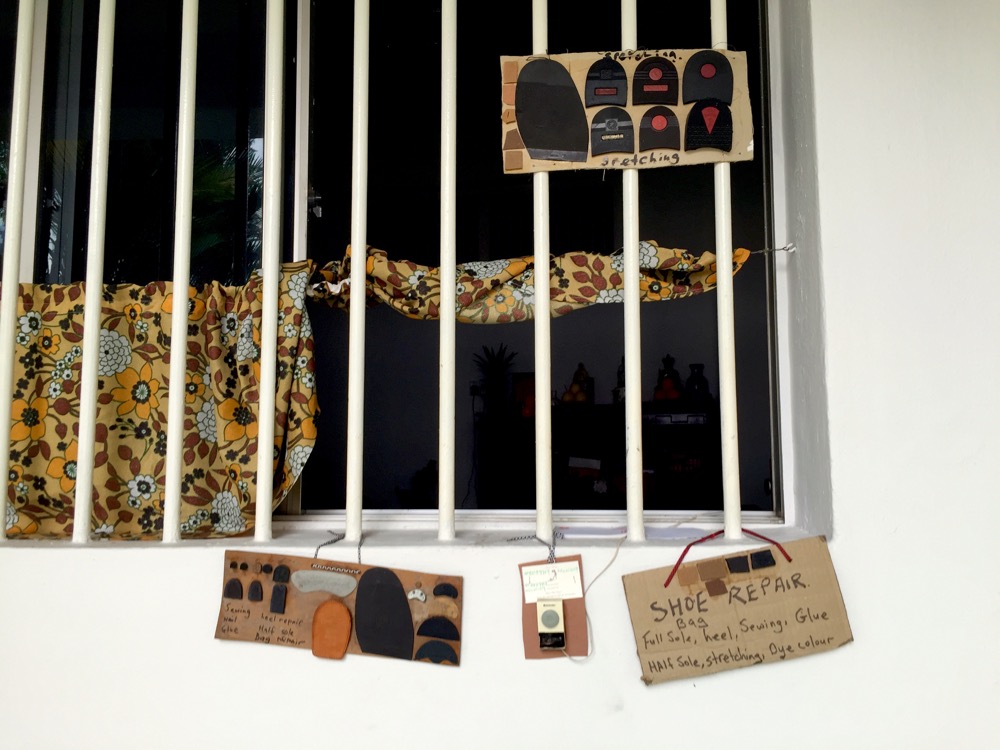
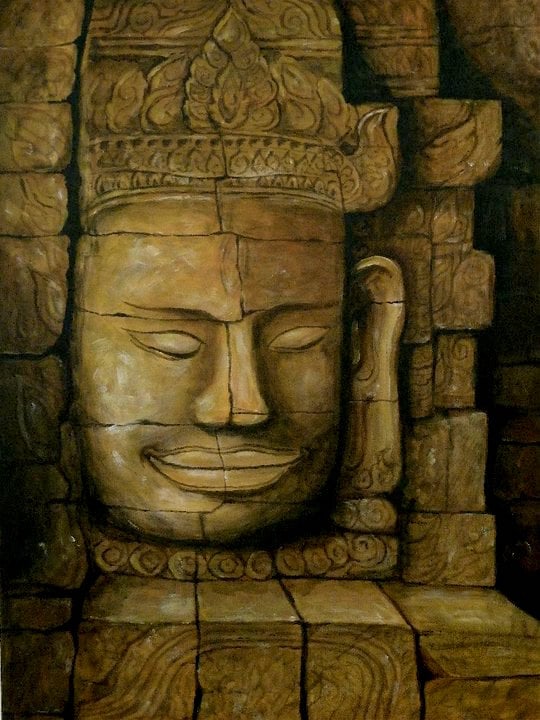
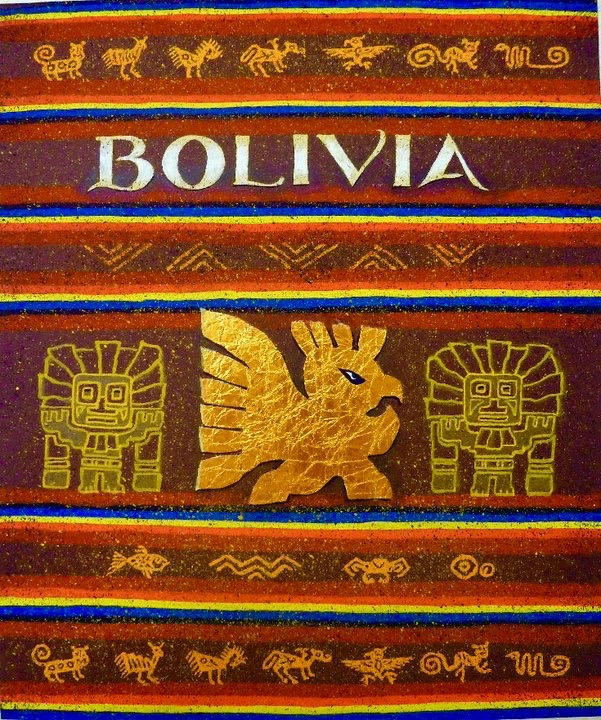
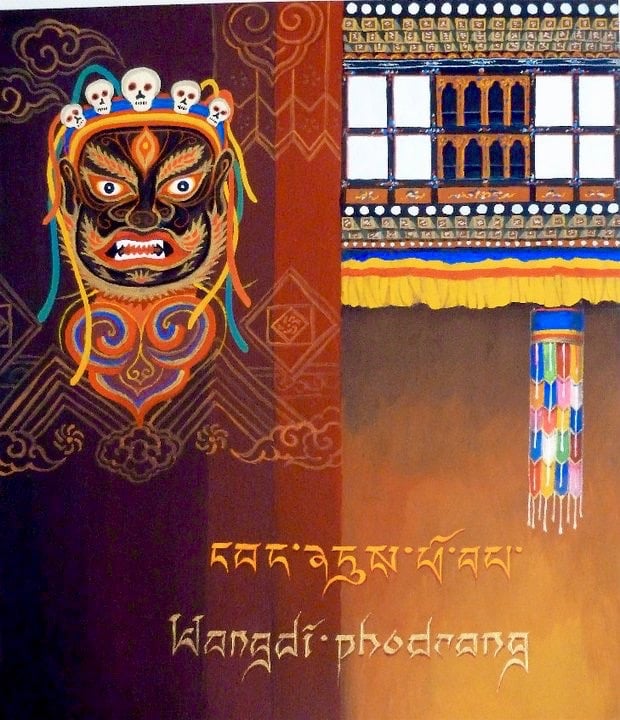
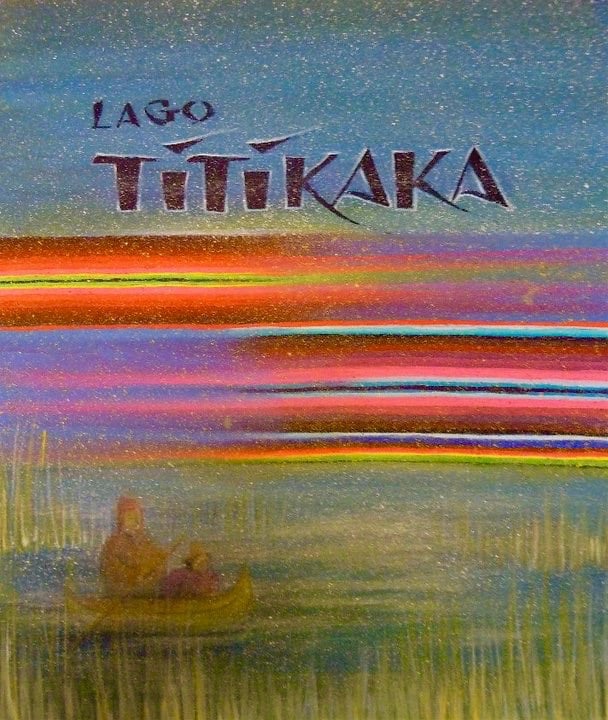
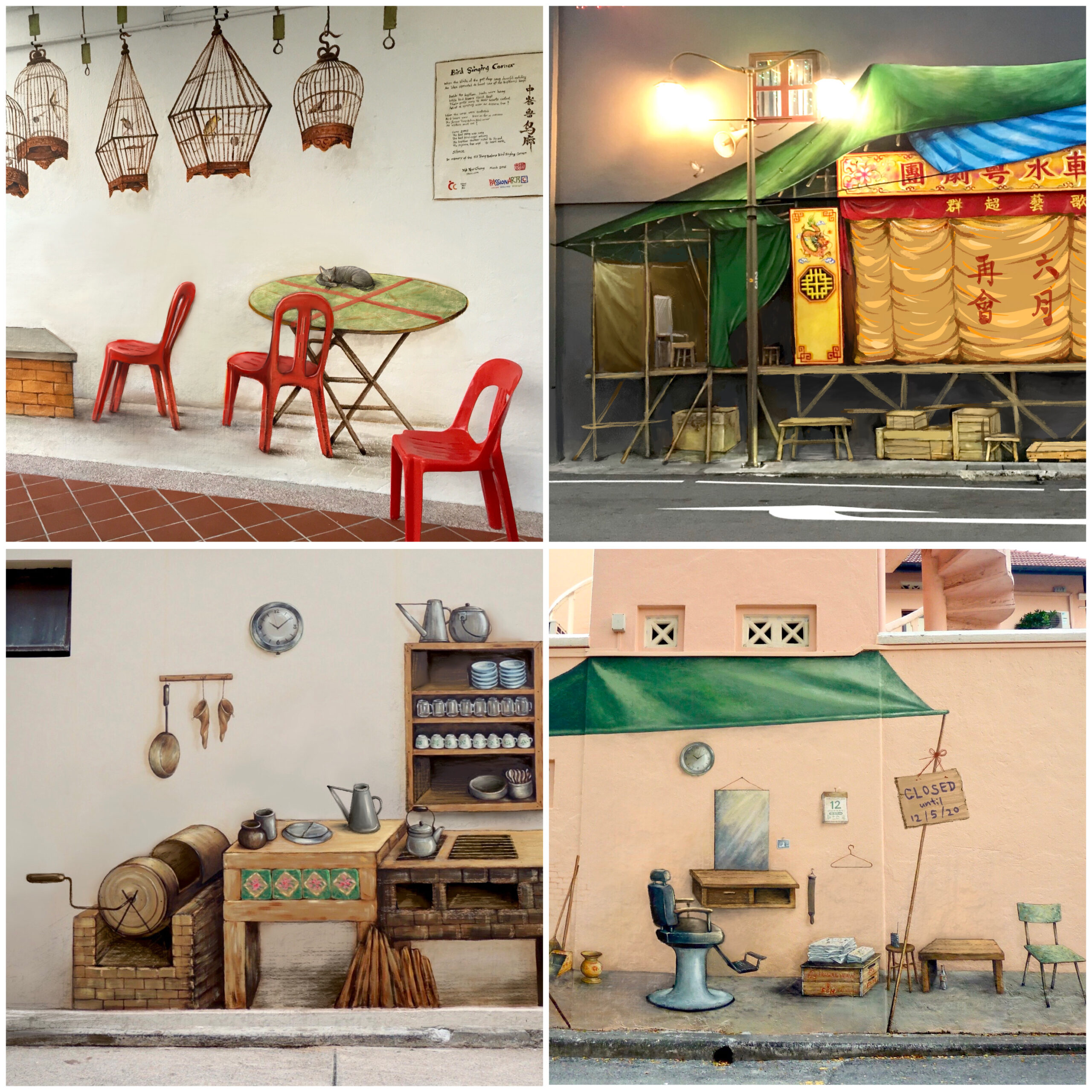
In the old kampong days, villagers used plants for many purposes. They built their house roofs using dried attap leaves, weaved baskets and floor matts, wrap food and even play games using a variety of palm, bamboo and pandanus plants.
This is one of 4 rock murals in the Ethnobotany Garden, within the grounds of the Singapore Botanic Gardens, a UNESCO World Heritage Site. The Garden showcases how people and cultures integrate plants in their daily lives. Try spotting the popular “Tarik Upih Pinang” game on the mural. Don’t miss the lazy cat too! The Ethnobotany Garden is a walking distance from Singapore Botanic Gardens MRT Station, near the Eco Lake.
Flowers and fruits are prominent and symbolic in many Indian festivals, celebrations and rituals. The fragrance of Jasmine, the glow of Marigold, the sweetness of bananas and the freshness of coconut, all add to a rich potpourri of festive sights and smells.
This is one of four rock murals in the Ethnobotany Garden, within the grounds of the Singapore Botanic Gardens, a UNESCO World Heritage Site. The Garden showcases how people and cultures integrate plants in their daily lives. The Ethnobotany Garden is a walking distance from Singapore Botanic Gardens MRT Station, near the Eco Lake.
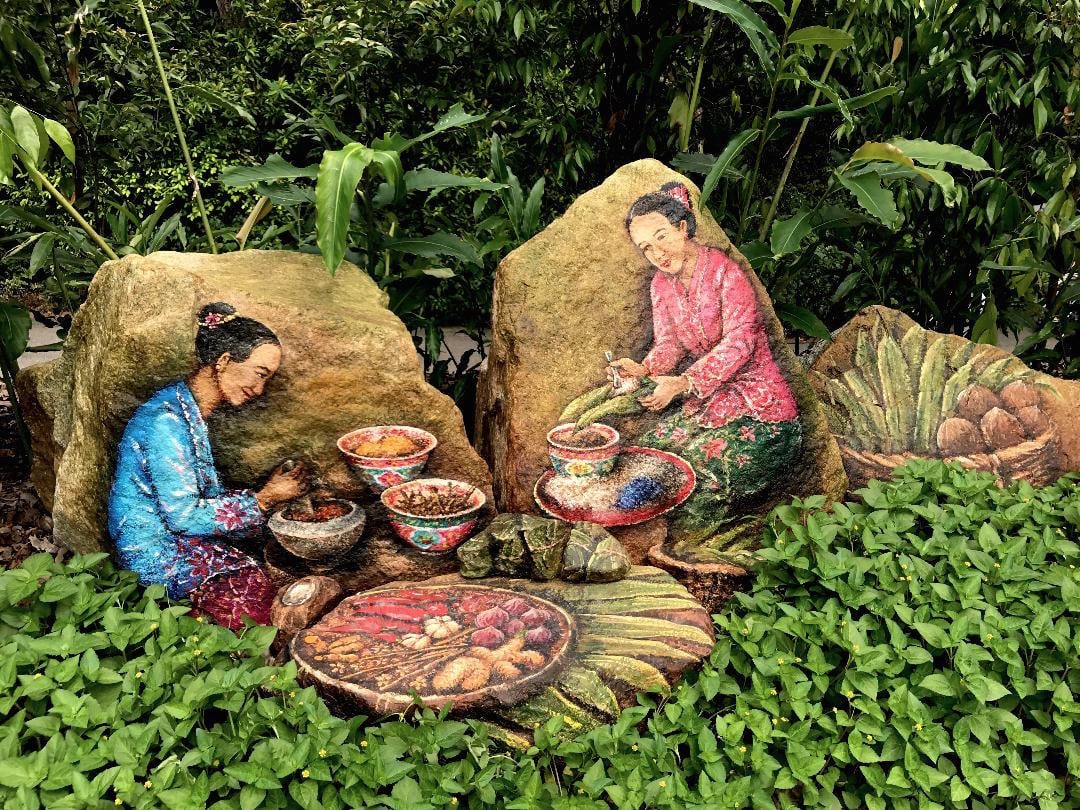
The colourful Peranakan people use colourful spices such as tumeric, blue pea vine, cinnamon and chili as ingredients in their food. This is one of four rock murals in the Ethnobotany Garden, within the grounds of the Singapore Botanic Gardens, an honoured UNESCO World Heritage Site. The Garden showcases how people and cultures integrate plants in their daily lives. The Ethnobotany Garden is a walking distance from Singapore Botanic Gardens MRT Station, near the Eco Lake.
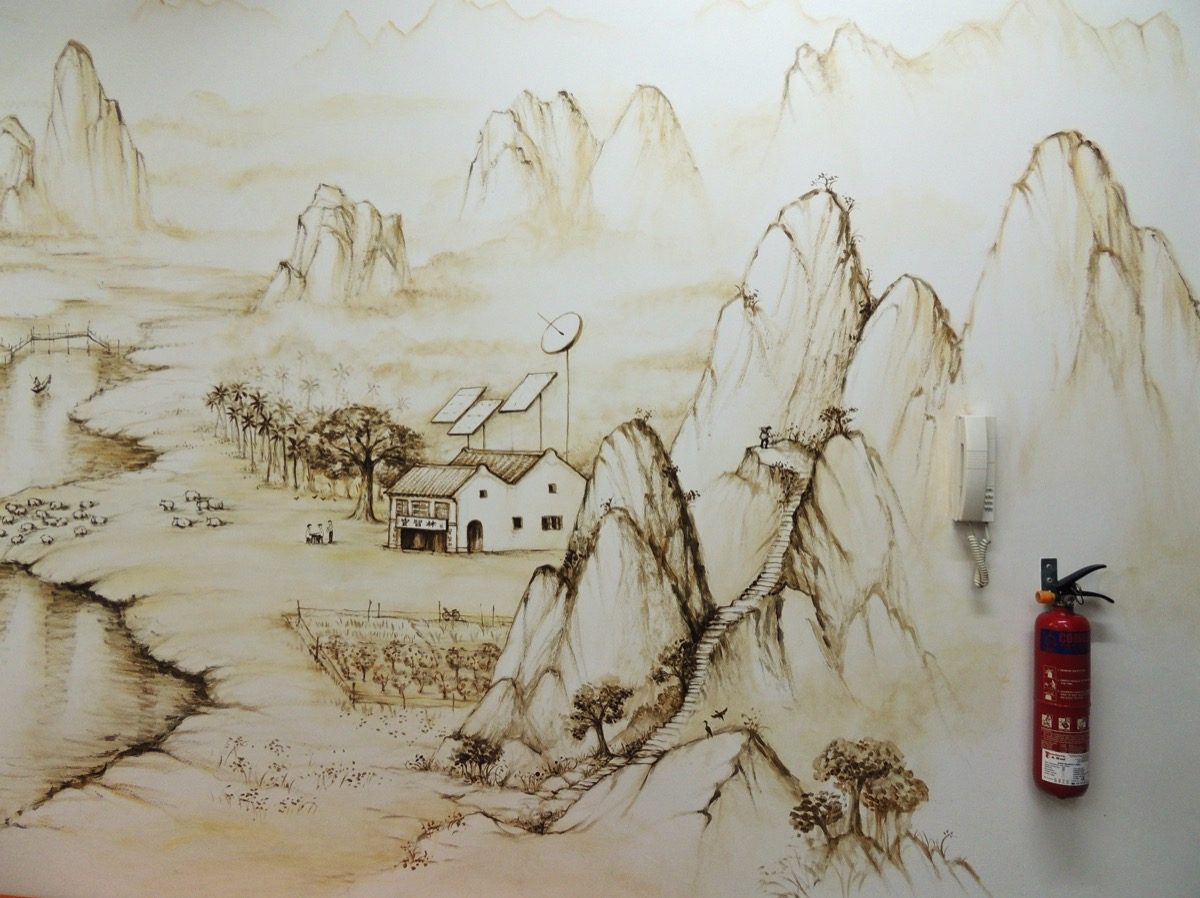
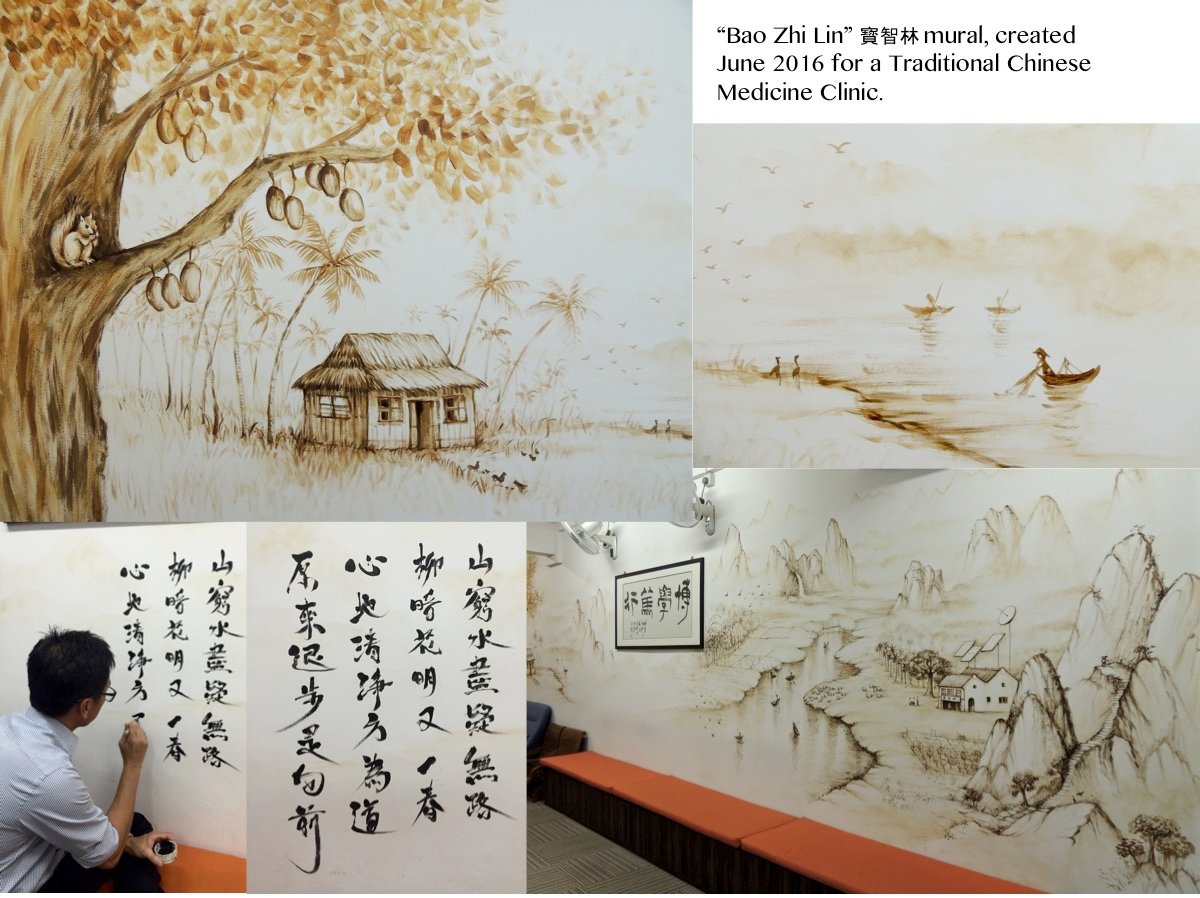
Plants are widely used as medicine in many cultures around the world. In Singapore, the Chinese continue to practise TCM (Traditional Chinese Medicine) which was passed down from generations. An interesting practice is the Moxibustion, a form of heat therapy in which dried plant materials called “moxa” are burned on or very near the surface of the skin. The heat warms and invigorates the flow of Qi in the body.
These three rock paintings depict the use of plants as medicine. They are one of four sets of rock murals found in the Singapore Ethnobotany Garden, a part of the UNESCO listed Singapore Botanic Gardens. It is a walking distance from Singapore Botanic Gardens MRT Station, near the Eco Lake.
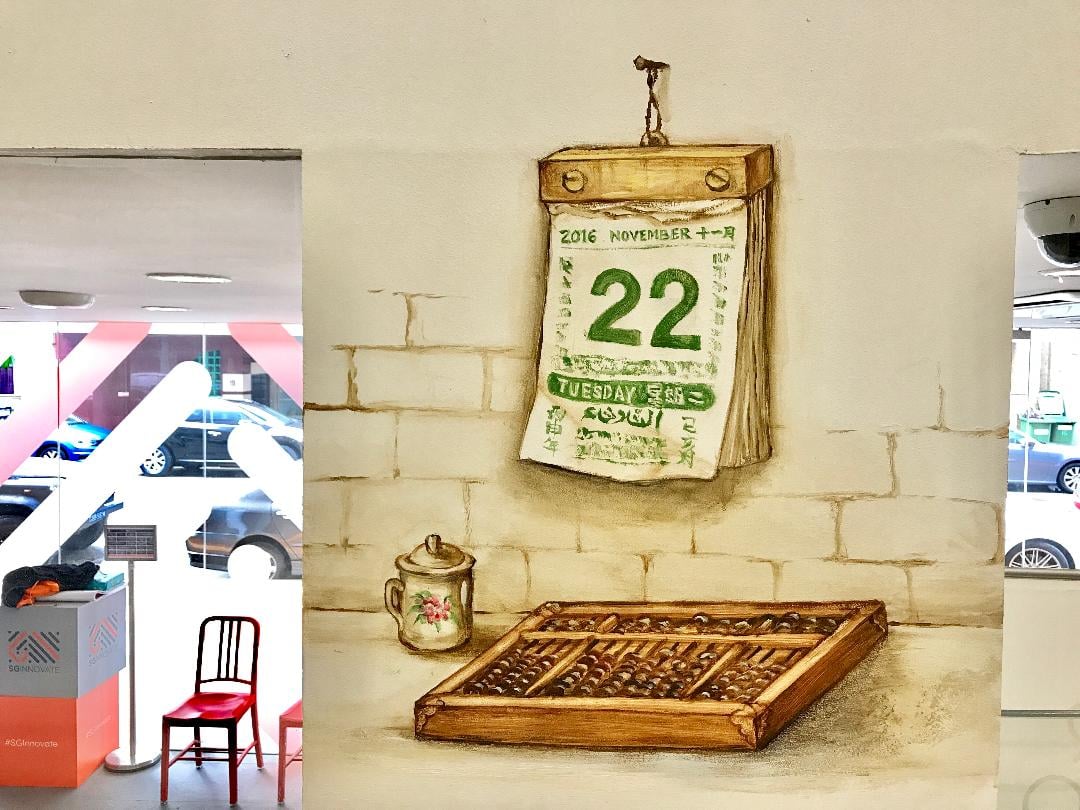
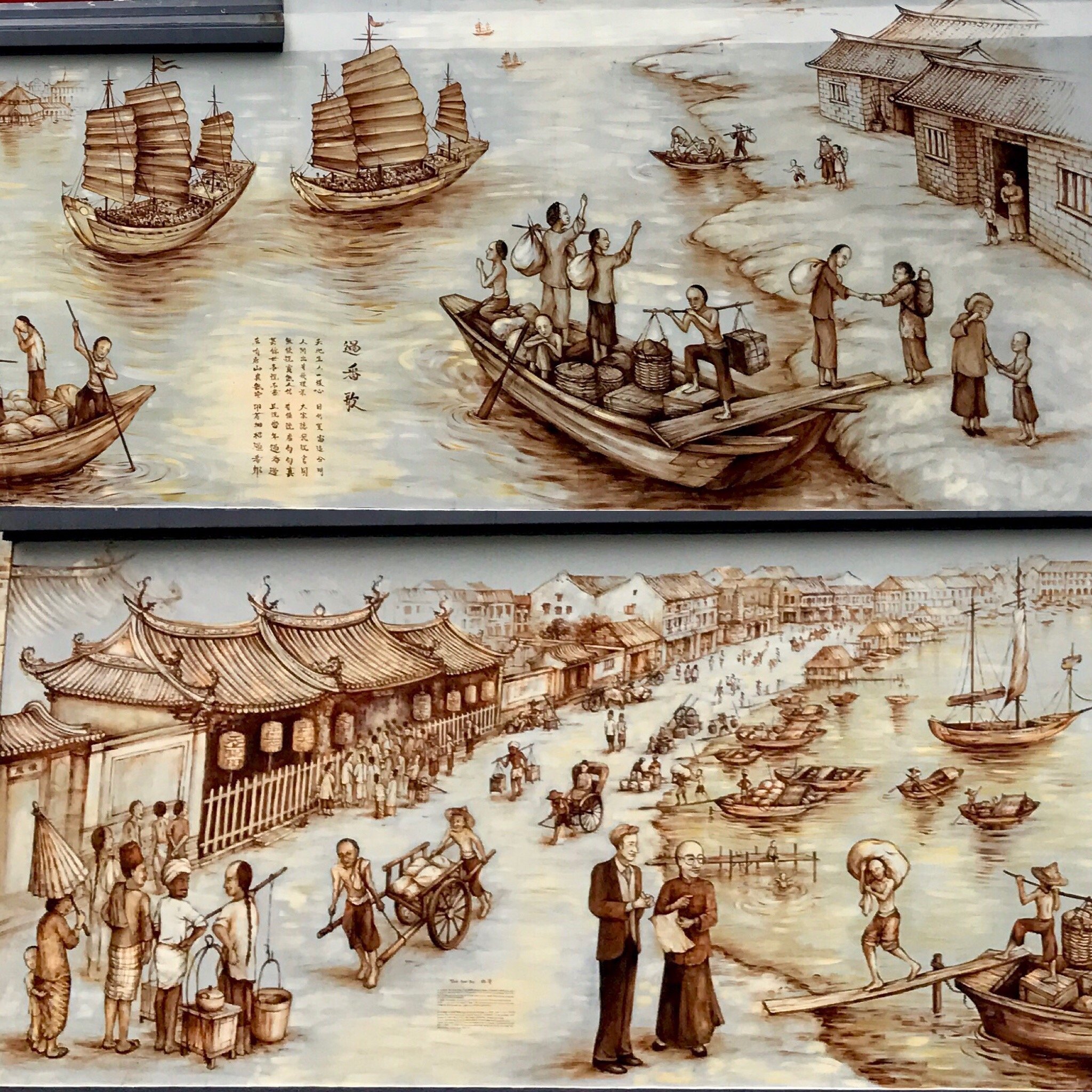
This mural, at the main hall of 32 Carpenter Street (SGInnovate), depicts the old Singapore River when it was the main artery for transporting goods to and from the ships anchored offshore and the hinterland of Singapore. Carpenter Street, being on the south bank of the River, became a thriving area for trading and warehousing the goods. The building at no.32 used to be a rice trader.
The mural carries details of the olden day commercial buzz around the river, including how the labourers carried heavy gunny sacks from the bumboats, to how an inside of the Rice Trader looked like. This scene went on for about 150 years until 1983 when the then filthy Singapore River was cleaned up. All the bumboats, traders and warehouses were relocated.
SGInnovate is a venture catalyst company aimed to help scientific entrepreneurs build and scale their businesses, building on the legacy of our forefathers. The hall is opened to the public for public events/talks. Register at SGInnovate’s website for its many free events/talks.
This hand-painted mural captures my memories of how Singapore used to celebrate National Day in her early years of independence.
I remember Singaporeans from all walks of life gathering to celebrate the big day at the old Queen Elizabeth Walk, which was then a seafront. They went there to watch the fireworks light up the sky above the old Merlion Park, and the ‘Sea Dragon’ bumboat-floats parading the mouth of the Singapore River. Many peddlers selling favourite local snacks like ice-cream and satay added to the party mood. Children could be spotted climbing the giant rain trees and playing sparkles. The whole place brimmed with joy, togetherness and pride.
On the column, I painted a scene of the heartland. Families would climb to the higher-floor corridors of their new HDB flats to enjoy a panoramic view of the fireworks. Take a peep into the windows and shops and find familiar scenes of everyday lives in our HDB heartland.
I hope this mural gives a glimpse into an older Singapore celebrating her birthday. Happy 53rd National Day!
Mural is at HarbourFront Centre, Level 2 Northlink to Vivocity.
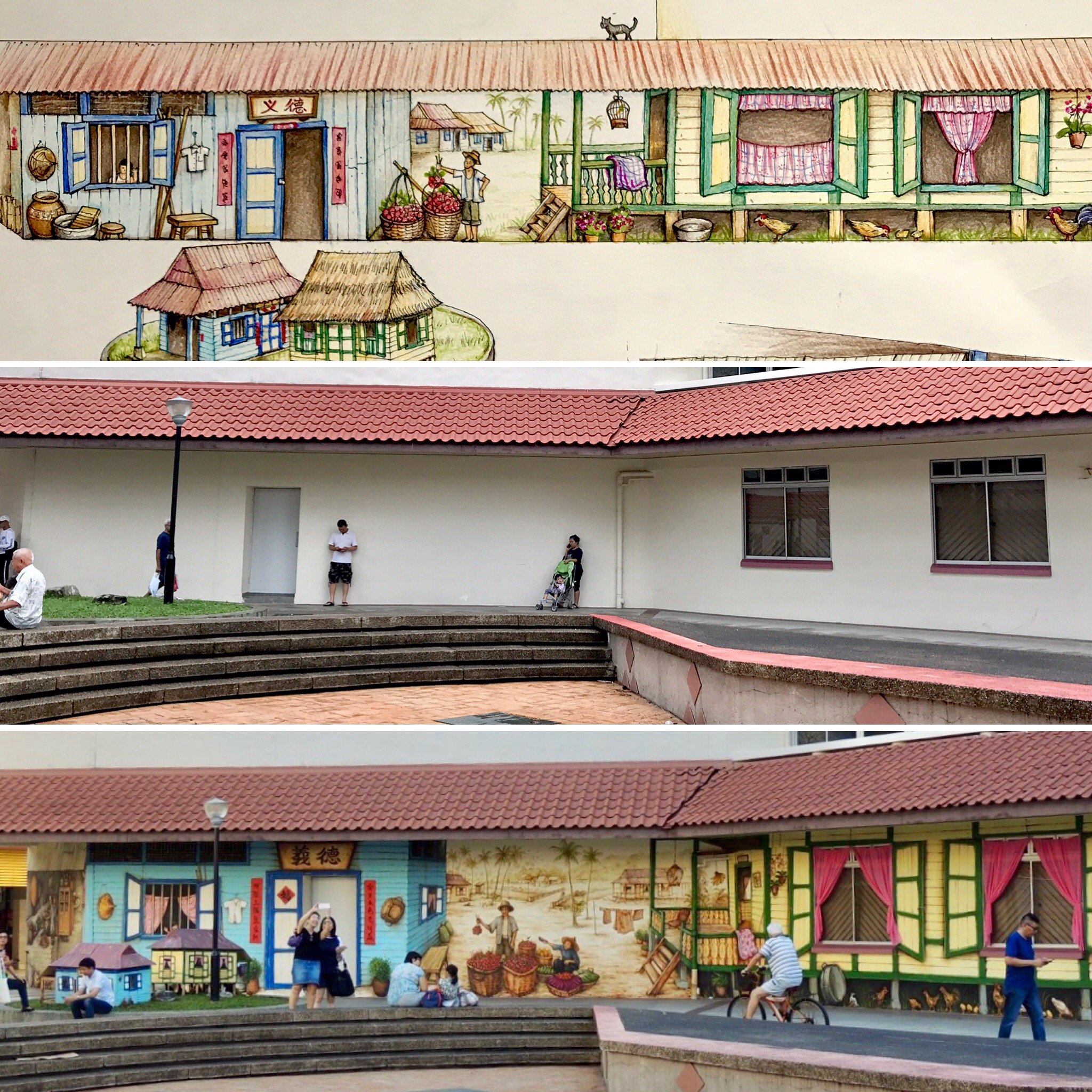
A project by the Public Art Trust (of the National Arts Council) to bring Arts to the heartlands, March 2018. The mural is at block 341 Ang Mo Kio Avenue 1 Teck Ghee Court Market. The Kampong houses have been de-installed.
Ang Mo Kio was once a cluster of rustic kampongs and markets spread across an expanse of rural farmland criss-crossed by streams and joined by bridges (kios) built by the colonial government (ang mo). Rambutan (ang mo dan) trees were also abundant in the villages. These possibly gave rise to the name “Ang Mo Kio”.
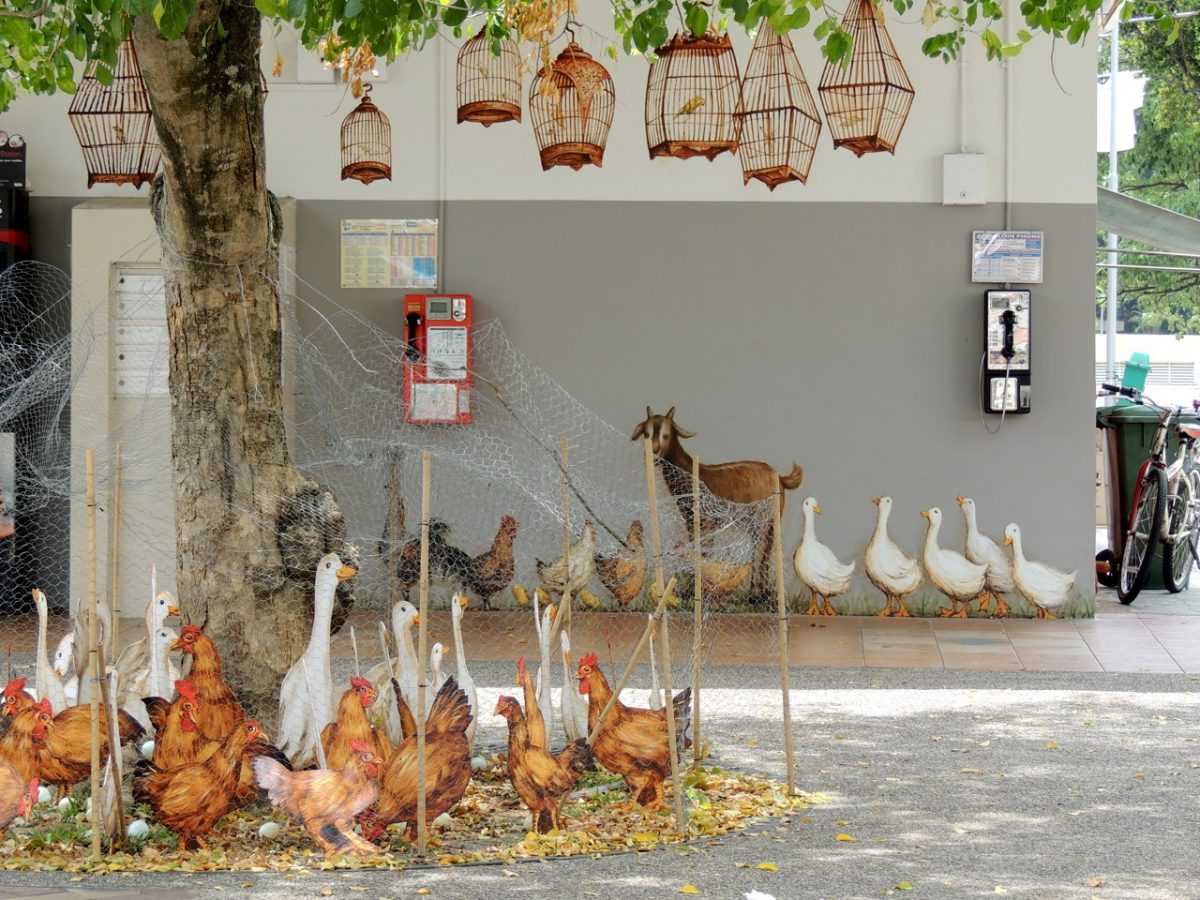
As a boy, I remembered visiting my uncle’s kampong house in Ang Mo Kio. We had to cross many streams and bridges to reach the house. I had fond memories of plucking and eating rambutans from behind the house. In contrast with the towering HDB blocks carpeting present day Ang Mo Kio, it would be hard to imagine its idyllic kampong days. The murals and installations aim to reminisce the Old Ang Mo Kio and intertwine its rustic old world charm with its present day buzz.
A project by the Public Art Trust (of the National Arts Council) top bring Arts to the heartlands, March 2018. The mural is at Block 226 Ang Mo Kio Avenue 1, Kebun Baru Market. The poultry coop installation has been de-installed.
A project by the Public Art Trust (of the National Arts Council) top bring Arts to the heartlands, March 2018. The mural is at Block 226 Ang Mo Kio Avenue 1, Kebun Baru Market.
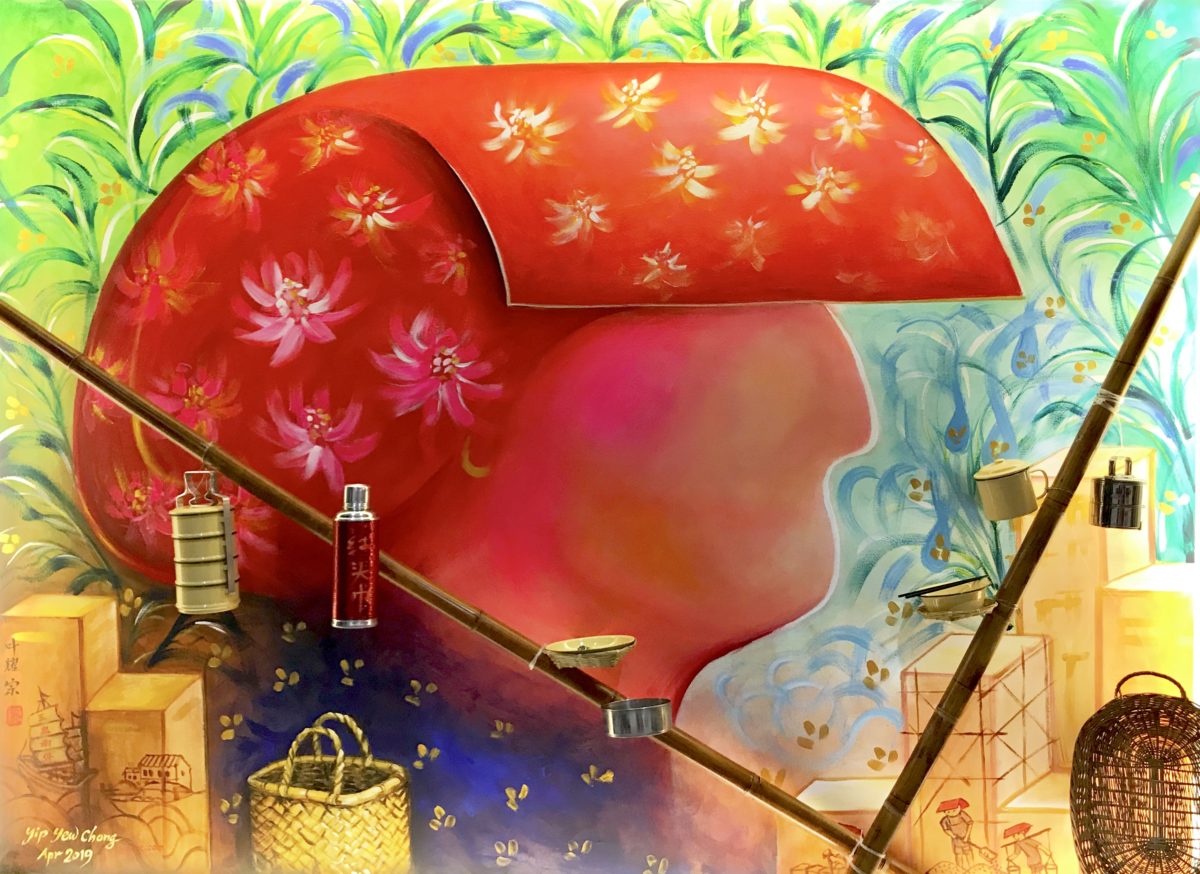
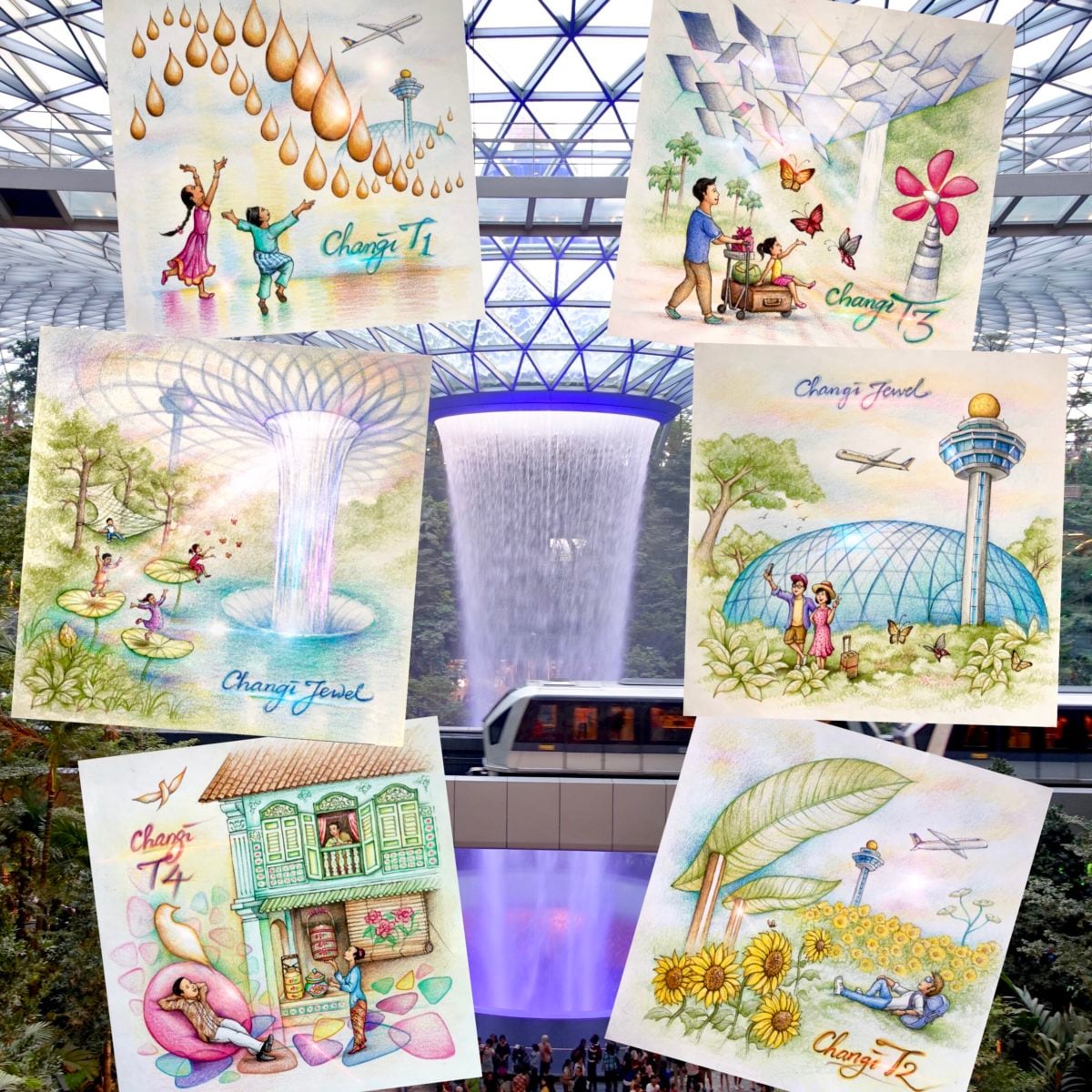
An abstract and colourful interpretation of the hardy Samsui Women, who migrated to Singapore from Southern China in the 1940s and worked mainly in the construction industry to make a living. This delightful installation outside the newly opened Samsui Restaurant at Changi Jewel L3, showcases their simple “lunch box” eating utensils. The Samsui Restaurant is part of the popular Cantonese cuisine group “Soup Restaurant”.
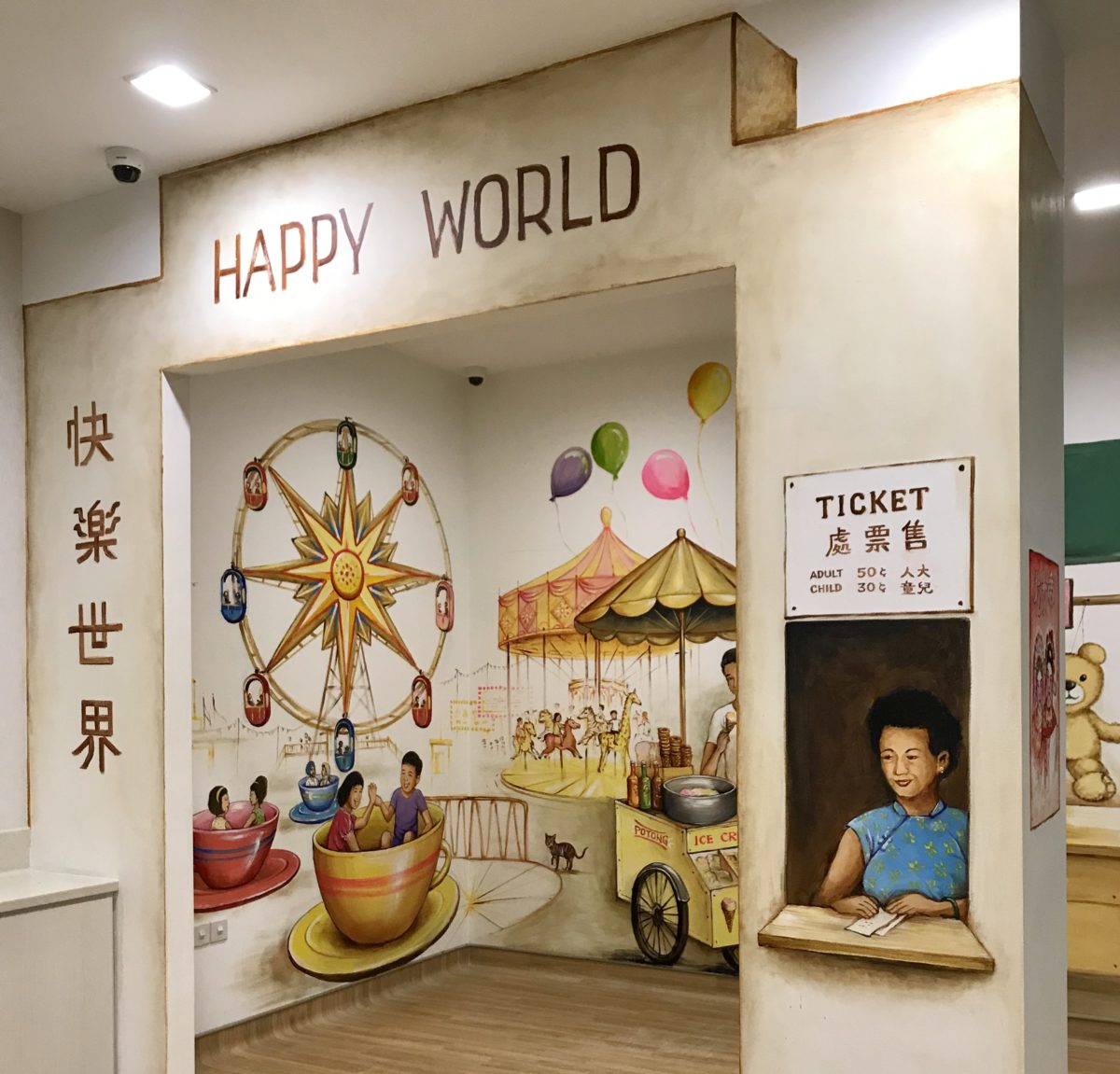
Happy World, located in Geylang Road, was one of Singapore’s most popular amusement parks and entertainment outlets from the 1930s to the 1960s. With the advent of TV and shopping malls in the 1970s, the popularity of amusement parks began to wane. Happy World was demolished in 2004.
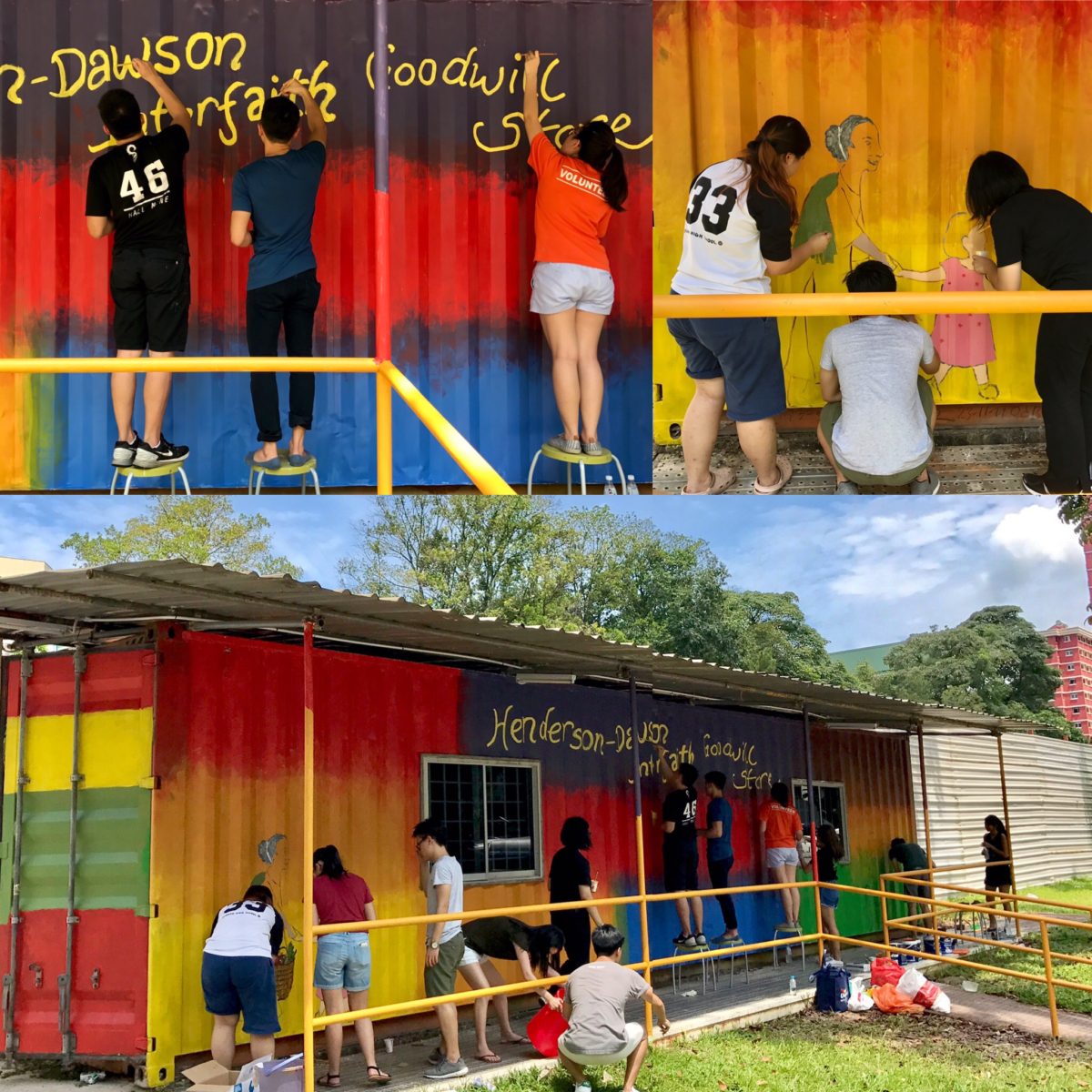
Here I am sitting on the lawn overlooking Bedok Reservoir, enjoying the breeze and watching families having great times of their lives. The slogan on this newly painted mural is the mission and vision of TRANS Family Service Centre (FSC), a non profit secular organization that provides social services to individuals and families, from all walks of life, as they navigate through challenging times. Established in 1979, TRANS FSC now has 5 centres across Singapore that organise outreach activities and provide support and counseling to the communities. This mural was created to commemorate their 40 years of services.
For my labour to create this mural, a group of 12 donors had collectively bid $27,000 during a charity auction as donations to the Assisi Hospice. Founded in 1969, the Assisi Hospice provides palliative care for anyone faced with a life-limiting illness, regardless of age, race, religion or financial status.
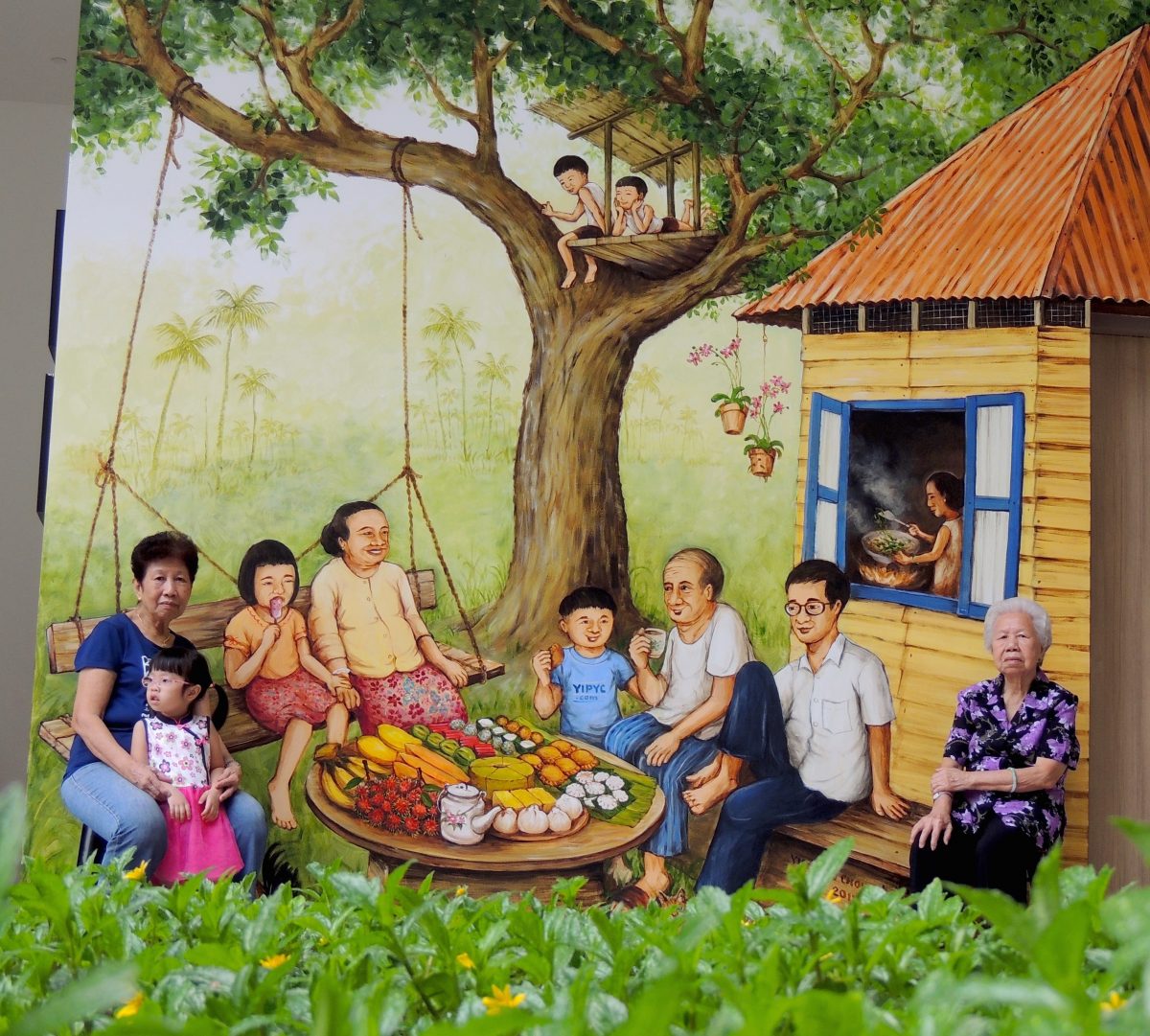
I marathon-painted the mural over a weekend (23 hours) on a large wall at the open courtyard of the newly rebuilt hospice. The mural depicts a family get-together, one of the most cherished and inspirational moments of our lifetimes.
The mural is opened to the public for viewing. It is located just next to the main entrance on the ground floor courtyard. However, visitors must register at the entrance and observe certain rules, including NO photo taking of patients, keeping quiet and avoid visiting in the evening.
I hope this humble mural will create more interest in understanding end-of-life care. I’m very happy I am able to use my art to contribute back to the society which has provided opportunities for my endeavor. Thank you! — at Assisi Hospice.
If we had not demolished the many Victorian and Moorish buildings that once decorated the Collyer Quay waterfront, the Fullerton Square and Raffles Place,
If we had not flattened Mount Wallich, Scotts Hill and reclaimed the Telok Ayer Bay,
If we had not cleared all the boats off Boat Quay.
““***““
The original Lau Pat Sat would be jutting out into the sea.
Singapore would have a square as charming as those found in Europe.
The Tan Kim Seng Fountain would be standing proudly in the centre of Fullerton Square.
We would have a Fort by the sea at the tip of Battery Road, like the Fort in Penang and Galle.
““***““
I thought the current Fullerton Building and the Victoria Concert Hall are grand old dames. When I learnt about their predecessors – the original General Post Office and the Old Town Hall respectively, I thought they were even more beautiful!
““***““
I imagine how the mighty Pinnacles could be integrated smartly into this charming heritage district of Singapore.
I imagine our dear Merlion gracing our historic Merlion Park happily ever before.
I imagine, with a tinge of regret, what an enchanting city centre Singapore once had.
I often dream of myself being in a utopia. One that is harmonious and bustling with activity, which arouses all my six senses.
The look and feel of Singapore, being clean, green, polished and orderly, is ideal for many people. But I prefer her to be a little bit more raw and messy which will accentuate her uniqueness and original flavour.
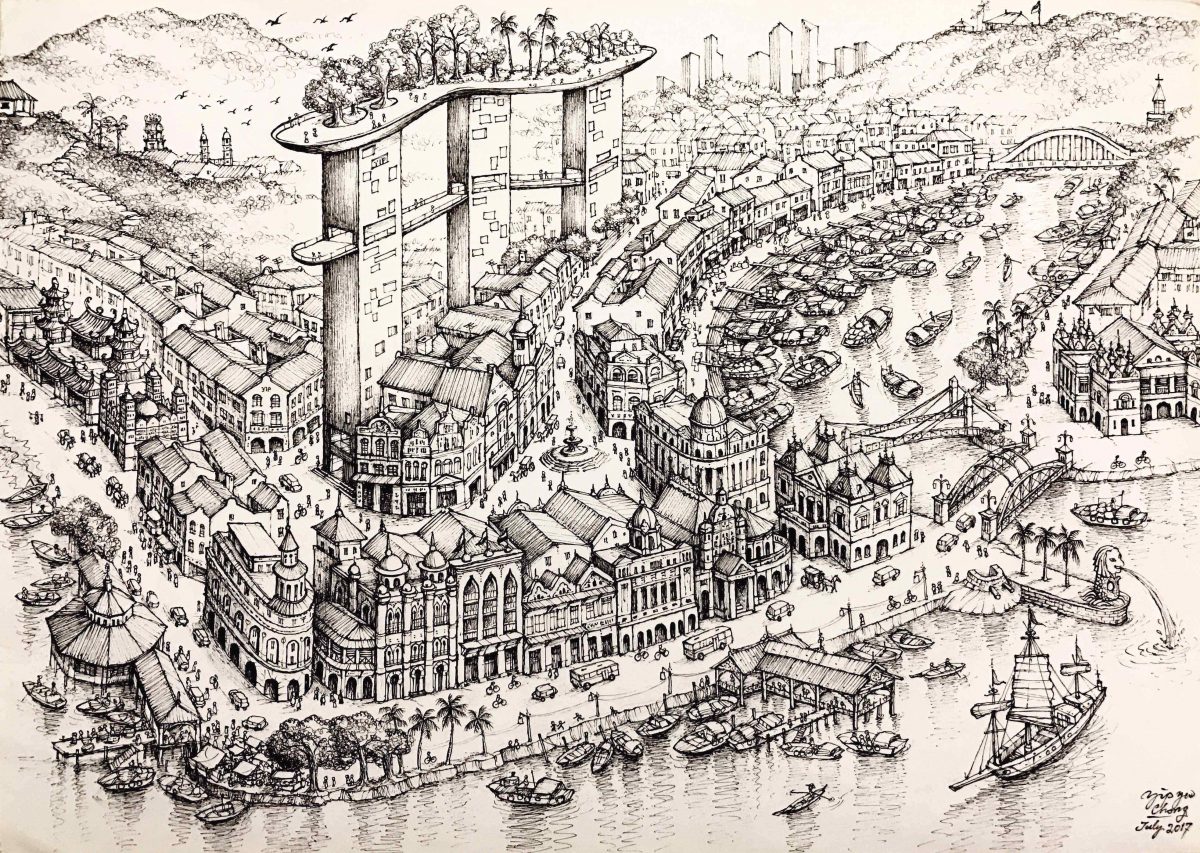
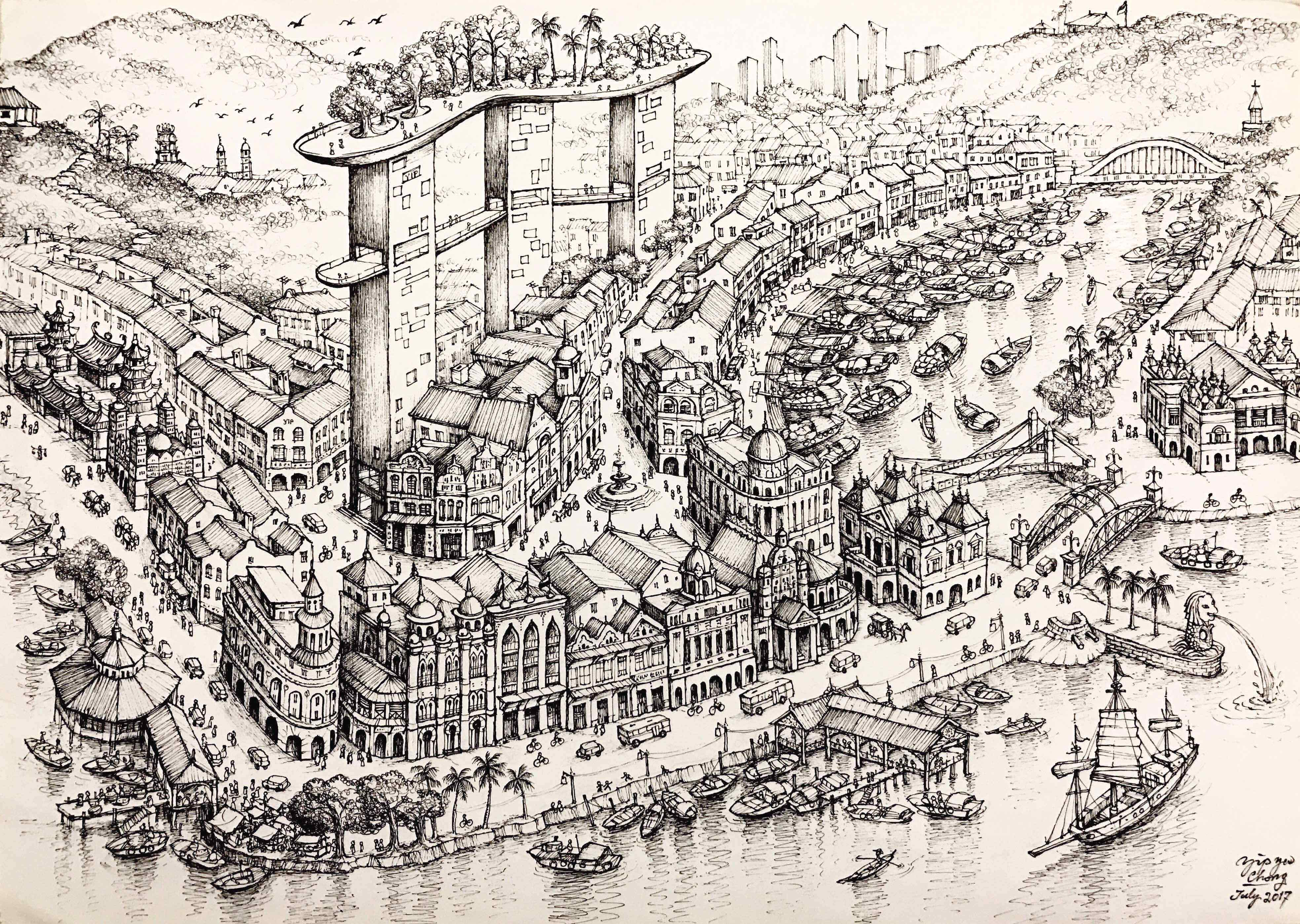
I’ve drawn these 3 scenes of the Singapore River from my imagination. Can you find me and my shops in these scenes? I invite you to jump in and soak up the sights, sounds, smell and tastes of my version of utopian Singapore!
How I wish we could retain all the forests in Singapore and build houses on the trees. I wish that one day, Singapore will have real ‘Super Trees’! versus the man-made ones at Gardens by the Bay.
Singapore heartland pulsating with life. Innovative roof-top hawker centres, playgrounds and gardens, all interconnected by sky bridges, calmed by the soothing flow of the Singapore River running below. That’s me! chillaxing on the tree and strumming “Count on me Singapore”.
Ahh, this is the ultimate Singapore I’ve always dreamt I could go back to…to climb the ladder and chillax on the roof top again!
Since this is my first blog, I’ll start with a walk down memory lane. I’ll describe the place where I lived my first 14 years – Sago Lane (硕莪巷), better known as “street of the dead” (死人街) .
Morbid and taboo to many people, it kindles fond memories for me. It was aptly called “street of the dead” because shops lined both sides of the street sold everything needed to prepare people for death, for people who had just died, and for everything else thereafter. Indeed a ‘one-stop convenient death mart’!
Coffins, Effigies & Funeral Parlour
I was often amused rather than scared of these shops. There was a sick bay for the poor and sick to wait out their final days. Complementing it were shops where coffins were carved, mourning clothes sewed, and paper effigies of servants, mansions, cars, ships and planes crafted. These paper “luxuries”, together with bags of origami “gold and silver ingots” would be delivered to the ‘Hell address’ of the deceased by burning them on the last night of the wake. (This rite is still practised today, and interestingly enough, include paper iPhones and iPads!) Last but not least, the centre-piece shop – the funeral parlour – would organise and conduct all the necessary rites for the wake and funeral to ensure a proper send-off.
The Wake
My family lived just above the paper effigies shop, so we got the “circle seat” view of the rites in action. Almost every night, the vivid sounds of wailing relatives, shuffling of mahjong tiles, chanting of priests and the ringing bells of tourist trishaws would reverberate through the street. You may wonder – how did we manage to study, watch TV and sleep? Firstly, you should know that I passed my PSLE 🙂 and secondly we got so used to it that without the sounds, the whole street would seem ironically ghostly! Towards the funeral, the tempo would build up with more elaborate rites, my favourite being the acrobatic “break the Hell” (破地狱) rite whereby the Taoist priests (南無佬) would circumambulate a fire pit which represented Hell. They would spit into the pit to create fireballs and then jump over them like acrobats.
The Funeral Procession
The noisiest of all the rites had to be the funeral, which was also the climax of the entire process. Most funeral processions had a blaring brass band of drums and trumpets, but the more elaborate ones had deafening gongs and dancing stilt walkers. Finally, long lines of relatives and friends trailed and wailed behind the flowery decorated vehicle which carried the coffin, to give the deceased a rousing send-off.
Corpses
Are you afraid of seeing corpses? I never was, because I passed them by everyday at my door step for 14 years. However, I remembered two incidents which chills me even today. On one occasion, the police came to investigate and opened a nailed coffin. The stench of death filled the whole street for days! On another occasion, when an ambulance from a mortuary had just arrived and its doors flung open, we heard people shouting and throwing stools about. We didn’t know what had actually happened but our neighbours subsequently told us that apparently, the corpse had sat up! bbrrrrr…
Fond Memories
In those days, my family didn’t have a camera. So I researched and refreshed my memories of the details from browsing archival websites and drew the above composite drawing from my imagination. In late 1983, just before the government relocated all the residents and trades to the nearby Chinatown Complex and demolished the shophouses, my dear cousin Sim borrowed a camera and took some photos of the street. By then, most of the residents and trades had already moved out, but at least we managed to capture a few precious images of our old home to preserve our fond memories to this day.
Sago Lane in 1983, a few months before its residents and trades were relocated to the Chinatown Complex a block away. My family lived in the middle house on the second floor with the pole of drying laundry. Today, the site is a carpark next to the Buddha Tooth Relic Temple! In a few years, it will be the entrance/exit to the Maxwell MRT Station.
And finally, a bonus pic of myself (with food in my mouth 🙂 )
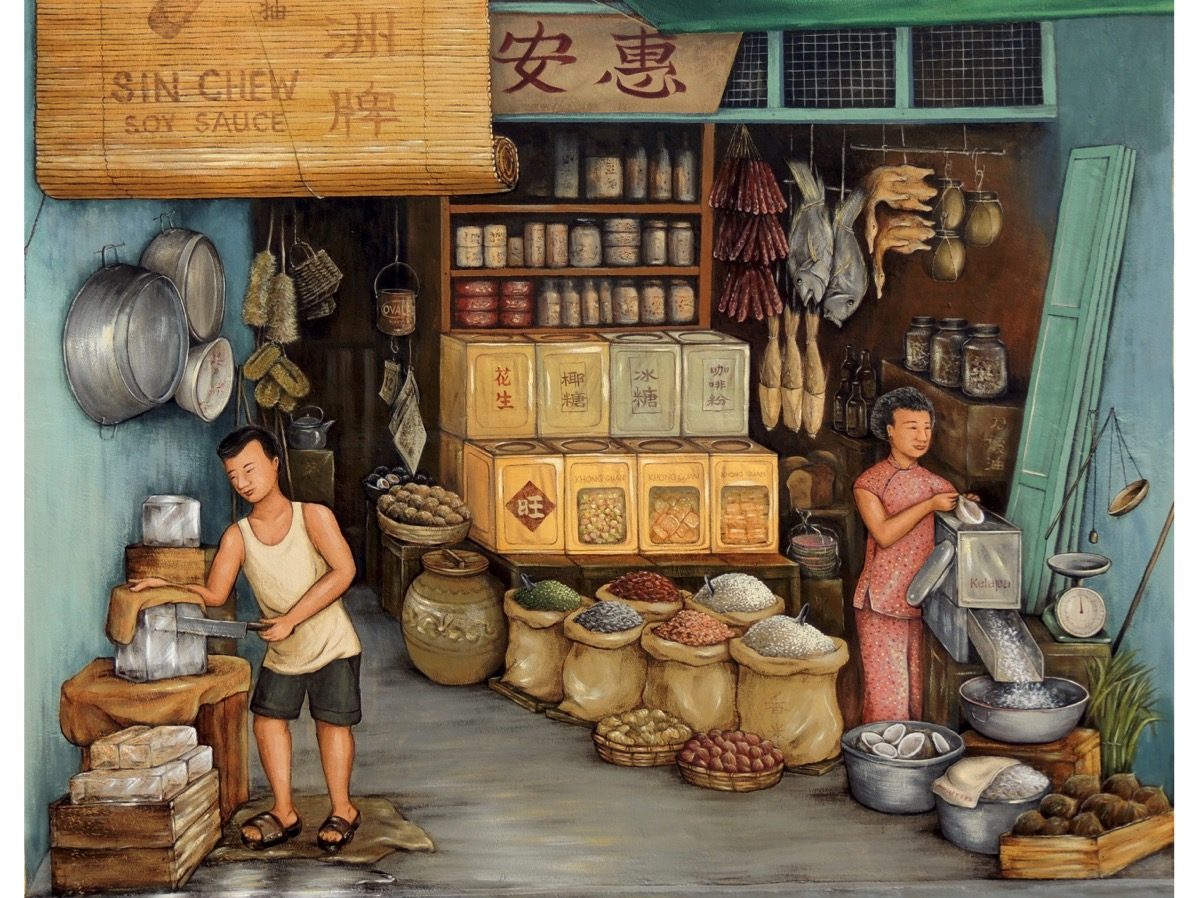
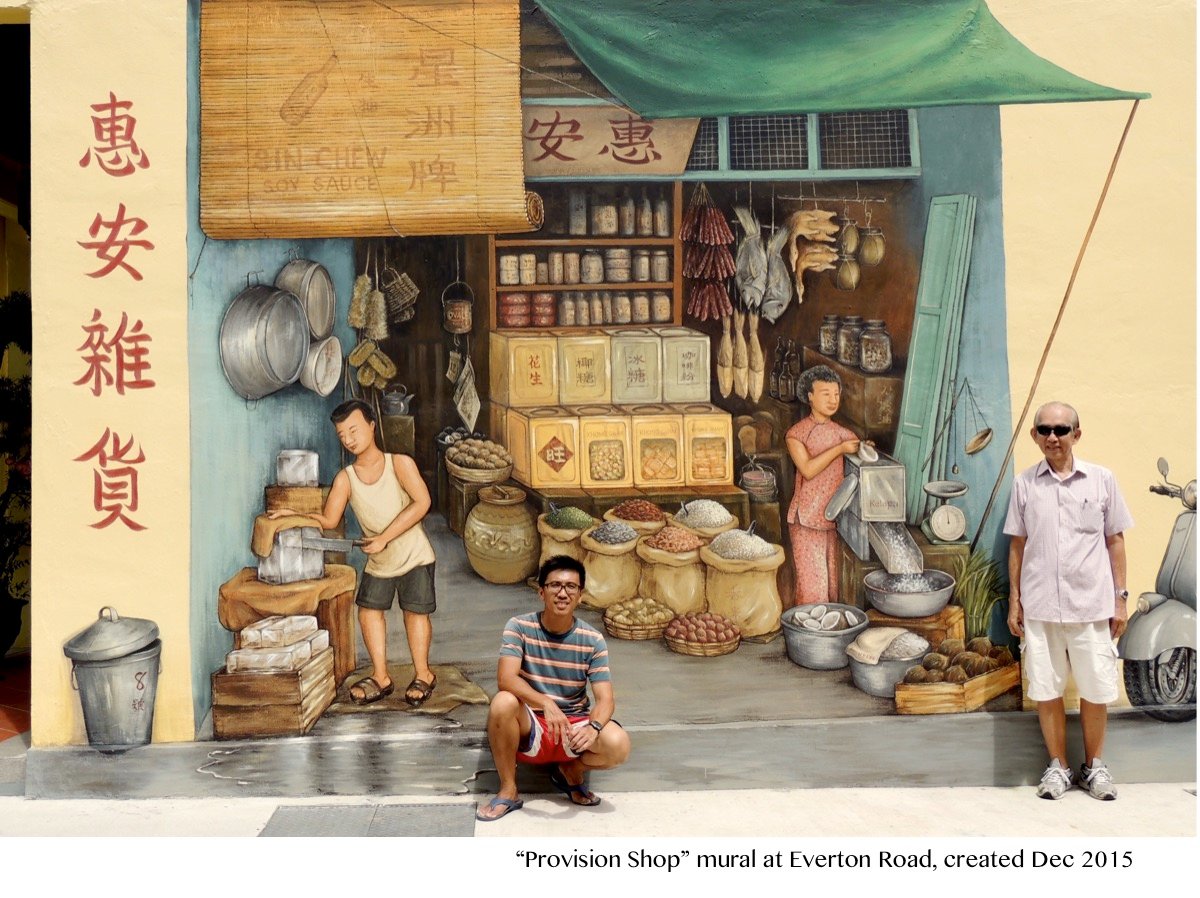
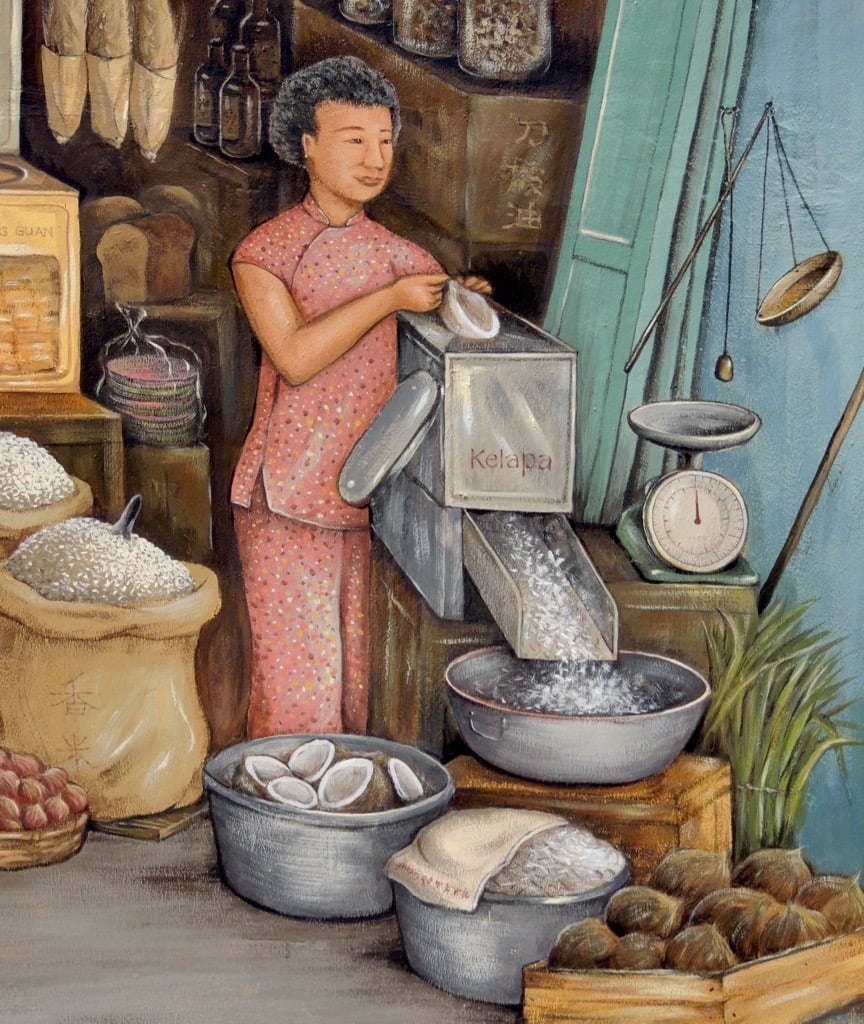
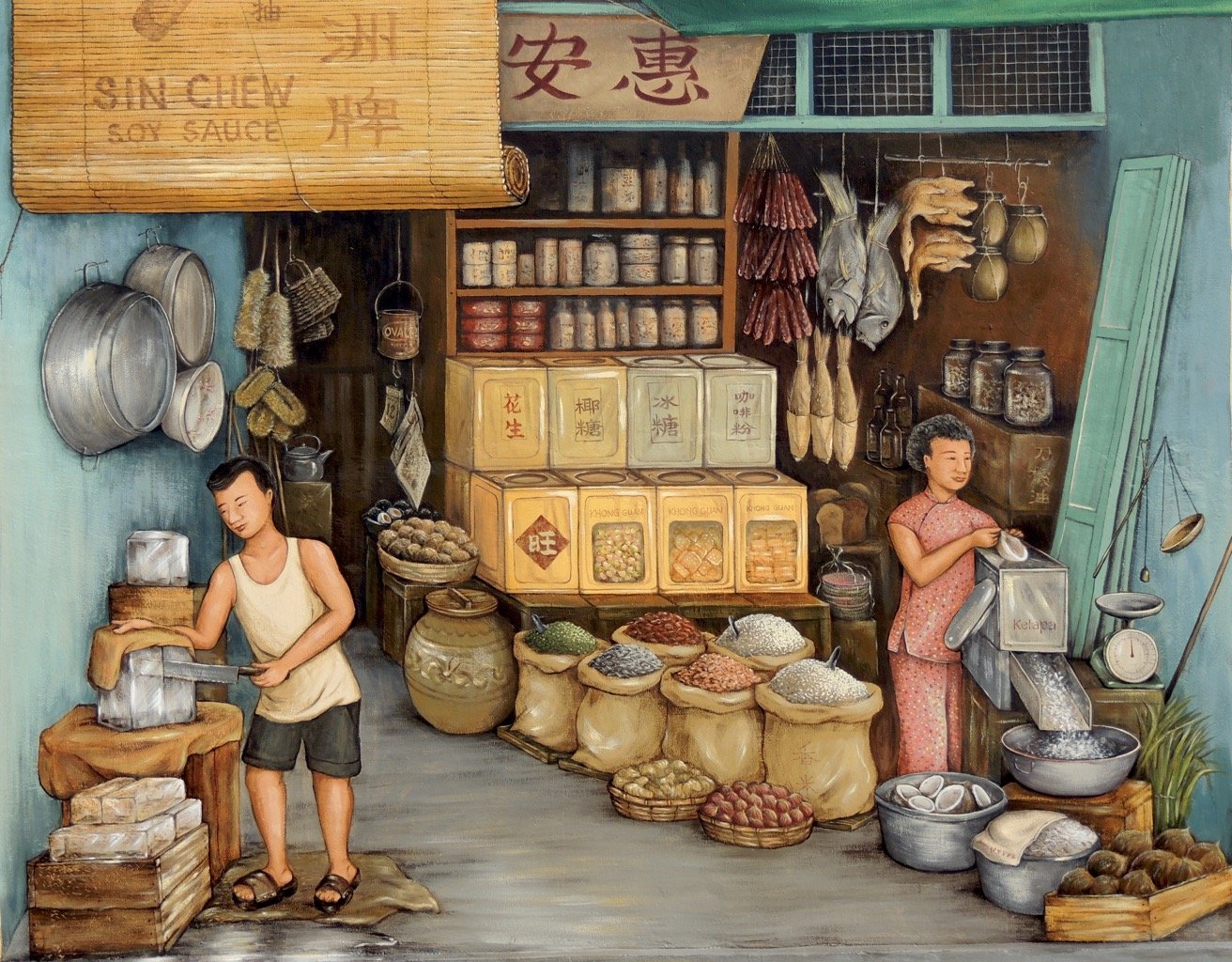
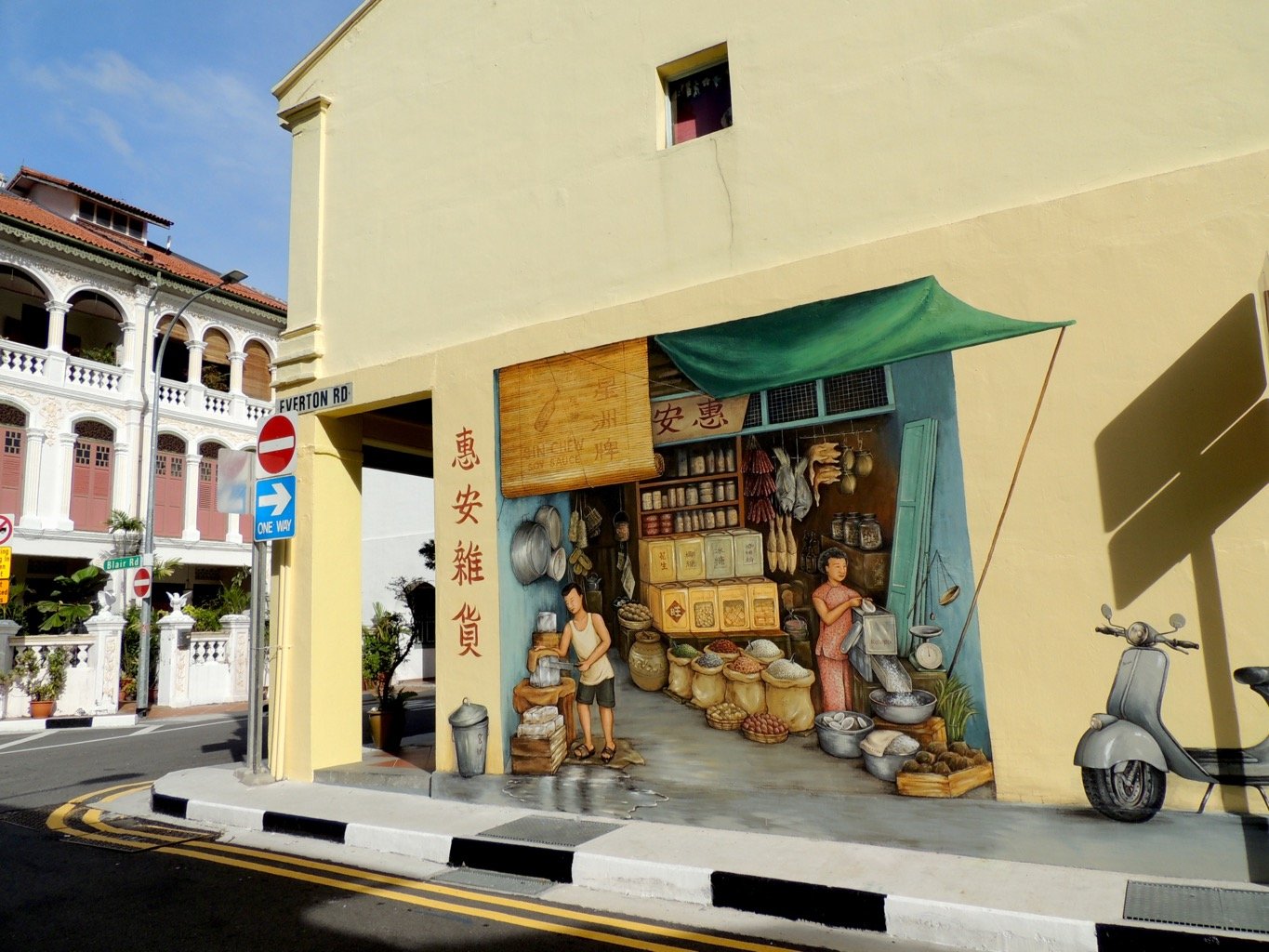
A one-of-its kind provision shop has just opened at Everton Road! Tucked away in a corner shophouse at the fringe of a busy financial district, nonchalant to large supermarkets and convenient stores, its towkay neo and her hardworking team run their little provision shop literally ’round the clock’. Here, you can buy traditional dried food stuffs, sundries, kitchenware and even freshly-sawed ice, all at unbeatable prices too! Can you spot and identify all the goods they sell? Bring your parents and grannies along when visiting the shop and hear their stories and experiences that come with each of the items displayed in the shop. Also, bring your own mug, container or carrier for the shop will only wrap your purchases in newspapers. They don’t have any plastic bags!
Welcome to my latest mural – the Provision Shop.
Inspiration and Meanings
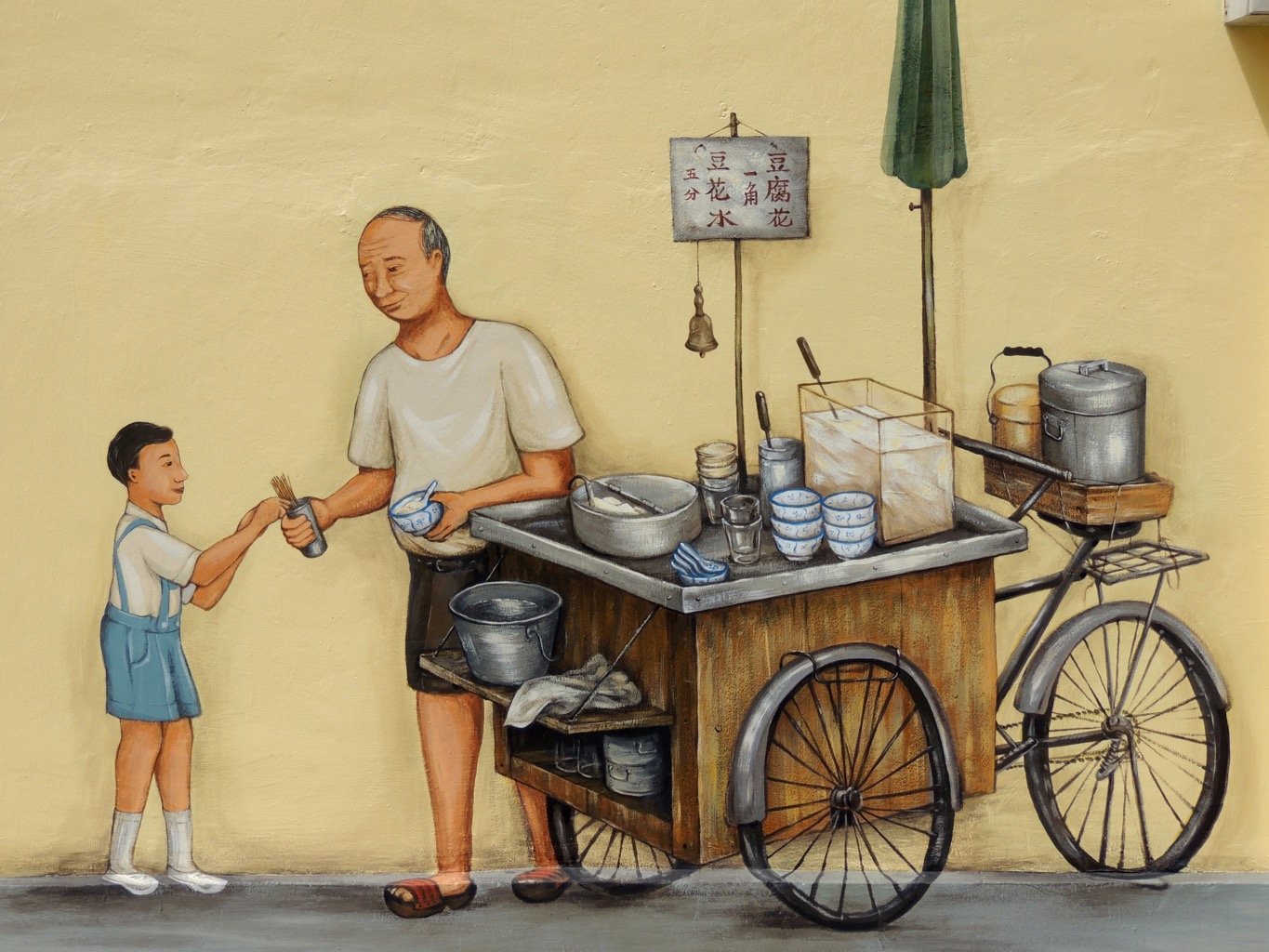
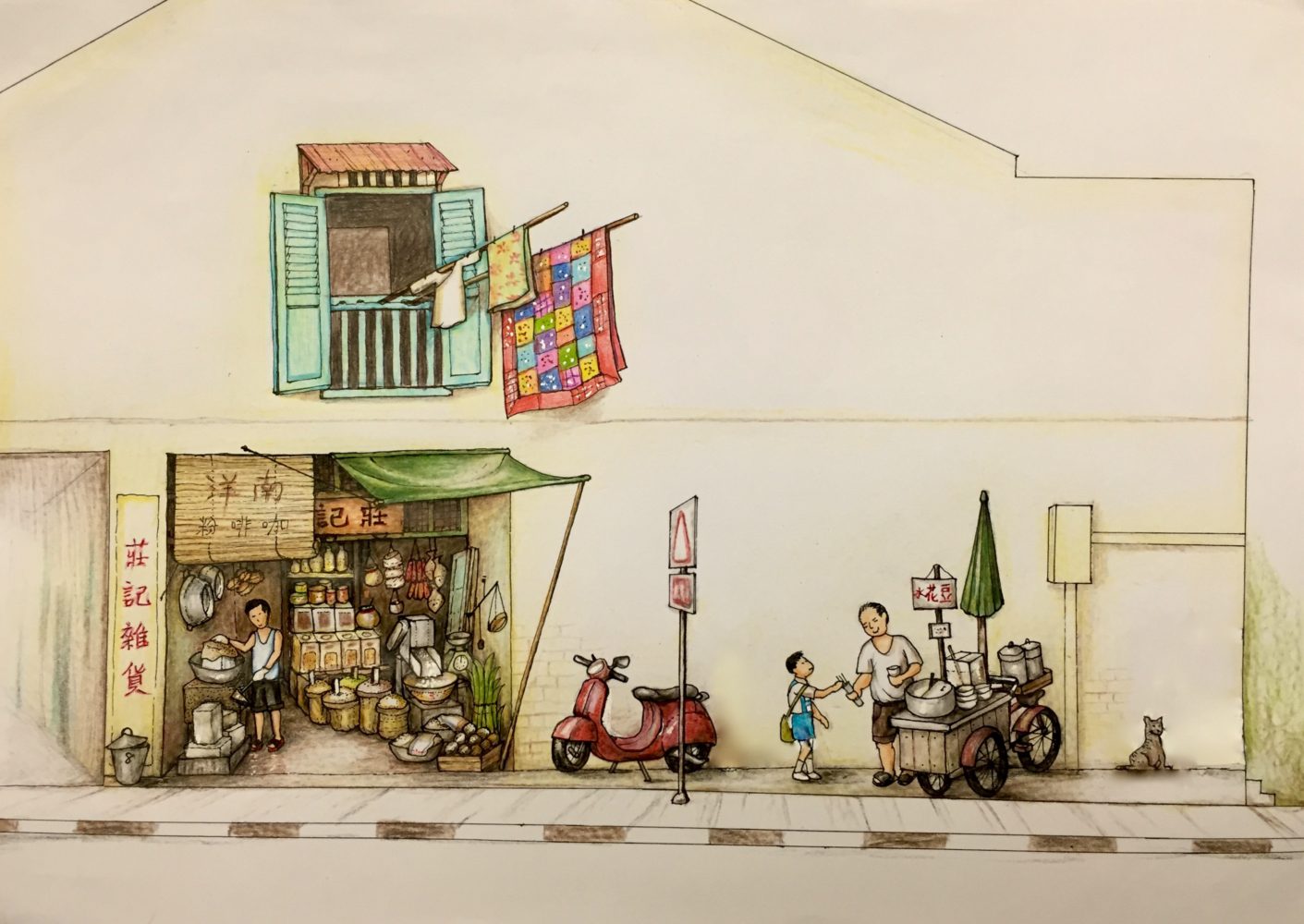
I felt very happy to be able to paint at Everton Road again. This time round, a house owner invited and commissioned me to paint on his house gable wall. The theme was based on the house owner’s verbal description of the place as he remembered it during his childhood days in the 50s and 60s. There was a provision shop near the junction which also sold ice. In those days, not every home had a refrigerator. Every evening, a rather plump and almost botak uncle in a silky white shirt would pedal his soya beancurd stall to the junction. Little kids would have a chance to eat beancurd or drink soya milk for free if they win a Tikam game by picking sticks from a tin can and getting two consecutive sticks with the same colour painted on their bases. The house owner also described his dad’s Vespa scooter on which he and his sibling took turns riding pillion around the area. As the owner described the scene, we also attempted to search the web for archived images of the scenes and objects to match his memories. In addition, I refreshed my own Chinatown childhood memories of how provision shops used to look like in the 70s and 80s. I further consulted my mother, my aunt, friends and even passers-by who looked elderly enough, to jog their memories of those scenes. The final outcome of the mural looks a bit like something out of the 60s to 70s, but actually spans across a good 3 decades. For example, while the sale of ice in provision shops was more common in the 50s to 60s, the biscuit tins with transparent plastic (so as to see the biscuits inside) and the coconut grating machines probably appear in the 70s, or even 80s. Coconuts were grated by hand in the 50s. Today, fresh grating of coconut can be seen in just a few wet markets or very old shops. We mostly buy ready made goods in fancy packaging from supermarkets.
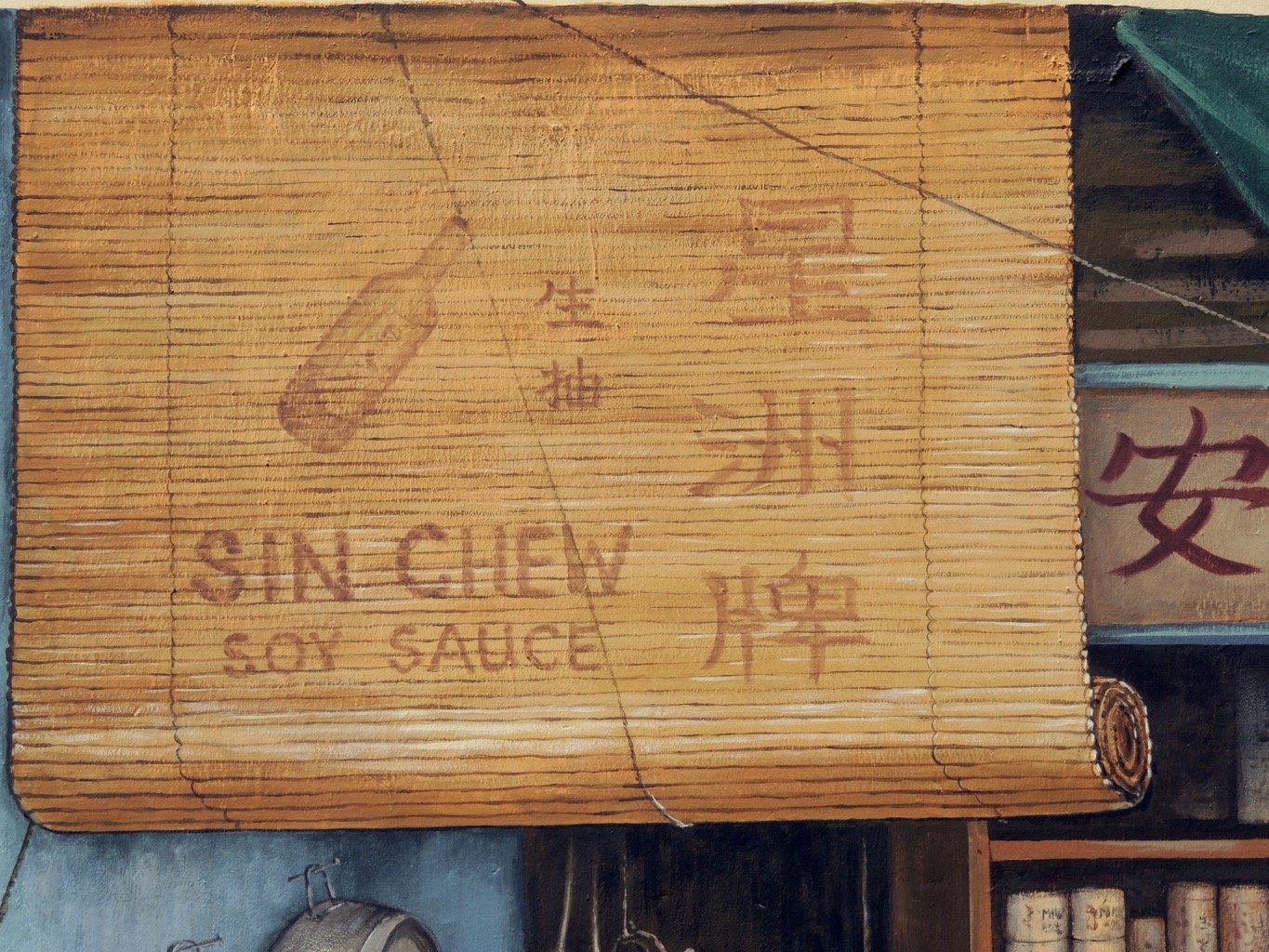
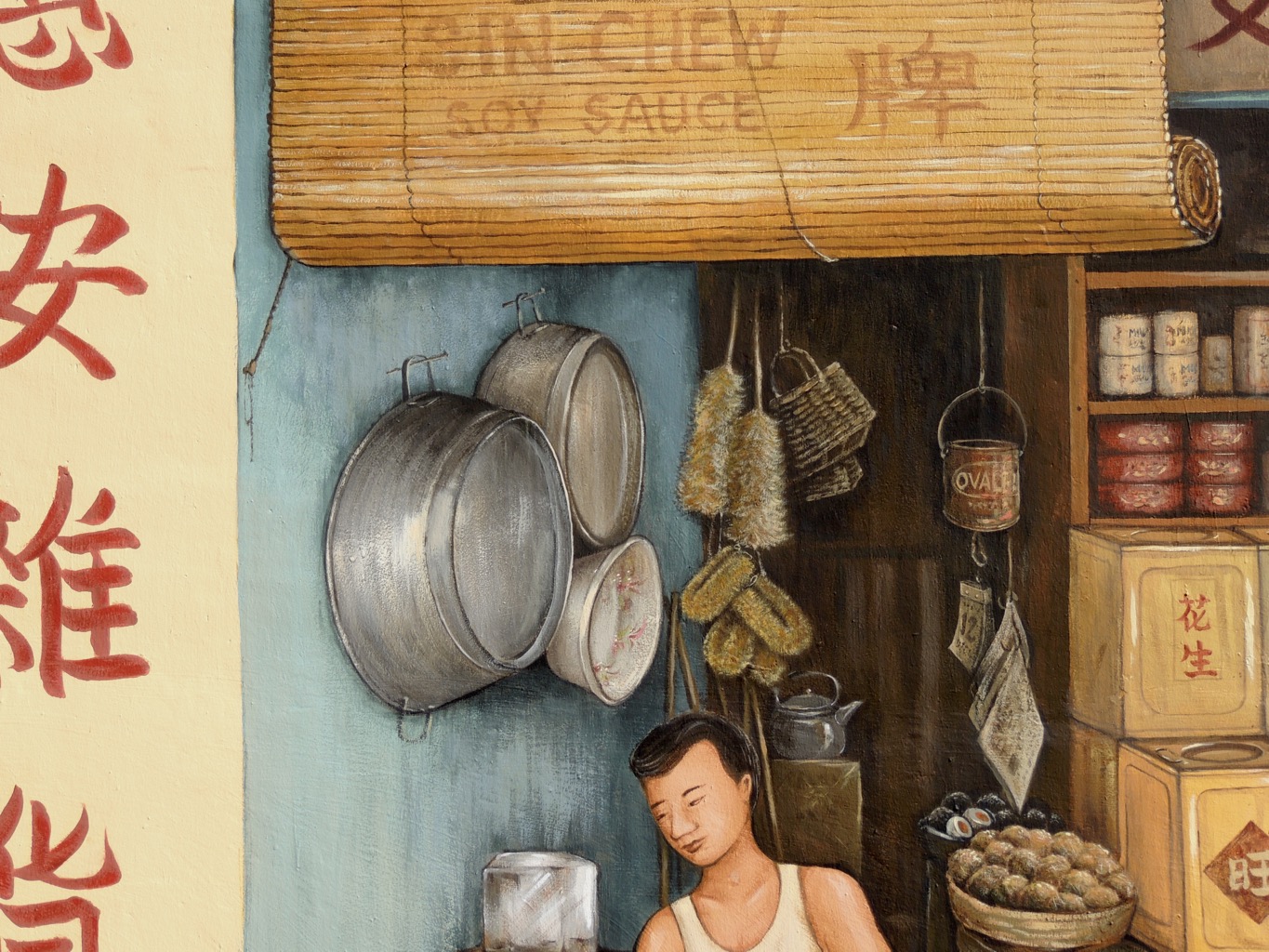
The provision shop’s signboard reads “Hui An” (惠安), which is the name of a county in China’s Fujian Province, where the house owner’s ancestry roots can be traced. The bamboo blind reads “Sin Chew brand soy sauce”, representing our forefathers’ migration from China and settlement in Sin Chew (星洲) which means ‘Singapore’. The word “Kelapa” on the coconut grating machine is the Malay word for coconut. A passer-by contributed this idea and I think it represents our pre-independence Malaya era and multi-racial society very well. My mum visited me when I was painting and corrected me about placing the gunny sacks of dried goods directly on the cement floor – they were usually placed on wooden planks to prevent moisture, hence I added the planks.
On the extreme right, a curious-looking fat grey English cat poses for your photo. If you are lucky, you may see the real cat roaming around the neighbourhood. It aptly represents the present day, our young generation and our cosmopolitan city. Lastly, don’t miss my signature way of signing off – on a uniquely Singapore red letter box.
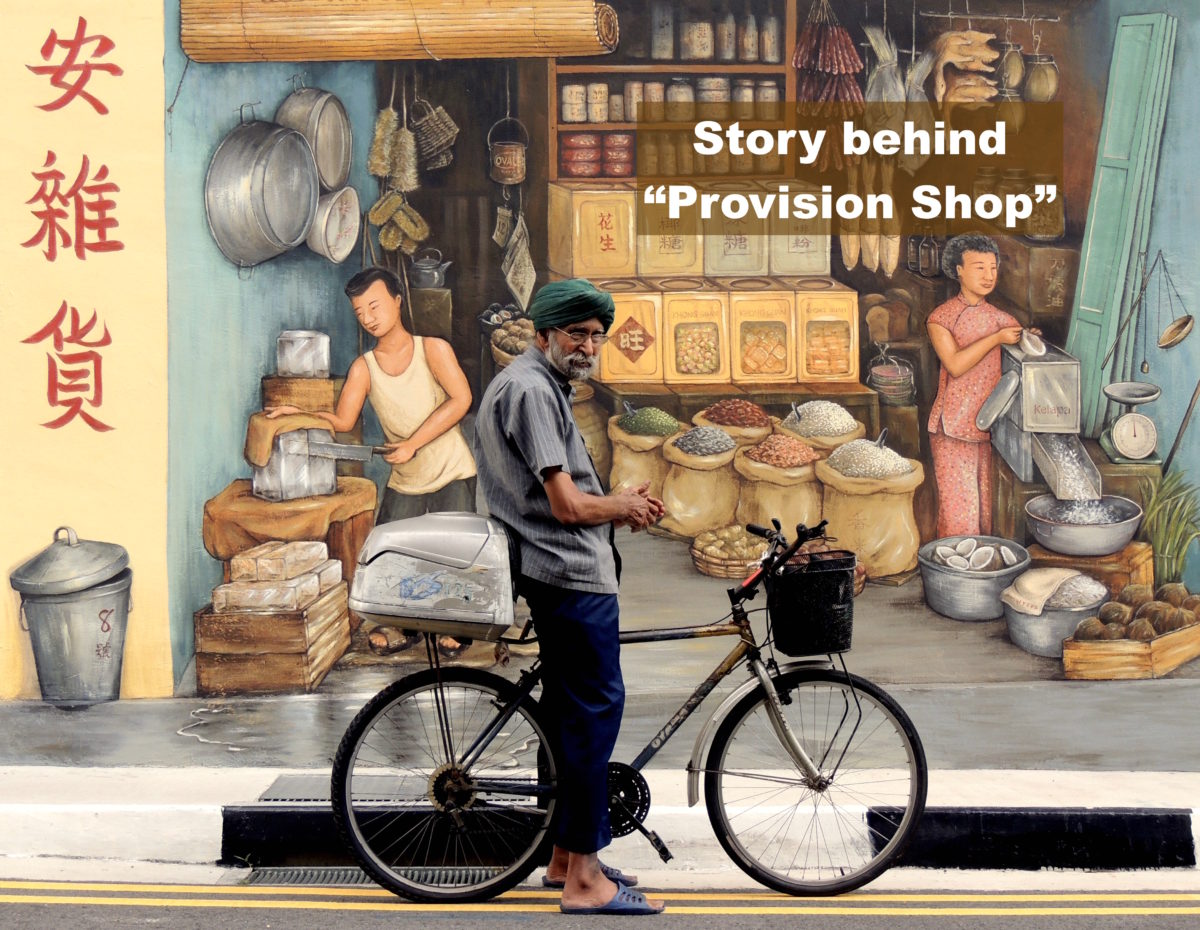
Feeling like a star. Many passers-by requested me to take pictures together with them. This uncle particularly took many shots of different poses.Mr Singh would cycle pass the mural site everyday in the early morning and evening. He would pause, stare at the progress and pedal on, without a word. On the first morning of completing the mural, I went back to the site to wait for him. We chat for the first time and took a few photos together. The next day, I went to his home in Cantonment Road to give him the printed photos. He was so happy!Encouraged by my family and friends, I started Instagram. This is my first Instagram photo.Grating kelapa (Malay word for coconut)Bamboo blinds with painted advertisements – where else can you find them in Singapore?Sausages, salted fish, waxed duck and fermented beancurdsCan you recognise the biscuits and crackers?Fermented century eggs wrapped in wood ash and salt. Salted eggs wrapped in a soggy paste made of charcoal, salt and water.The ubiquitous tin basins before plastic basins took over. Notice the Ovaltine can for putting the money!This dustbin is probably the only one made of tin whereas the whole street is lined with the green plastic dustin. Hope the Garbage collectors do not miss it!A shot from behind the gutter gives it a surreal effect.The little boy wears a uniform from the St Matthew’s Chapel Kindergarten at Neil Road. The chapel was demolished in the early 80s but the bigger church building beside it still stands today, waitiing for its new purpose.Get free beancurd and soya milk if you win the Tikam game by picking two consecutive sticks with the same colours painted at their bases.The Vespa scooter which the owner and his siblings used to joyride pillion around the area.So lucky to see both cats together!My signature way of signing-offZoomed in and cropped view evokes a different feelingBlends in with the streetscape
Visiting the Mural
The mural is on the gable wall of No. 8 Spottiswoode Park Road, at the cross junction of Spottiswoode Park Road, Everton Road and Blair Road.
By MRT : It is about 7-minute walk from Outram Park MRT Station, Exit G. Upon exit, turn right and walk along the front porch/perimeter of the Cantonment Police Complex. Pass by an overhead bridge, grass field and bus stop. Cross the traffic light, turn left into Spottiswoode Park Road and pass by a kopitiam and noodle shop until you reach the cross junction.
Carpark : You can park at any available white parking lot along the roads, or at the Everton Park carpark.
Please take care and watch out for vehicles when viewing the mural. You can get a panoramic view of it by standing on the shaded five-foot way opposite the mural. As the mural faces both the morning and afternoon sun diagonally, it will look parched and white-out under the strong sunlight, so the best time to visit is in the early morning and evening, when the diagonal sunrise and sundown gives it a soft, surrreal feel.
Surrounding Area of Interests
1. House No. 66 Spottiswoode Park Road has a beautiful century old facade painted in porcelaine blue and brown, believed to be the oldest shophouse facade mural still visible in Singapore. It was discovered about 10 years ago during renovation and restoration of the shophouse.
2. Visit my other two murals along Everton Road – “Amah” and “Barber” at the Choa Kim Keat Garage.
3. Everton Park (HDB flats) and the row of old shophouses along Kampong Bahru Road – there, you will find hip cafes and creameries alongside traditional shops selling Ang Ku Kueh, Antiques and Korean Cakes.
4. Blair Road and Neil Road Peranakan Conservation Houses – Besides the beautiful Peranakan motif tiles on the walls and floors of almost every house, pay attention to house No. 147 Neil Road which was owned by the late Mr Lee Kuan Yew’s grandfather and when Mr Lee once lived during his childhood. Also, you don’t want to miss the beautifully restored Baba House (No. 157 Neil Road), now a Baba Nonya Museum showcasing Baba history, culture and architecture.
5. Spottiswoode Park Heritage Trees – Take a walk around the little forest to discover the three Heritage Trees (2 Rain trees and a century old Binjai tree). A rare site so close to the city centre that remains wild and green.
Bonus Pics – Painting process over two weeks (courtesy of Sarah Catton)
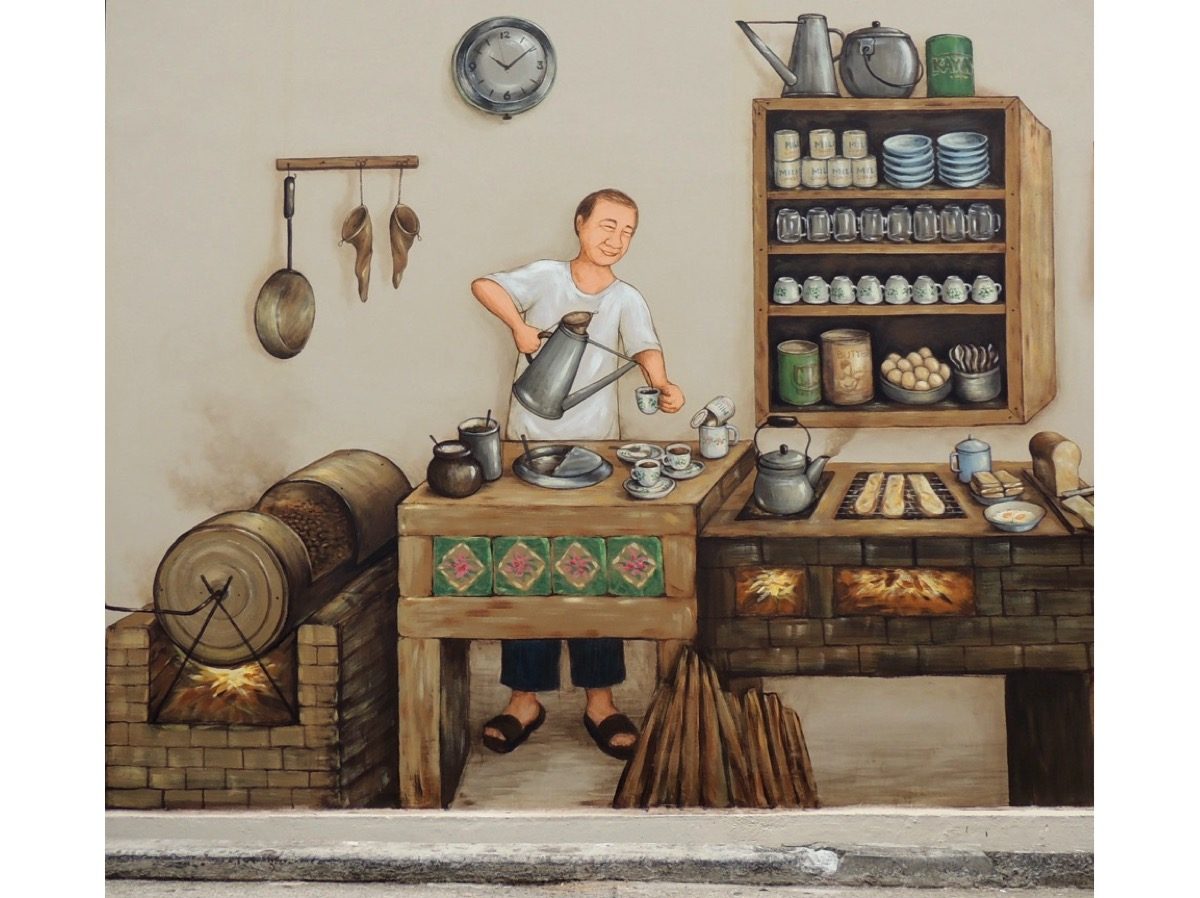
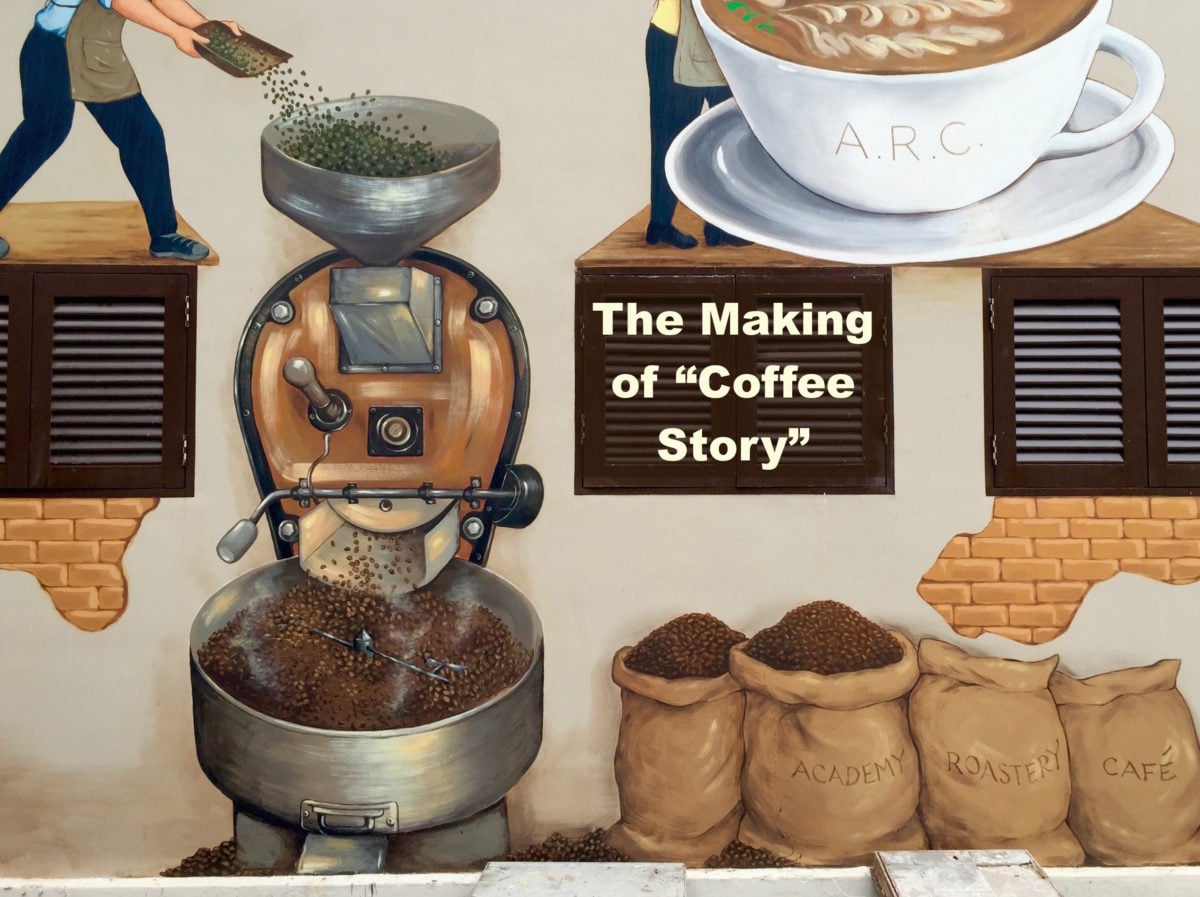
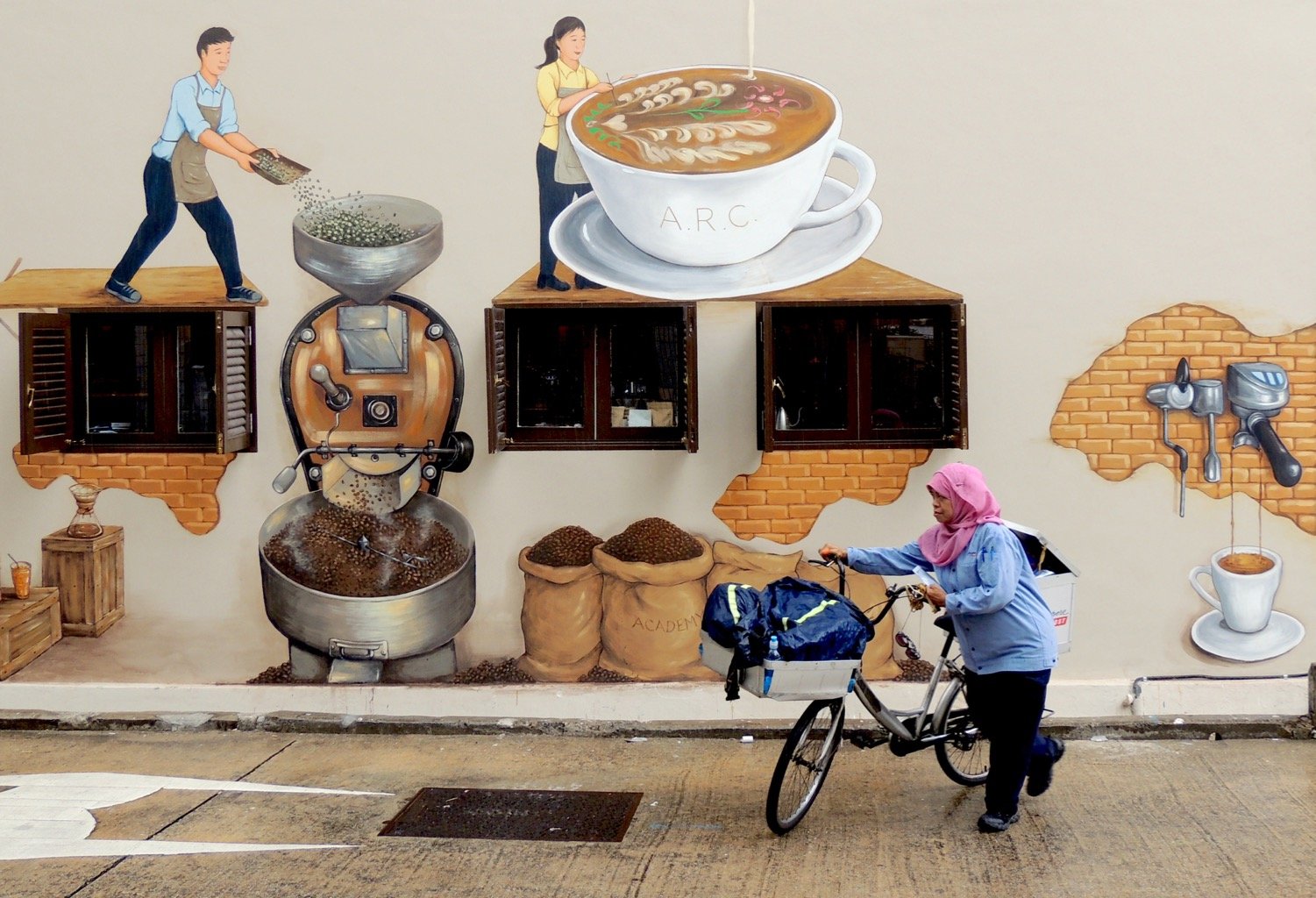
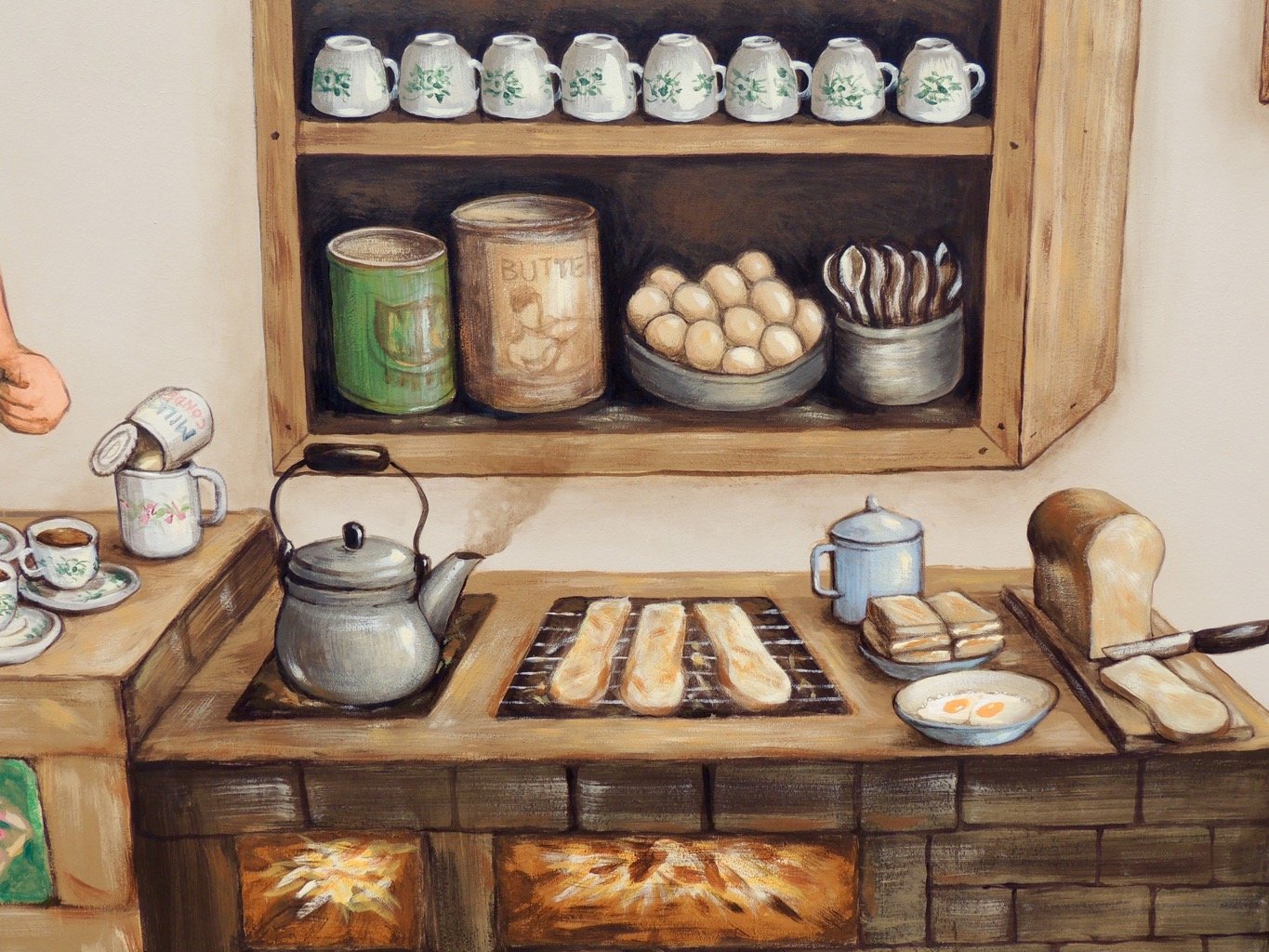
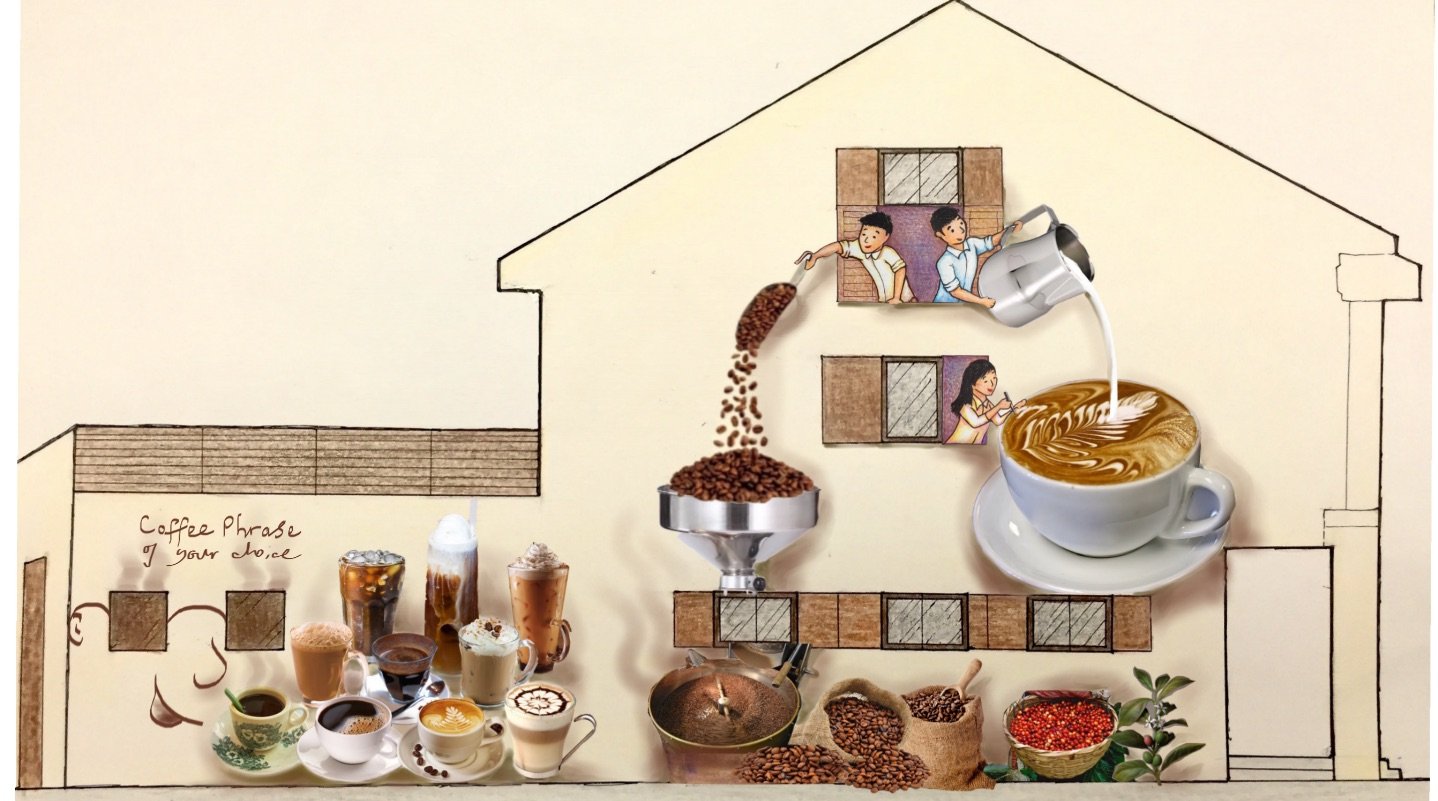
The title of this mural is ‘Coffee Story’, but rather than writing about the details of the various coffee aroma, history and art of coffee brewing (best left to the baritas), I’ll share a little story of the joy and challenges of making this “cup of coffee”, the largest cup I’ve ever made!
After the Sunday Times reported my two Everton Roadmurals in September, I received several enquiries and requests to paint murals on residential and business premises. For this one, I received the request through a Facebook message to paint a mural for a Café, (A.R.C. – Academy, Roastery, Café) then under construction at 29/31 Sultan Gate, Kampong Glam conservation area. I got excited because the area is well known for its cluster of street arts, including those by Ernest Zacharevic, the famous Lithuanian mural artist who painted those iconic murals in Penang. Precisely, it is his murals at Victoria Street which inspired me to start my own mural adventure. Moreover, as this was the first formal request to paint for a business premise, I thought it would really be interesting.
On my first site visit in late September, I was very surprised to see a 3-storey high gable wall because I had only imagined it to be a small shopfront wall along the the five-foot way of a standard shophouse. My first concern was the logistics and risks involved in painting at a height without any experience. But such a rare opportunity also got me really excited to want to attempt it.
I was quietly proud to hear from the A.R.C. team that they had at first approached Ernest Zacharevic to paint the mural. However, because they did not manage to contact Ernest directly, perhaps he was busy, the house owner suggested to them to contact the local muralist who was recently reported in the Sunday Times for painting the Everton Road heritage murals (yours truly:-)). They told me the house owner even gave them the newspaper cutting.
Working with the A.R.C. team
Thereon, we worked through several versions of the concept, from an unrealistically ambitious first design to the final much more relevant and logistically humbled version. I must admit that, in the beginning, I was overly enthusiastic in emphasising my signature heritage theme, with lesser weight for the business, so I was really glad that the A.R.C. team guided me along to strengthen my imagination of their business concept and operation. It was hard for me to imagine it when the Café was under construction, but A.R.C.’s General Manager, who is Singapore’s 2008, 2009 and 2015’s Barista Champion and his youthful team, patiently described the details and showed me pictures of how their operation should look like. It was a joy to learn some trendy things that happen behind the Barista’s counter, from bean sourcing, roasting, to the art of brewing and serving. While I only had a vague childhood memory of how coffee beans were roasted in an oil drum coated in black soot at the backlane of a Chinatown kopitiam, I now learnt how coffee beans are roasted in a modern roastery. Vice versa, I advised them about balancing the aesthetic, interaction and how to better evoke emotions in the public’s heart. I feel young again working with such a youthful, energetic and entrepreneurial team!
Enjoying the aroma of coffee
A.R.C. chef serving me his signature Ray’s Ben, slurp!
Overcoming Challenges
In Singapore, doing street arts on private or public properties require owner and/or authorities’ permissions, otherwise one could land up in jail. The approval of the concept from the URA authority was the easy one as the concept was straight forward without any potential danger to property and lives, or subversive messages, and also follow conservation guidelines. The key challenge was my inexperience with painting on high walls. After researching how other muralists do it, I soon realised it is very troublesome logistically and very costly! To rent a boom lift or scissor lift with an operator, plus obtain the Land Transport Authority’s road use approval and other insurance costs required, would cost an economical bomb disproportionate to my commission. Nevertheless, I attended a one-day scissor lift operator certification course anyway so that I may self-operate it, and I thought it would be fun to have the experience and expertise for the future too.
Due to these troublesome logistics and high costs, we almost wanted to give up the concept and keep the whole mural to just the ground level. However, we were all determined that there must be other ways to do it more smartly, yet retain most of the elements of the concept required to give it the oomp. In the end, we collectively decided to downsize the mural to a height that doesn’t need these troublesome scissor lift and road closure logistics. Similar to my “barber” and “provision shop” murals, a sturdy ladder could easily paint a mural height of about 3.5 metres very safely. A paint brush strapped to a long bamboo stick with rubber bands, plus my steady hands, would do the trick for the milk line pouring from the second storey milk pitcher. The barista pouring the milk from the second storey window could be painted from inside the window with a stencil. The plan sounded “bingo” but along the way, we continued to face challenges such as the exposed drain between the wall and road made it too far to paint even using a ladder. A ledge on the second storey window parapet blocked a part of the window. As a resourceful team, we brainstormed ideas to overcome these challenges one by one, with safety first foremost in our minds and sheer hard work (including running up to the second storey to paint and running down to view the outcome, countlesss times). Neighbours also kindly contributed by lending us suitable ladders, concrete drain covers and safety cones. Many passers-by gave moral support through compliments, drinks and food (on top of the A.R.C on-the-house!). I was stuffed up! An uncle who worked at a nearby shop even offered to be my model for the kopitiam man, but unintentionally, it turned out he looked more like the teh tarik man!
Lastly, I painted this mural single-handedly exactly within 7 days during the monsoon season. 7 days had to be a hard-stop as I had to leave Singapore for a backpacking trip with my daughter. The week had two storms that almost flooded the drains and countless showers. Due to rains mostly expected in the afternoons and my need to complete the work in time for my planned vacation, I had to start work at first light everyday (around 7am) and normally ending in the dark. Aside from the rains, it was a joy to paint under a blessingly cloudy sky and cool weather.
Future
During the painting week, I was offered a finance job which I accepted. The recruitment firm even visited me at the mural and I signed my offer letter by the road side! The company kindly allow me to start work in Feb 2016, so that I can complete my father-daughter backpacking trip (overland Hanoi to Shanghai) and other plans in January 2016. The other plans include doing one or two murals, if feasible, at another location. Otherwise, I will make a short film, something which I told my ex-colleagues I had wanted to do during this sabbatical, but which I hadn’t started a stroke. Painting murals to such extent wasn’t in my sabbatical plan, but it was a really nice twist. Although I will return to the corporate world soon, I know I have started a life long journey in the creative arts as a hobby. Due to my time constraint, I will do it more selectively and collaboratively (I still dream to paint the life-sized Cantonese Opera Stage mural one day).
I will remember these few adventurous months for life. Thank you!
The traditional way…Someone brought the clock from the “Barber” over here!The day immediately after the completion, I came back to do some photoshoot, but was disappointed that a motorbike and a car were parked right in front of the mural. Since I can’t move them away, I made use of them in the photoshoot, and the outcome was unexpectedly interesting.The day immediately after the completion, I came back to do some photoshoot, but was disappointed that a motorbike and a car were parked right in front of the mural. Since I can’t move them away, I made use of them in the photoshoot, and the outcome was unexpectedly interesting.The day immediately after the completion, I came back to do some photoshoot, but was disappointed that a motorbike and a car were parked right in front of the mural. Since I can’t move them away, I made use of them in the photoshoot, and the outcome was unexpectedly interesting.Too yummy not to eat it again.This cat was the last item to be painted, almost in dark. The car spotlight gave it a real feel.Meow, Good morning cat!Notice the white paper stencil on the second storey window?Careful, don’t spill on my car!My daughter sheltering me from the light drizzle to expedite the painting completion, so that we can go backpacking on time.Location of A.R.C. and the “Coffee Storey” muralMy coffee break. Such beautiful Latte Art, can’t bear slurping it down.
Bonus pics – Concept evolution From a complicated and overly ambitious design to a practical design that doesn’t even need a scissor lift.
This mural was painted to celebrate the 50th anniversary of Sesame Street, which was first broadcast in 1969. I wanted to paint a familiarly bSingaporean scene of that time, so I had Big Bird lounging in his comfy nest watching the broadcast on a black and white TV set. Try spot the various characters and the vintage objects in the scene. Also spot who else is watching the broadcast!
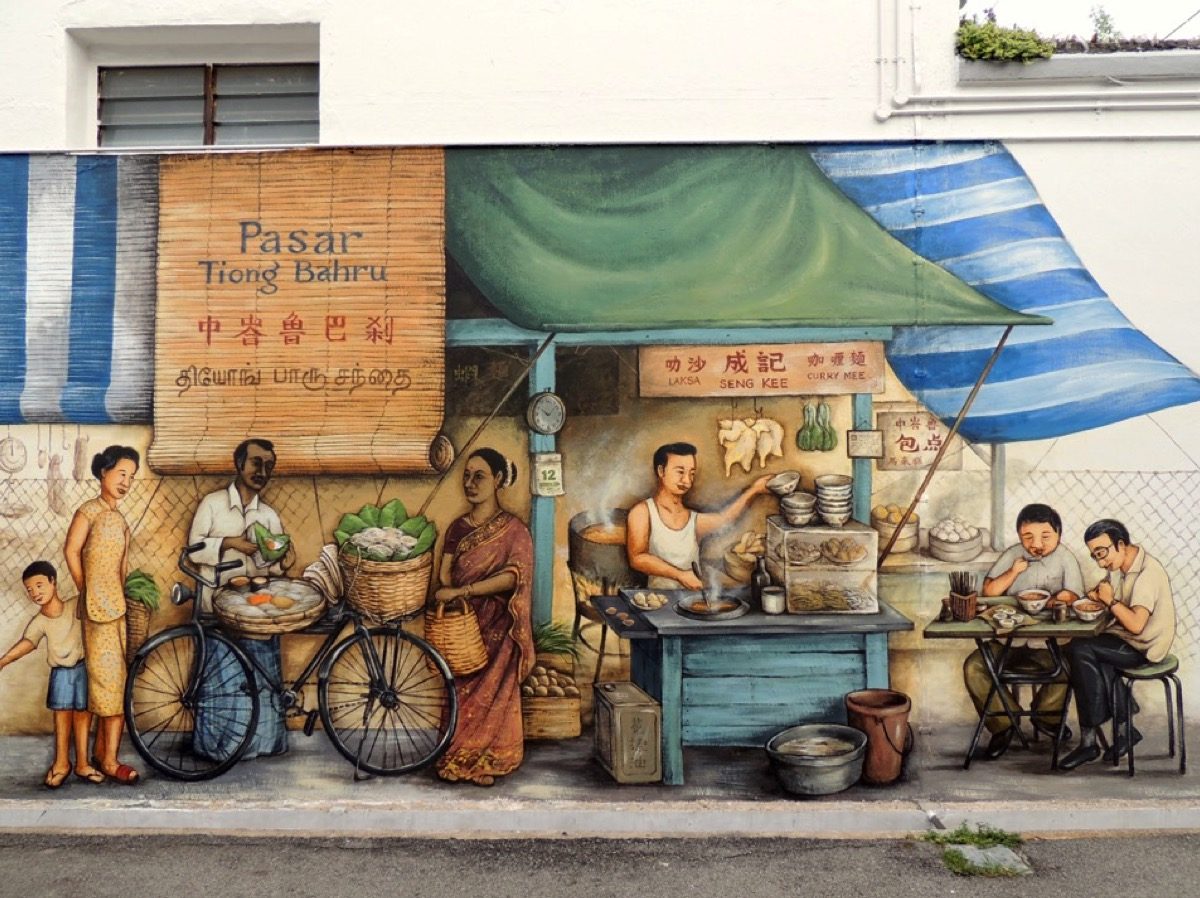
2016 : When the public tags me on their Instagram or Facebook photos taken at the Tiong Bahru murals, I feel encouraged and recognised, even if I haven’t signed off on the murals yet. I will sign them off soon, probably with poetry to explain the painted scenes. Looking back, I’m so glad I persevered to materialise these murals, because they nearly didn’t. On this blog post, I’ll share my story:
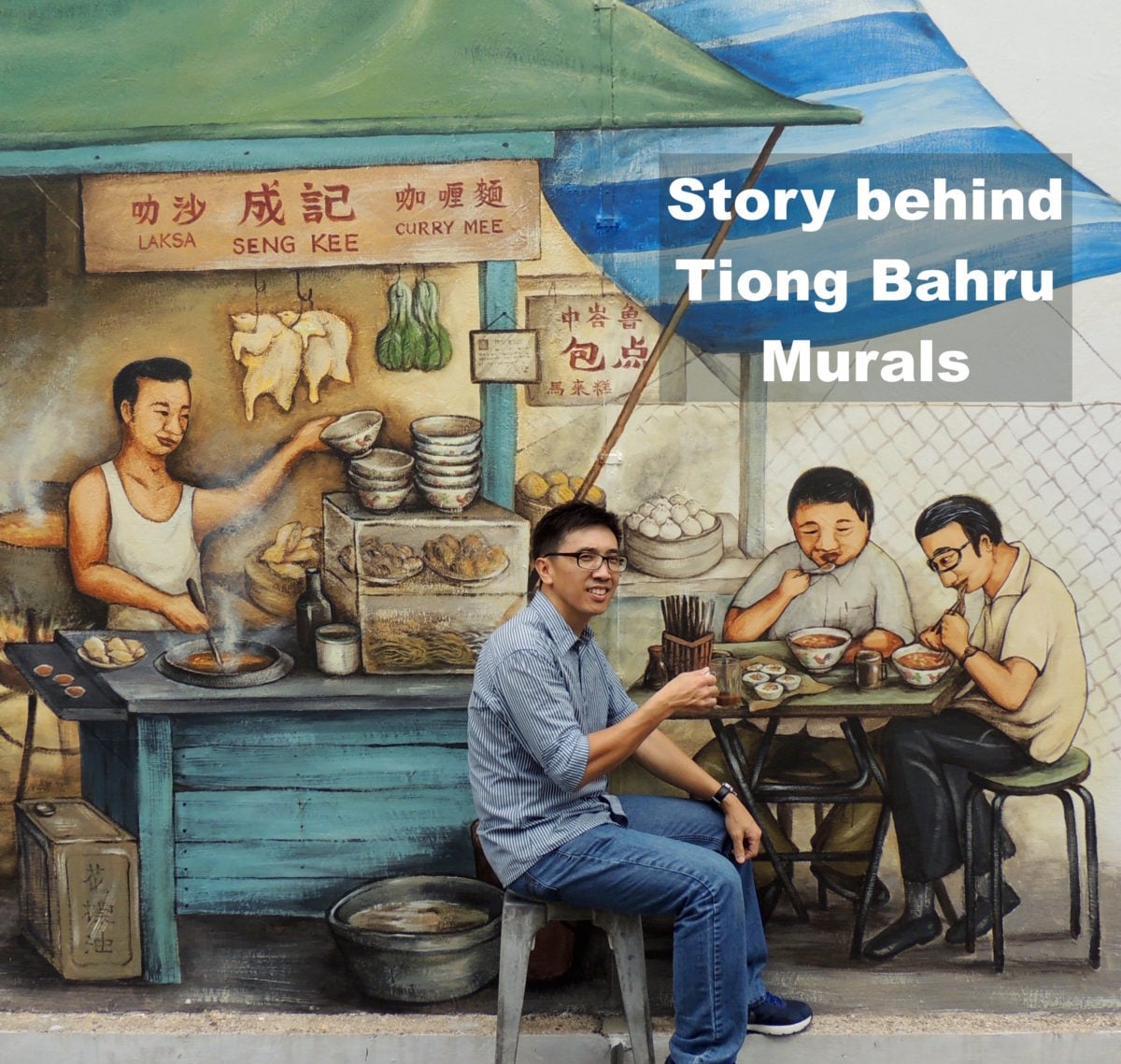
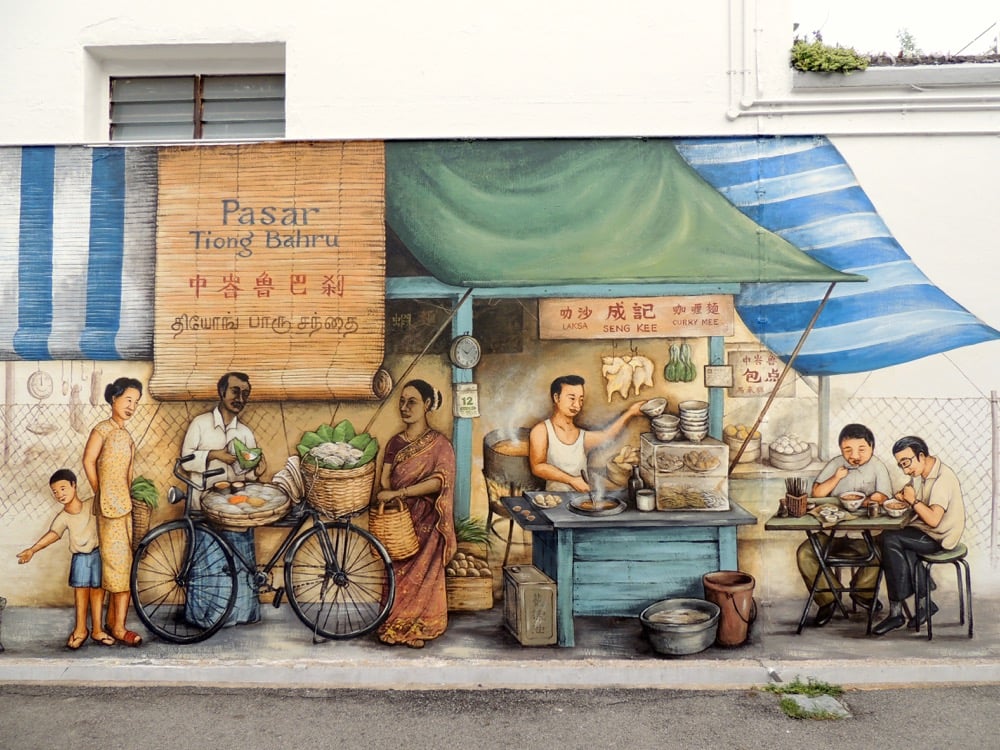
Enjoying the Laksa and Zui Kueh at “Pasar Tiong Bahru.” I named the stall “Seng Kee” in memory of my dad. He loved the yellow “Malay sponge cake” in the background (above my head)
Why I chose to paint in Tiong Bahru
Feeling encouraged by the appreciative public response to my Everton Road murals; in late Sept 2015, I started to draw up my wish list sites for my future murals. Chinatown and Tiong Bahru were my immediate targets. Chinatown was where I grew up (Read YC’s blog “Sago Lane, Street of the Dead”), and Tiong Bahru was my childhood playground where my cousins, siblings and I ran around the estate to hunt for the Saga red love seeds littered from the estates’ many Saga trees. Three of my aunts still live in Tiong Bahru today. I feel connected with these two places with a sense of belonging and fond memories. As they are also conservation areas with unique history and identities, they are very suitable sites for painting heritage-themed murals.
In Sept 2015, I went around scouting for walls in Chinatown and Tiong Bahru. I found Tiong Bahru more suitable as a place for murals due to the abundance of clean white walls lining the quaint back alleys and corridors, whereas those in Chinatown backalleys were greasy with stuff piled up. However, the walls in Tiong Bahru were much smaller, and often blocked by thick pillars.
The clean white walls of historic Tiong Bahru were ideal for heritage murals (Photo by Robin Gn)
Finding the contact to pursue the idea
During the Tiong Bahru recce, I spotted the remnants of the credit plaques of the Roosters and Goldfish murals done by Ernest Goh. The sticker murals had peeled off due to the weather conditions, but I found a plaque intact with the Resident Committee contact on it. I got excited when I noted the fine print on the plaque was encouraging the public to come forward with future mural ideas. With excitement, I sent an email to the Resident Committee to express my interest in creating murals in Tiong Bahru.
When I didn’t get a response after almost two weeks, I was about to give up on the idea, thinking that they were not keen. Until one day, while chatting with a friend over coffee, I was advised to contact a well known Tiong Bahru resident who is a champion of the estate’s culture and conservation. With a quick online research, I managed to contact this champion resident who responded swiftly! I soon learnt that the champion resident is actually also a member of the Resident Committee. When he apologised for the Committee’s delayed response, I felt empathetic and apologetic too because I understood that the Resident Committtee is made up of volunteers with day jobs. As a volunteer myself, I admit that it is a continuous struggle to catch up on both my day-job work emails and volunteer-work emails
Soon after the Resident Committee and I got in contact, they invited the community Arts Council to join in on the collaboration. Together, we discussed the preliminary concept of the mural project. The joint committee expressed keen interest and even indicated that the redecoration was timely because the whole Tiong bahru estate was about to undergo repainting work. They then requested for me to prepare a proposal.
The initial proposal
My initial proposal was to paint 5 heritage murals depicting historical scenes of Tiong Bahru, with options to paint the murals selectively or entirely. They were mostly concentrated around the Community Centre and Market areas so as to form a cluster within short walking distance, suitable for the elderly. Initially, I priced each mural according to market prices. However, in December 2016, while we continued to consider options for the project, I had found a job and was ready to return to the corporate world with the start date in mid February 2016. Due to time and resource constraints, we decided to do 3 of the 5 murals. In fact, the “Bird Corner” was not chosen at first but I threw it in at a good discount because I felt that the series without the “Bird Corner” would be missing an icon, as it already is in reality. I further explained that although I wasn’t doing public street art for money, I wanted to uphold or even increase their value in Singapore, which at times, may have been taken for granted as free with no value. Ultimately, I agreed on a nominal allowance for the murals. I considered this project to be pseudo community work. We also dispersed the locations of the murals to spread out the areas of interest. When we were choosing the locations, we tried to ensure that the residents’ privacy would not be compromised and businesses not obstructed. Upon finalisation, we submitted the plan to the relevant authorities for approval.
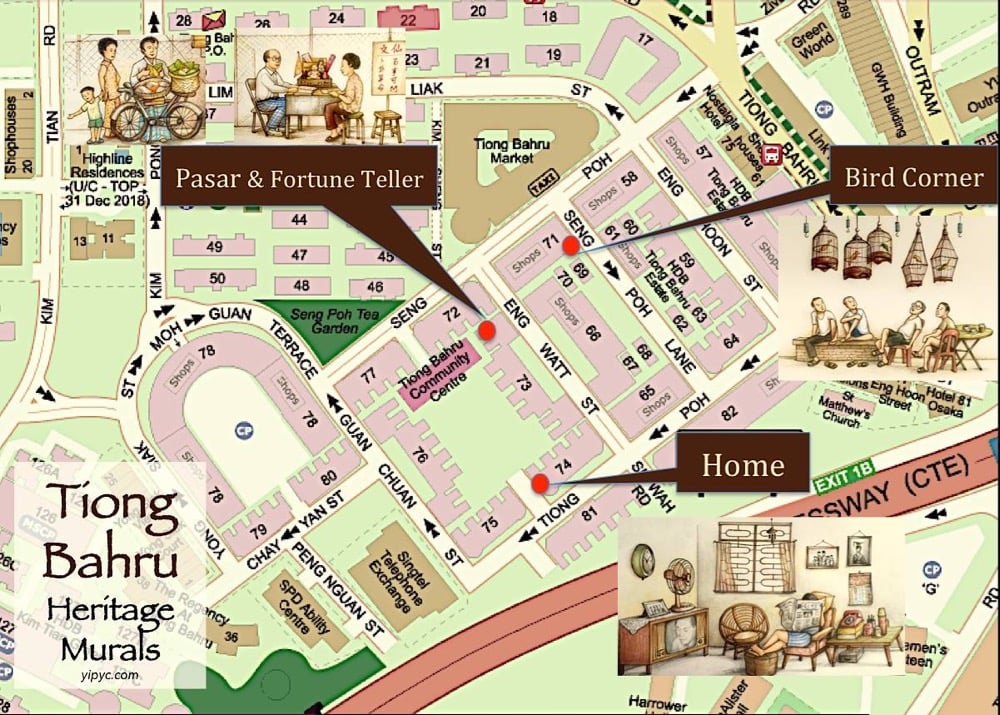
The final locations of the murals. This serves as a good walking map guide.
Almost gave up while waiting for authority’s approval
We submitted the approvals for the murals to three authorities in January 2016. Two of the authorities granted their approval quite efficiently, while one authority was less structured and did not provide an estimated reply date. I knew I had just enough time to complete the murals before my return to the corporate world in mid February immediately after Chinese New Year, so I was following up on the approval status almost daily. When I started my new job, the approval was still not granted, resulting in us missing our targeted unveiling of the murals as a gift to the residents for Chinese New Year. Even after I had started my new job, there was still no news of the estimated reply date and no indications of what the authority’s concerns were. In my mind, I had resigned to the fact that the project would not materialise. Then, three weeks into my new job, the approval came! Thereon, I spent the next 5 weekends painting the murals while holding a full-time job. I even had a business trip to Dubai during the period. It was indeed tiring, but I felt motivated to fulfil my dream.
Tired but motivated
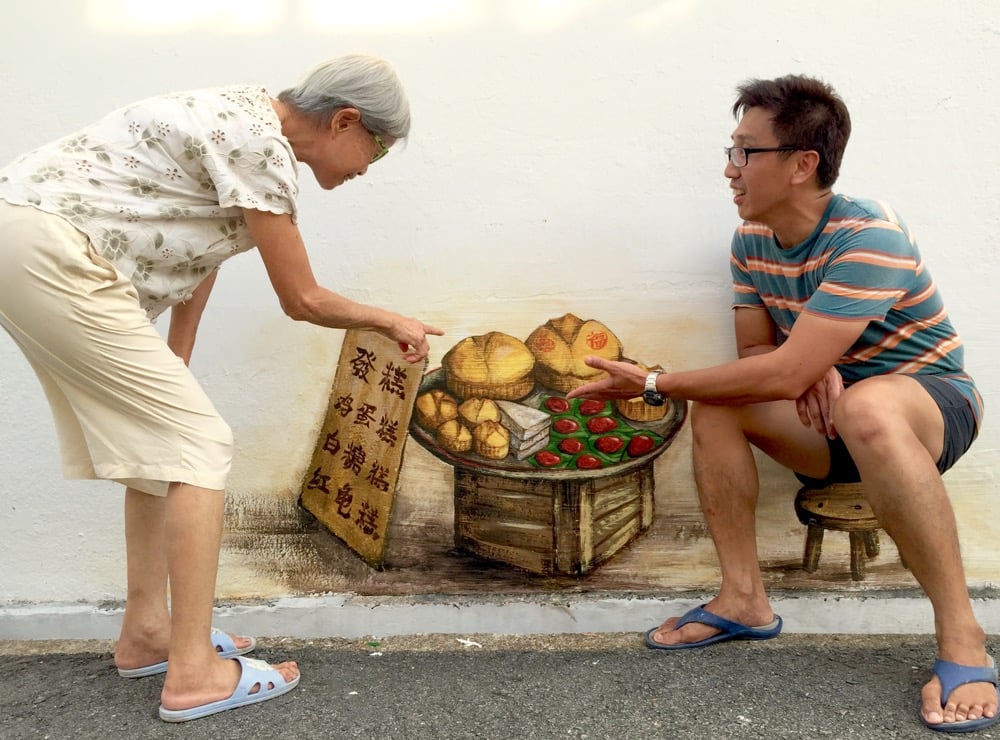
The semi-sheltered corridors of the “Bird Corner” and “Home” were a luxury to paint at, whereas the hot sun and occassional showers of the outdoor “Pasar and Fortune Teller” mural was toil. The toil melted away when supportive friends, residents and my family visited me, stuffed me with food, drinks and even wine (from an Italian resident family). I was touched when my uncle who is still living in Tiong Bahru came by on his wheelchair! I am very grateful to the Resident Committee who rallied the residents to give me logistical support, and the community Arts Council for unrelentlessly chasing after the approvals from the authorities. I was happy I could paint much faster than when painting the Everton murals, but I also felt rushed because my next mural project at Waterloo Street had an unveiling deadline which could not be postponed. I painted the Bird Corner in 1.5 days, Home in 2 days and Pasar & Fortune Teller in 4.5 days. Each day averaged 12 hours of work. On the last day of the Pasar mural, I added a small squatting stall which sells traditional cakes and kuehs, based on a resident’s suggestion.
Almost immediately after the Kueh stall was “set up”, an elderly lady patronised it! But don’t worry, the Kuehs will never be sold out.
.
Why I choose the themes:
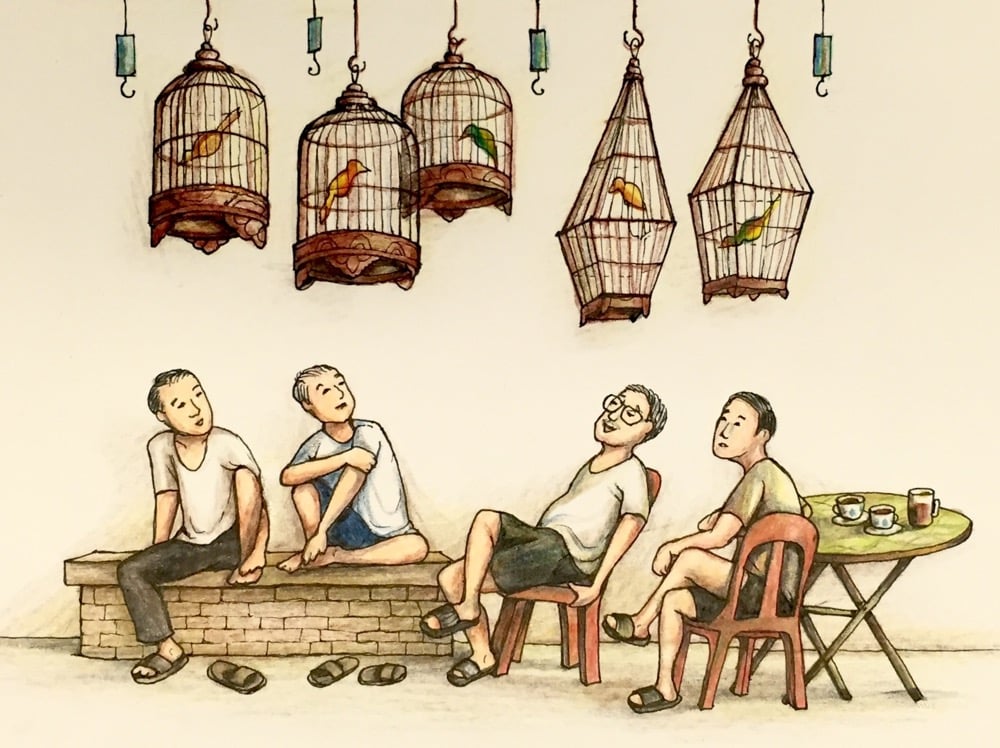
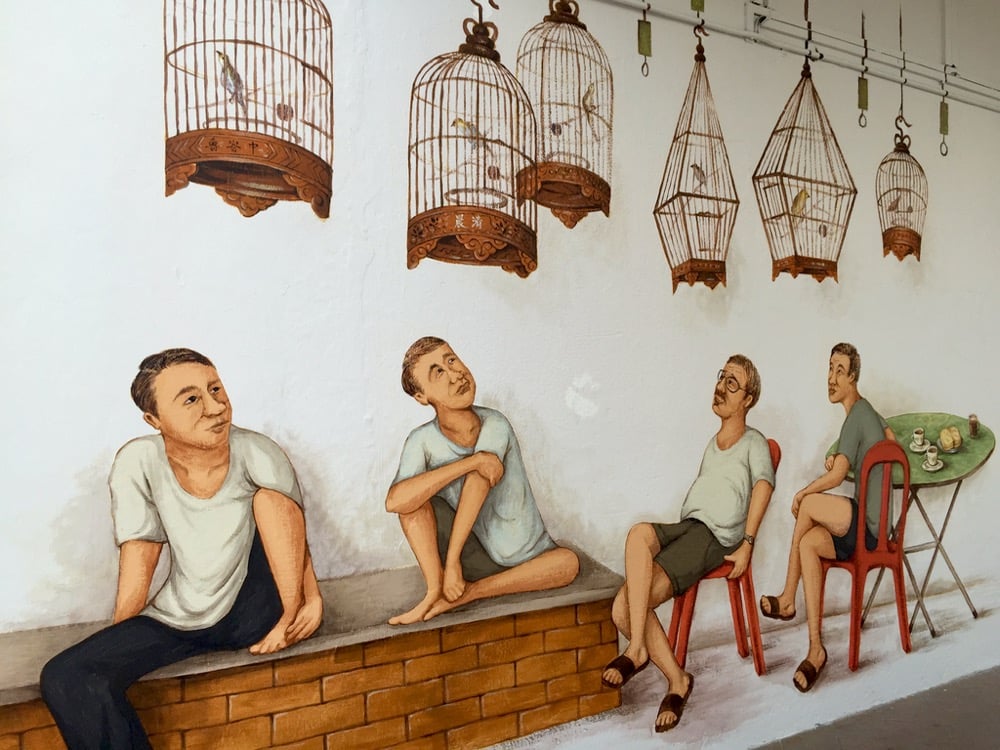
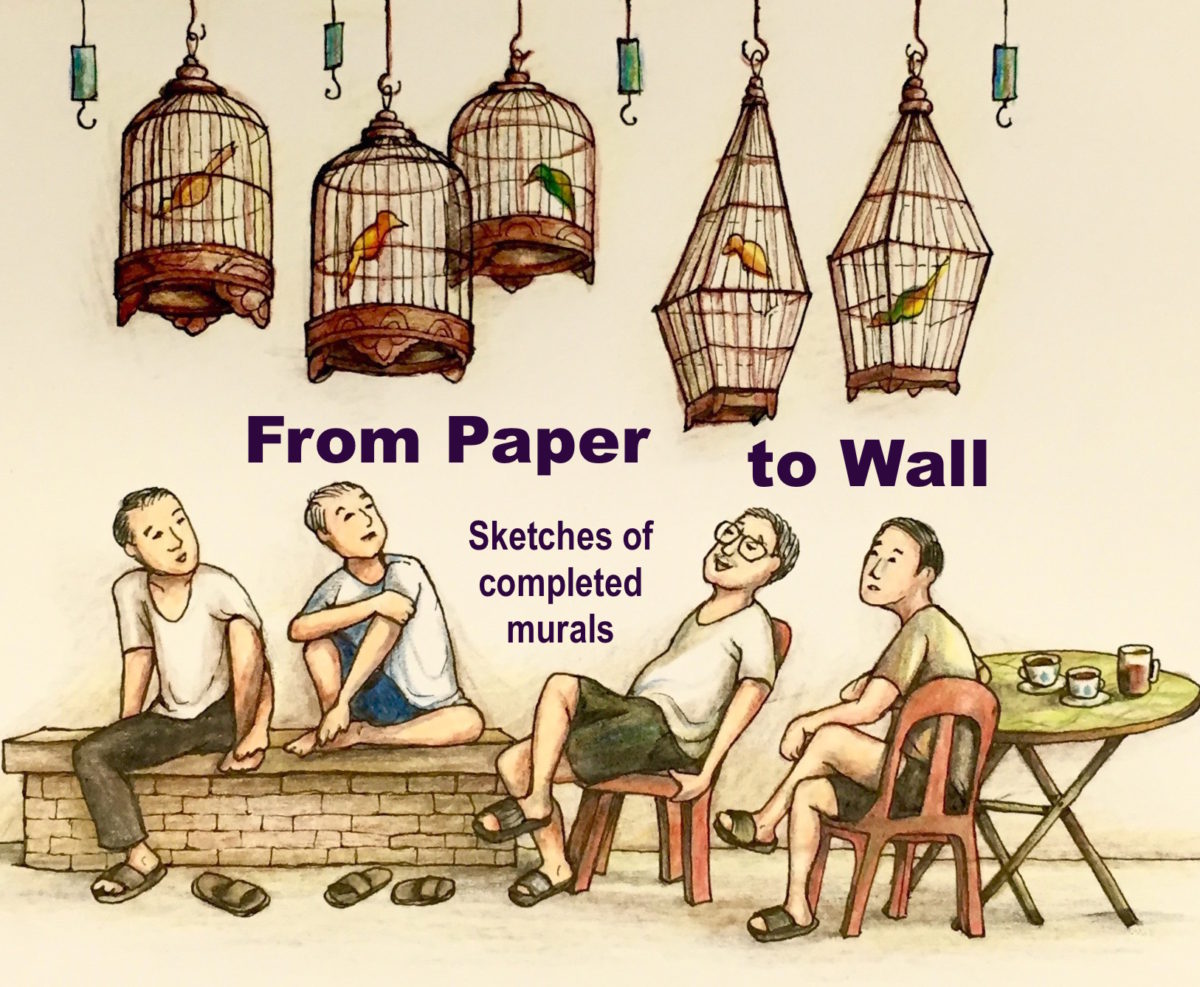
Bird Singing Corner– To many people, one of the most commonly thought-of scenes of Tiong Bahru has to be the bird cages and their owner uncles sipping kopi. Unfortunately, it is a bygone scene. The original location is beside the current Link Hotel. The hotel once attempted to revitalise the activity but the reality is that the uncles and their birds have mostly moved out of Tiong Bahru. Today, the hooks are still dangling and waiting for the birds to return, to no avail.
When I conceptualised this, I was concerned that I may be perceived as promoting caging of birds, which is contrary to my personal value to respect the natural habitats of fauna. I was especially concerned since I am also a Board member of the Nature Society, an NGO which promotes the appreciation, conservation and protection of Singapore’s natural flora and fauna heritage in their natural habitats. I decided to proceed anyway after considering that the scene was an undeniable part of Tiong Bahru’s culture and history. When creating art, it is common for artists to be caught in between expression which upholds one’s values and self-censorship.
The original sketch of “Bird Singing Corner”The songs of the birds now resonate in the neighbourhood
.
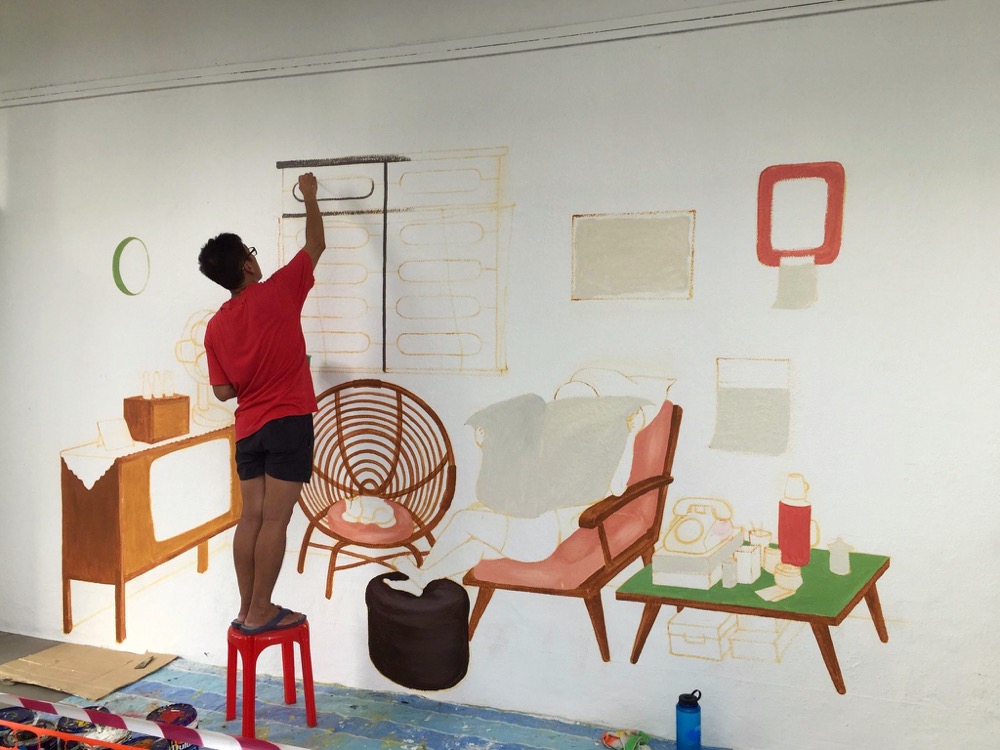
Home– I’ve always wanted to paint murals which are relevant and reflect the history and ambience of the site. Tiong Bahru being a housing estate, and being one of the first public housing estates in Singapore, is most suitable to carry a scene of the inside of the home. I know that some of the homes in present day Tiong Bahru is still furnished the traditional way, and many visitors tend to “peep” into these homes. I thought that if I can paint a typical home furnished in the traditional way, the mural can actually act as an alternate “showroom”.
I enjoyed conceptualising the “Home” mural most. I drew the sketch almost from pure memory of my own home in Sago Lane, Chinatown. We had our first sofa set and telephone in 1977. The sofa replaced the rickety wooden chairs and stools scattered around the living room. The sofa set was actually recycled from my aunt’s home in Tiong Bahru! I remember that as a kid, I was so happy to be able to slouch on a sofa at home.
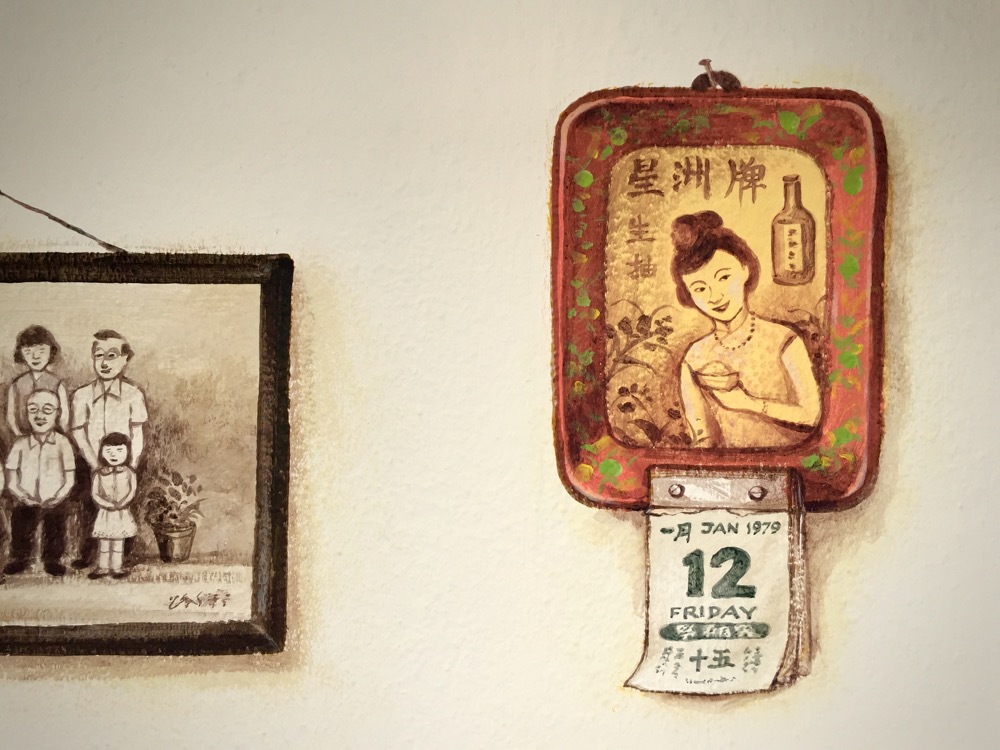
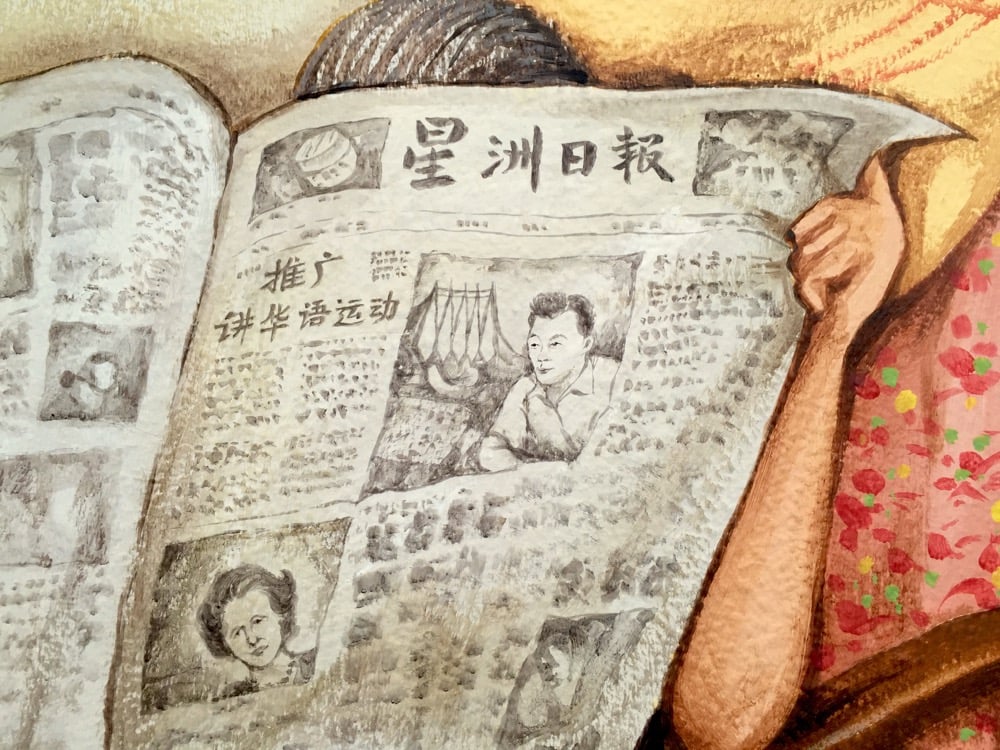
Did you notice that on my sketch, the image on the TV was that of our first PM Mr Lee Kuan Yew announcing Singapore’s separation from Malaysia in the 60s, but the actual mural was that of Wangsa Yefung, a popular comedian duo in the 70s? We decided to change it because the sentimental historic moment didn’t quite fit the room’s lepak setting! Instead, I painted Mr Lee’s image on the newspaper, of him promoting the Speak Mandarin Campaign in 1979. His good friend Margaret Thatcher, ex PM of the United Kingdom, was also painted on the newspaper, even though she was only appointed in May 1979 but the date of the calendar was 12 Jan 1979.
The original sketch of “Home”. Drawn almost entirely from memory. As a kid, I was so happy when my home in Sago Lane got its first sofa set, even though it was a second hand set recycled from my uncle’s home in Tiong Bahru. It was a luxury!The actual muralCreating the “Home” (Photo by Zhang Jianyong)
.
Pasar and the Fortune Teller
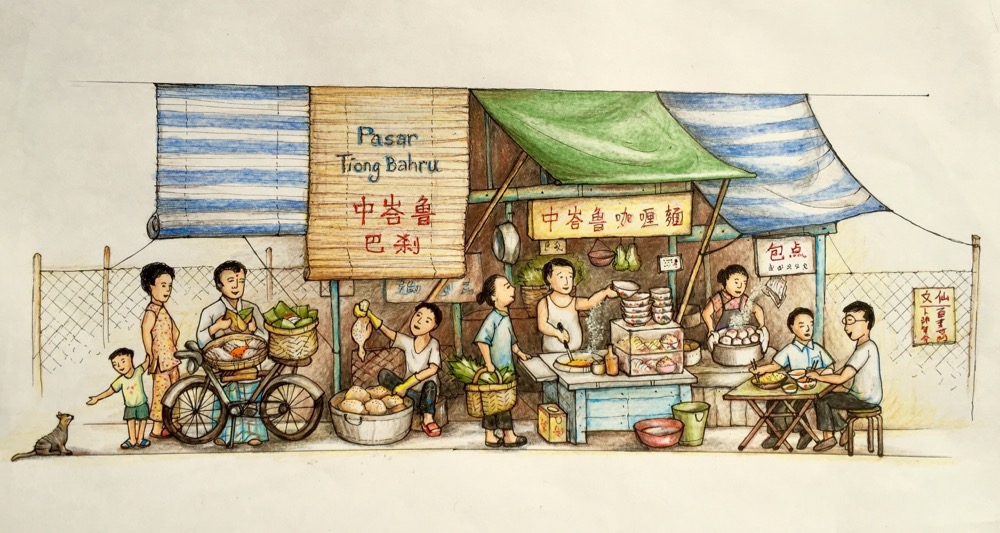
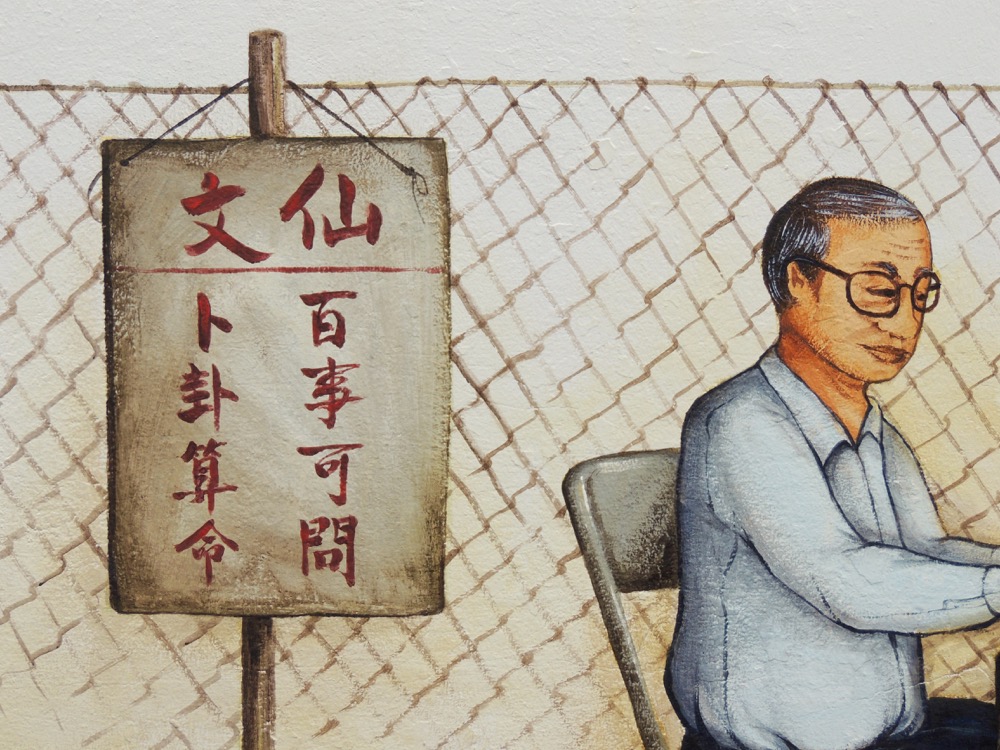
These were actually two murals during conceptualisation, but I eventually combined them into one. The “Pasar” (Malay for market) was originally not chosen by the committee due to its high costs but they liked the concept. In the end, we simplified its design, combined it with the “Fortune Teller” and reduced the costs. Otherwise, the Fortune Teller who used to sit outside the Pasar in real life, would look out of place without the Pasar. The mural series would also be missing its pivotal focal point – the market place.
When the mural was completed, I tried to use social media to find the original fortune teller, whom I had painted based on a small black and white photograph. I thought it would be touching for him to view the mural of himself, complete with his unusual business attire and his signboard. Unfortunately, in just less than a week of the hunt, I received information that the man had passed on some years ago.
The original sketch of “Pasar”The “Pasar” muralThe original sketch of “Fortune Teller”The “Fortune Teller” mural. Unfortunately, I could not invite the real fortune teller to view this mural. He had passed on several years ago.
The murals which did not make it
The fifth mural, a scene at the “Community Centre” did not make it to the series due to time and resource constraints.
The “Community Centre” mural which did not materialise.
In fact, there was to be a 6th mural – “The Cobbler”. I had aspired to paint the cobbler after chancing upon a cobbler operating in his house along Moh Guan Terrace (picture). It did not go into the proposal after I felt exhausted drawing the first 5 sketches.
The “Cobbler” mural which did not go into the proposal
Future Plans
I have been thinking where this mural painting will lead me to. I admit that I am still enjoying the appreciation and recognition so far. I especially feel appreciated to see the public, young and old, Singaporeans of all races and foreigners alike, posing and taking photographs at the murals. However, I know that someday, I will need to cut down or even stop painting murals altogether. I know I will get tired, people will also get tired, and some walls are best left alone. I also understand that all my murals will fade over time and be whitewashed over. Murals are never meant to be permanent.
Meanwhile, I aspire to create a series in Chinatown (hopefully the Chinese Opera Stage scene can be painted there) and a series in Little India (scenes and landmarks of South Asia, for our hardworking foreign worker friends, to let them feel at home. I think most of them will not have a chance to visit those places in their own countries!).
When I stop painting murals, I want to practise painting on canvas and study art. I always feel inadequate being untrained in art. Declaring myself as “self taught” is a good short term excuse but if I want to progress, I need to get some proper training someday. Till then, I’ll continue to bask in the sunshine, just like my murals, before they fade away.
“Home” – My family installed a telephone at our home in Sago Lane in 1977. We had so much fun calling our cousins in Tiong Bahru. On the table, you will find my dad’s ash tray and my grandmother’s 555 cigarette tin.The typical calendar we used to hang on the wall.Sin Chew Jit Poh (Singapore) was merged with Nanyang Siang Pau in 1983 to form the present day Lianhe Zaobao. In 1979, Mr Lee Kuan Yew promoted the Speak Mandarin Campaign. It was funny to watch Hong Kong Cantonese drama series dubbed in Mandarin from that year onwards.Here’s my dear aunt, a Tiong Bahru resident for many years. She is 89 this year, yet she walked all the way from the far end of Kim Tian Road (near Jalan Bukit Merah) to visit me during my painting. When she arrived, she was exhausted, but smiled immediately upon spotting her favourite comedian duo on the TV! Somewhen around 1979, we had our first set of boxy monochrome Telefunken TV, again generously given by my Tiong Bahru uncle when he bought a colour TV.On the second day of painting “Bird Corner”, I added 4 fluttering pigeons. The caged birds were jealous!Sipping kopi, teh and munching kaya toastMy wife loves Zhui Kueh and I love Laksa for breakfast.My dad and my daughter love Putu Mayam. Nowadays, it’s hard to find them in the hawker centres. I did online research to find the Tamil translation of “Tiong Bahru market”. They were kindly verified by two Tamil workers who were passing-by. A resident also helped to contact her Indian friend to re-verify the words in case Singapore Tamil is different from India’s Tamil.Re-creating a hawker stall on the street has always been my dream.The black and white photograph was too small and blurry. These details were my extrapolated imagination of the vague photograph.I painted these characters exactly as they were written on the actual signboard.
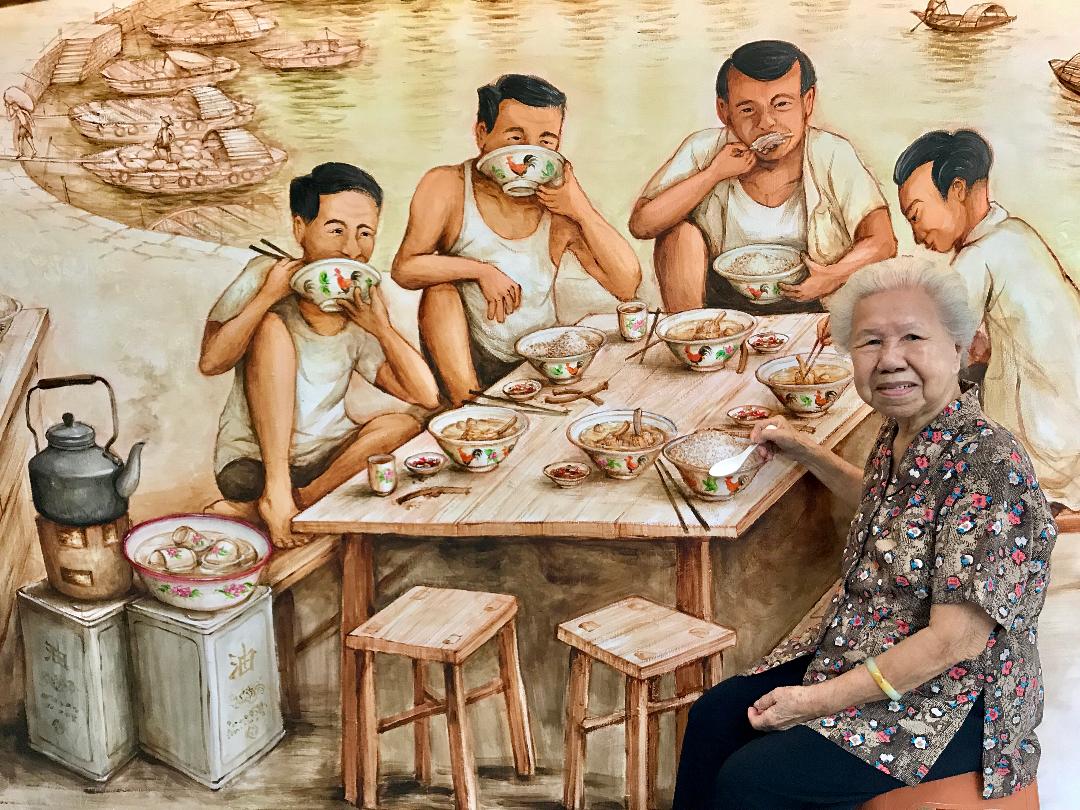
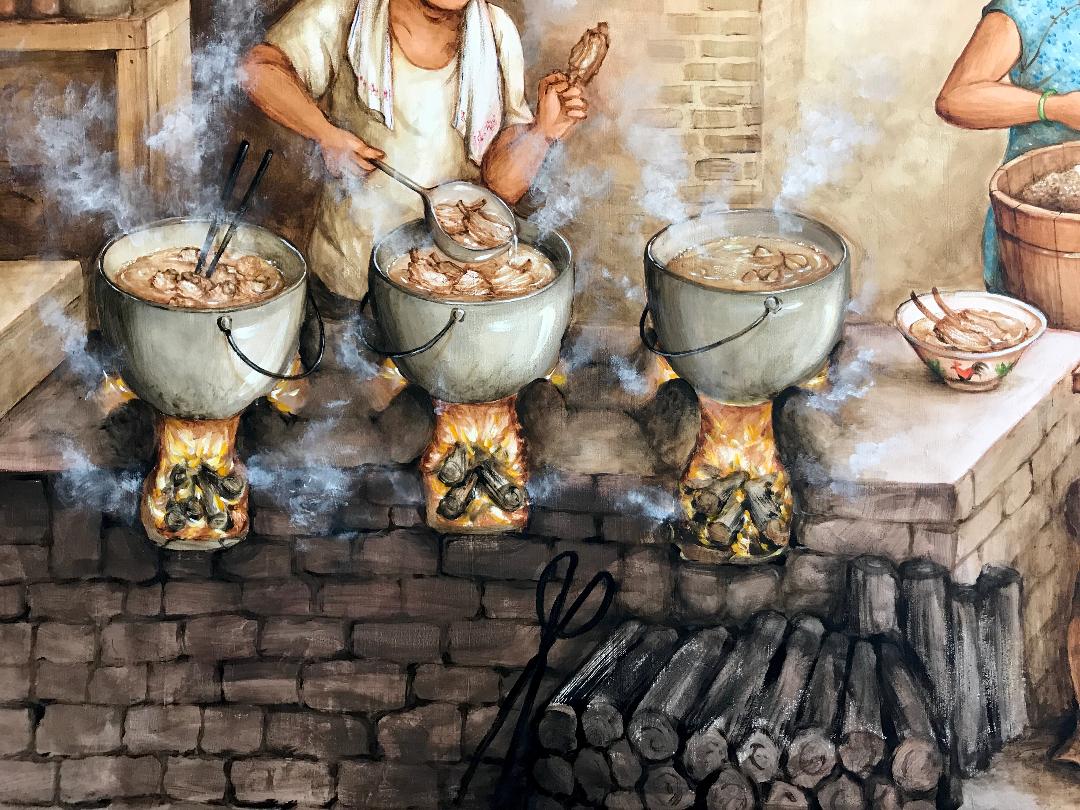
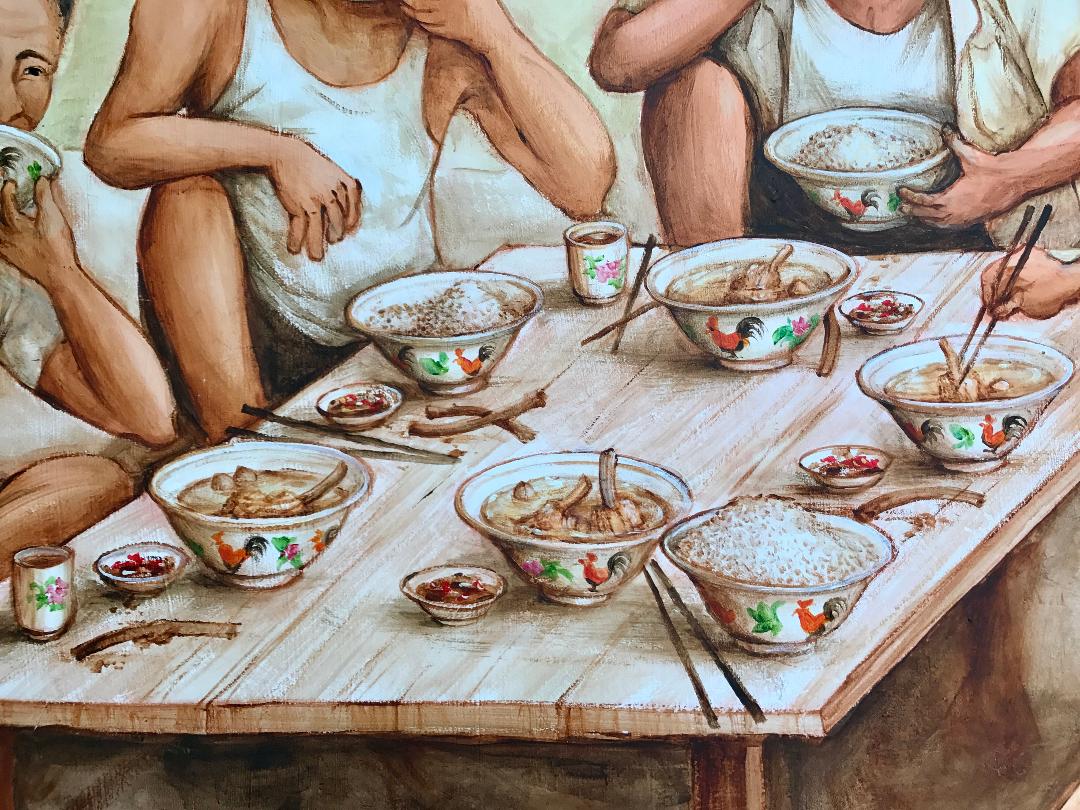
This mural, located at Block 127 Kim Tian Road (Tiong Bahru area), tells the olden day story of Teochew Bak Kut Teh, when it was a simple staple mostly eaten by the coolies (labourers) at Clarke Quay, to restore their energy after a hard day’s work. In this mural, one will find many familiar details of olden day cockeries, cooking method and even the postures of the labourers.
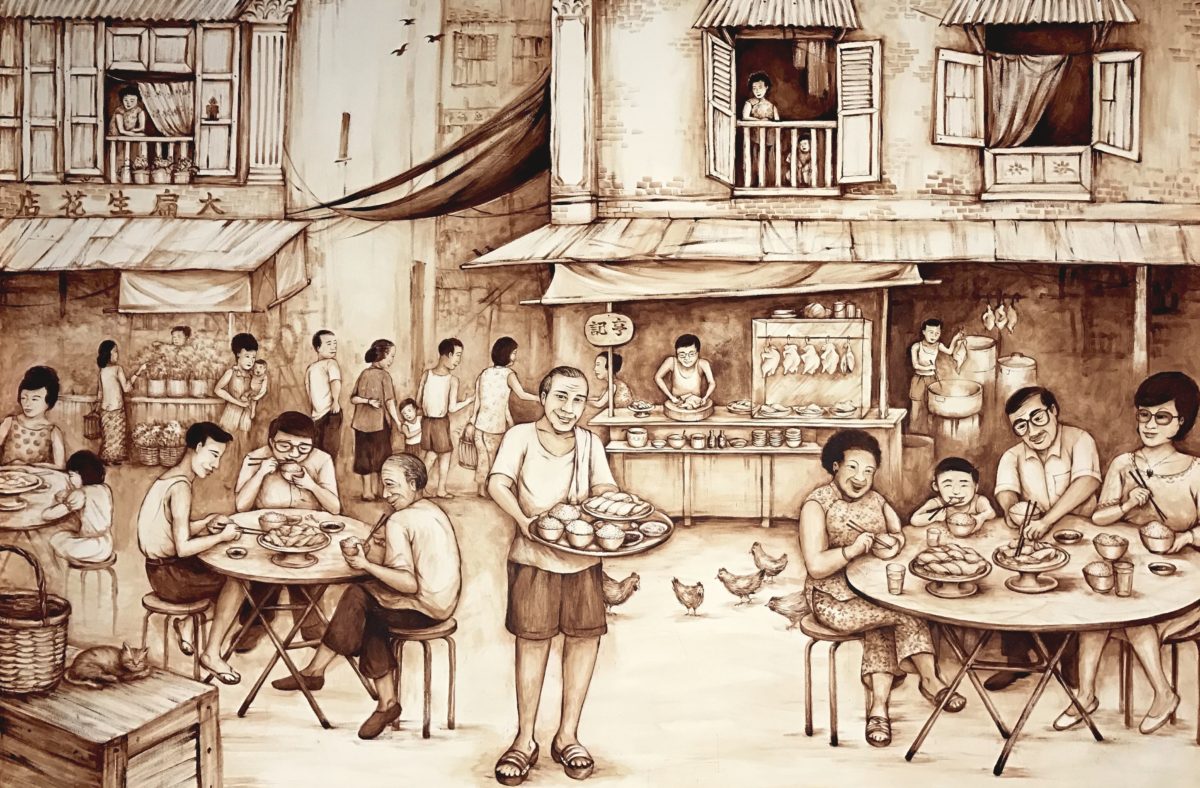
This mural, painted at 729 Havelock Road (Uncle Chicken Rice – Sin Kee Famous Cantonese Chicken Rice by Niven) depicts a scene close to my heart. The scene is that of a chicken rice stall at Chinatown’s Smith Street, where I lived from 1983 till 1995. In 1983, during the big Chinatown cleanup, my family moved from the old funeral shophouse of Sago Lane (Street of the Dead, now the carpark next to the Buddha Tooth Relic Temple) to the HDB block at Smith Street above the hawker centre, just a few hundred metres away from Sago Lane. Before the cleanup, street hawkers used to hawk all over the streets in Chinatown. The hawkers poured waste and sewage water into the drains which often ended up in the Singapore River. I vividly remembered this chicken rice stall and the florist next to it.
The centre figure is the old Mr Leong who started out at the chicken rice stall ‘Hang Kei’ in the 1940s. In the 60s, his son Niven Leong learnt the culinary skills from his father at this depicted Smith Street stall (In the mural, Niven is depicted chopping the chicken behind the stall.) The inherited skills and recipes were carried from Chinatown to Margaret Drive Hawker Centre and then to the Bedok Market Place, and now to Havelock Road.
Singapore is developing too quickly. I’m glad to be helping the community, in a small way, to memorialise its heritage.
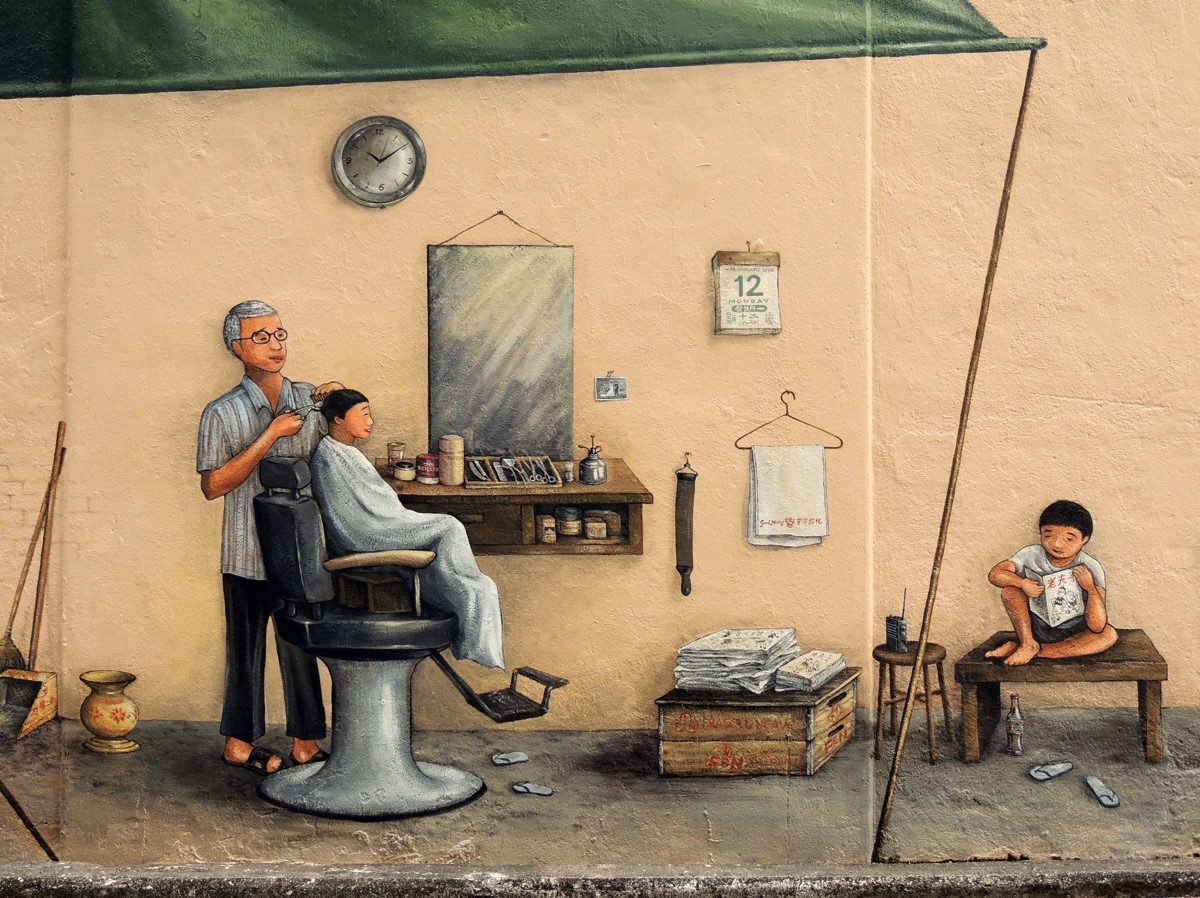
This Barber shop was the very first street mural I conceptualised. I was inspired to paint a street mural after having spotted many murals popping up all over Singapore and Malaysia around 2013/2014. I even spotted Ernest Zacharevic’s murals in Victoria Street! I wanted to give painting murals a try too, but I was too busy at work, I had a full time job in Finance. In 2015, I saw hundreds of murals popping up in Singapore to celebrate SG50, I thought I had missed the boat. Better late than never, when I was taking a break from work, I decided to give it a shot.
I cold-called on doors in my neighbourhood. It was difficult because most residents were out at work and they were tenants rather than owners. I saw a house with a nice wall at the back alley. I googled the address and found that it was for rental, with a number to call a Property Agent. With a bit of courage, I called the agent and requested her to introduce me to the owner because I wanted to paint on his house wall. She was so kind to agree to convey the message., Two weeks later, I got a call from the owner!
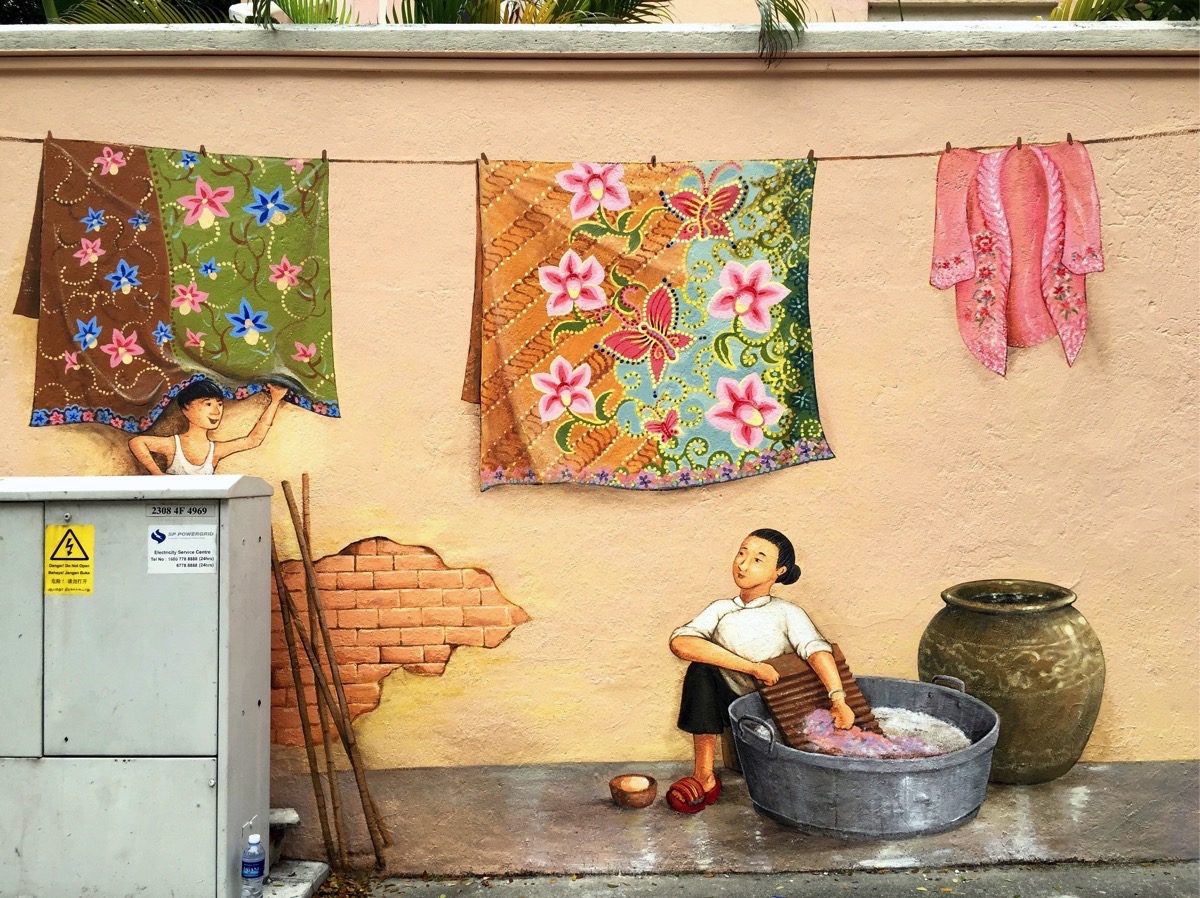
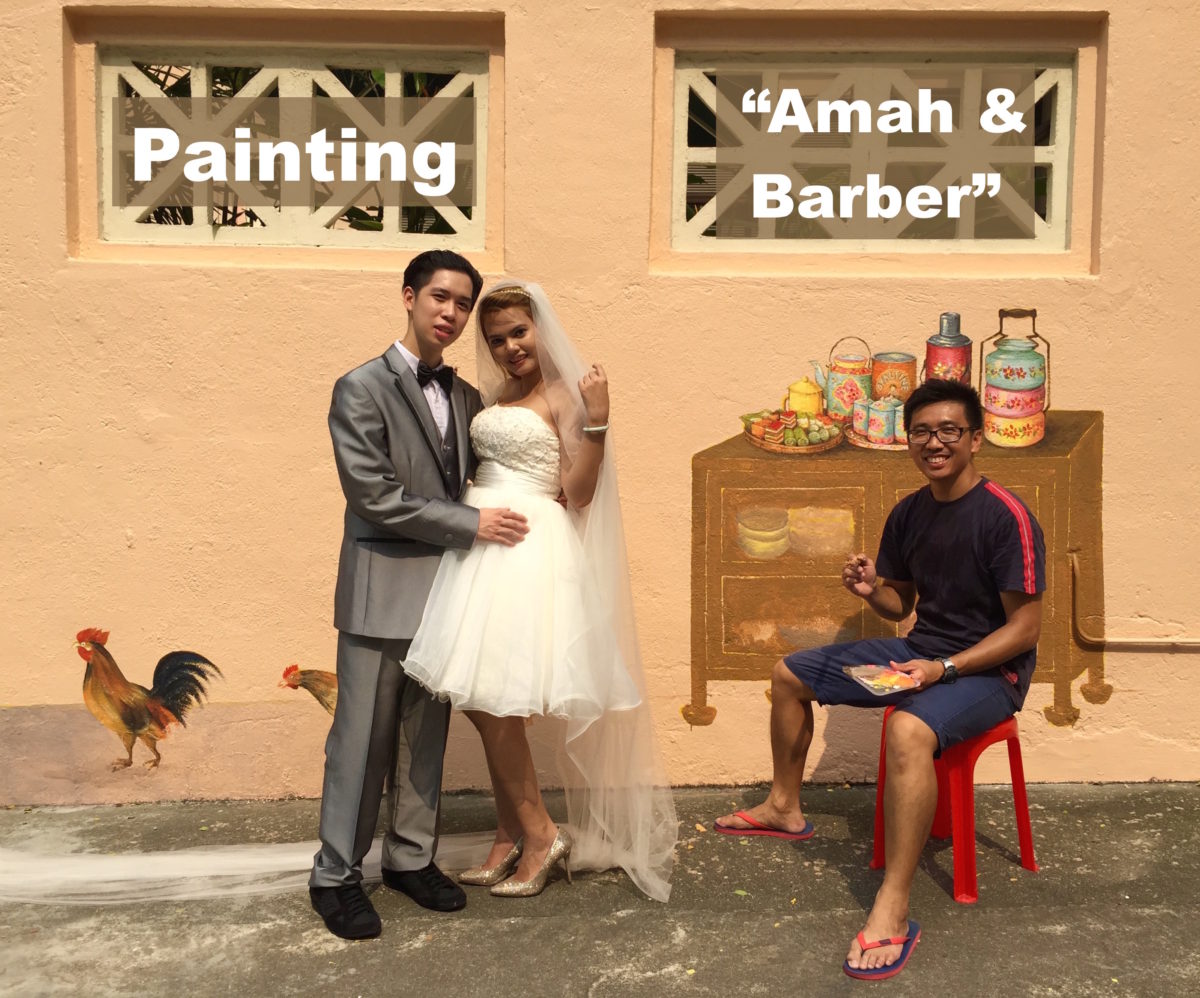
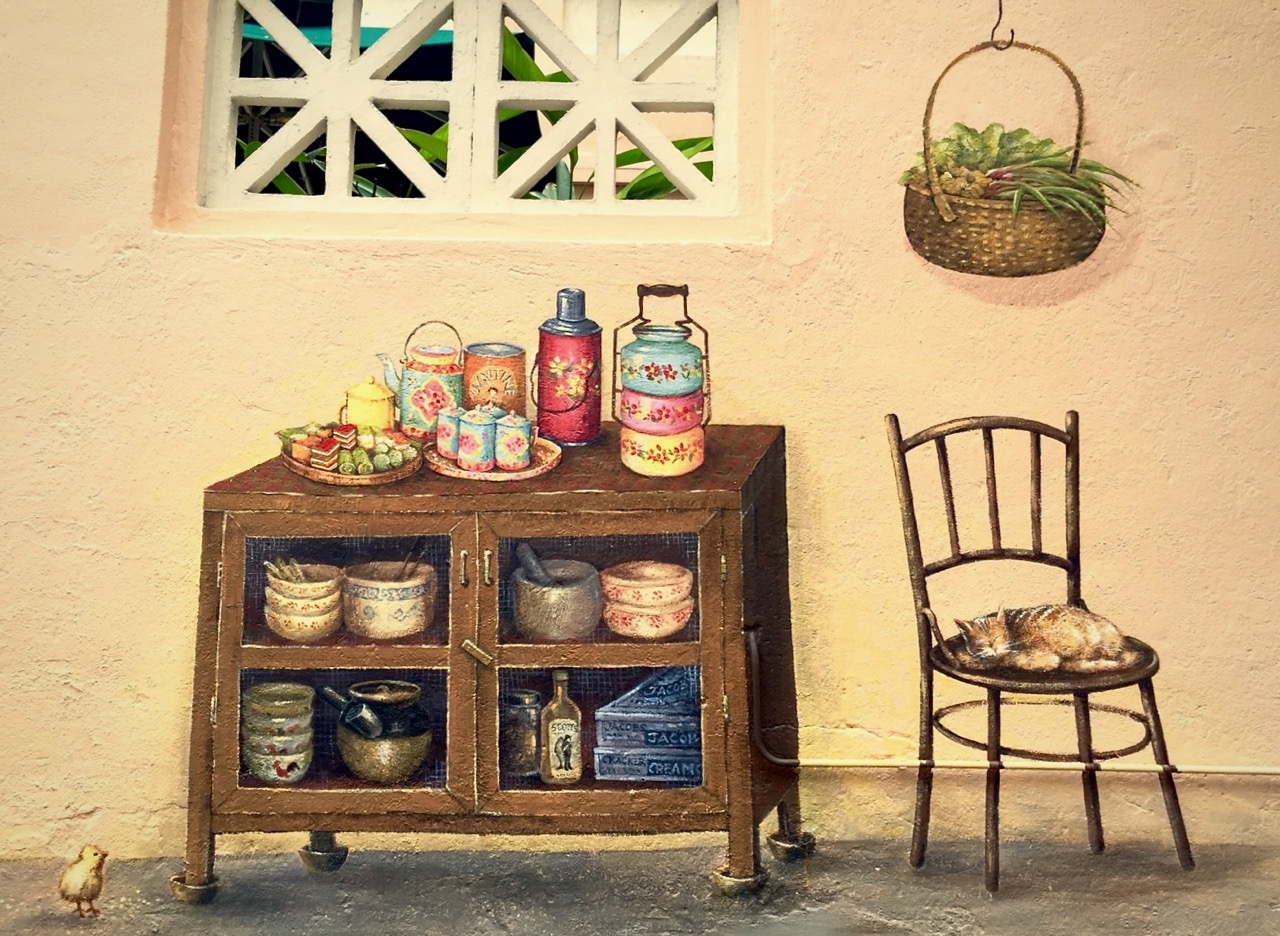
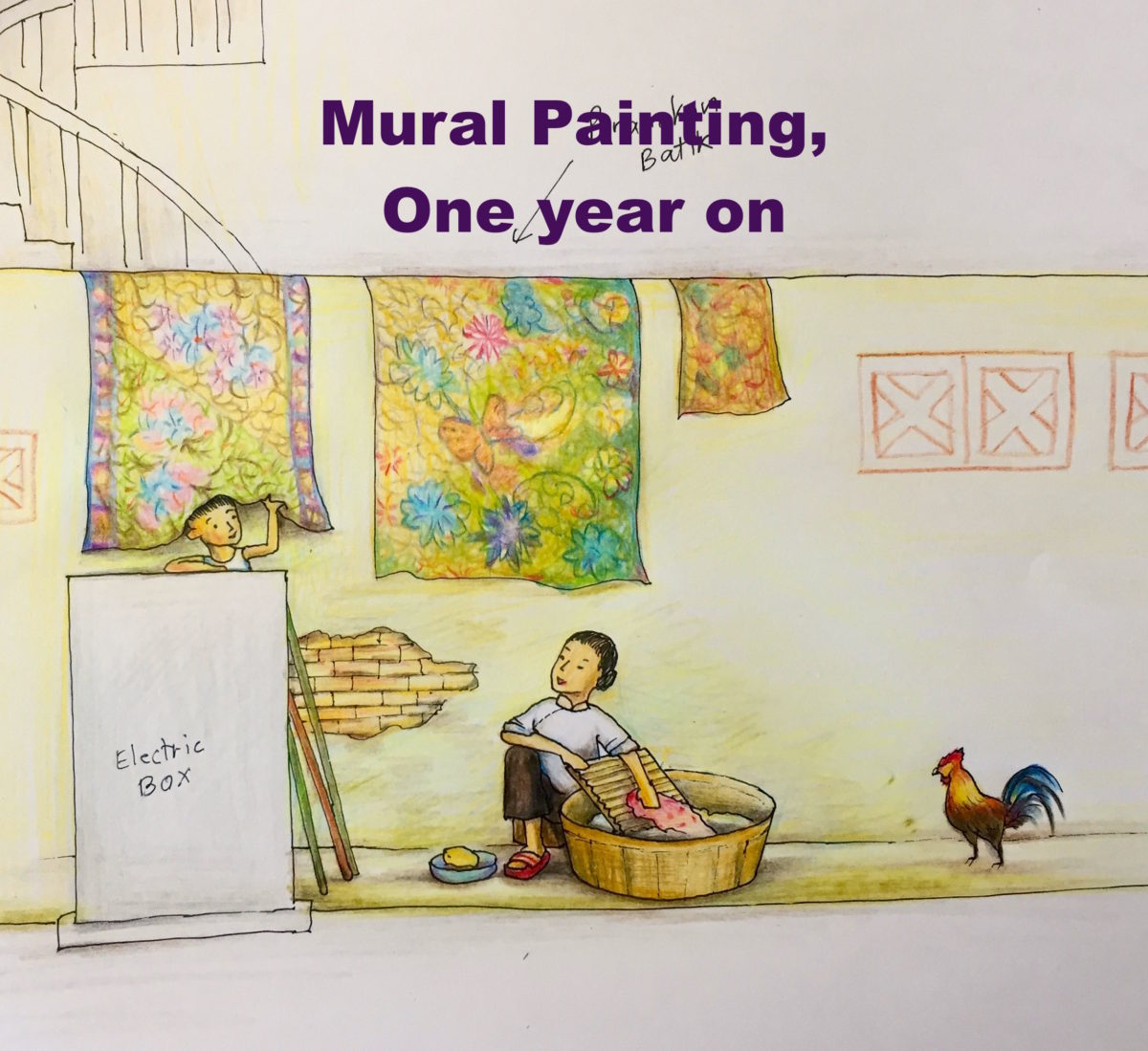
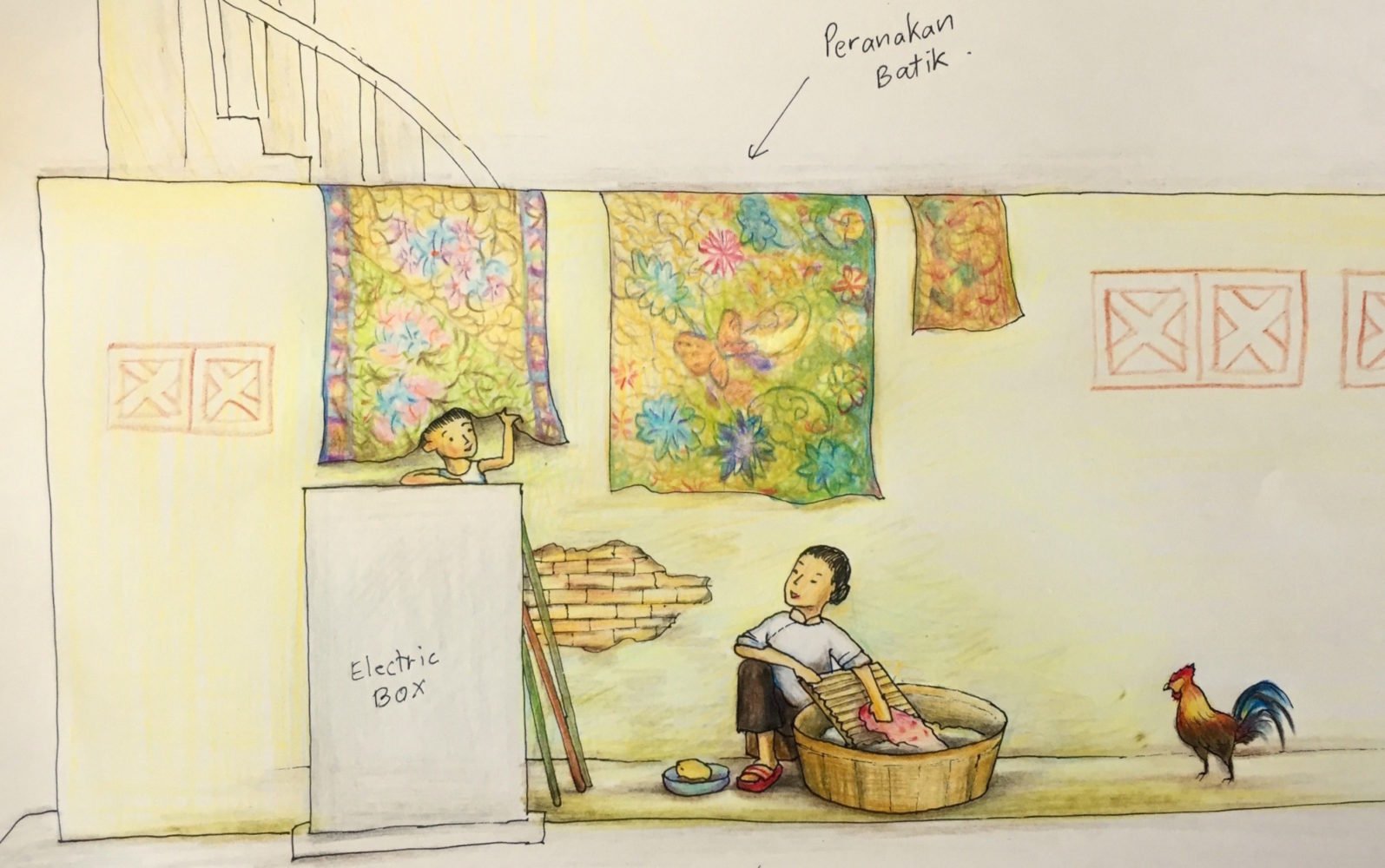
When I met him at the site, he asked men to show him my portfolio which I had none. But I convinced him with the “Barber” sketch and said that I would whitewash the wall if he didn’t like it. He asked me if I could paint something related to Peranakan because he is, Overnight, I researched and drew a sketch of “Amah” doing laundries of Peranakan dresses in a Peranakan kitchen. He liked it and asked me to paint both “Amah” and “Barber”! We submitted the sketches to URA for approval and received the “no-objection” notice after two weeks. I couldn’t wait to start painting.
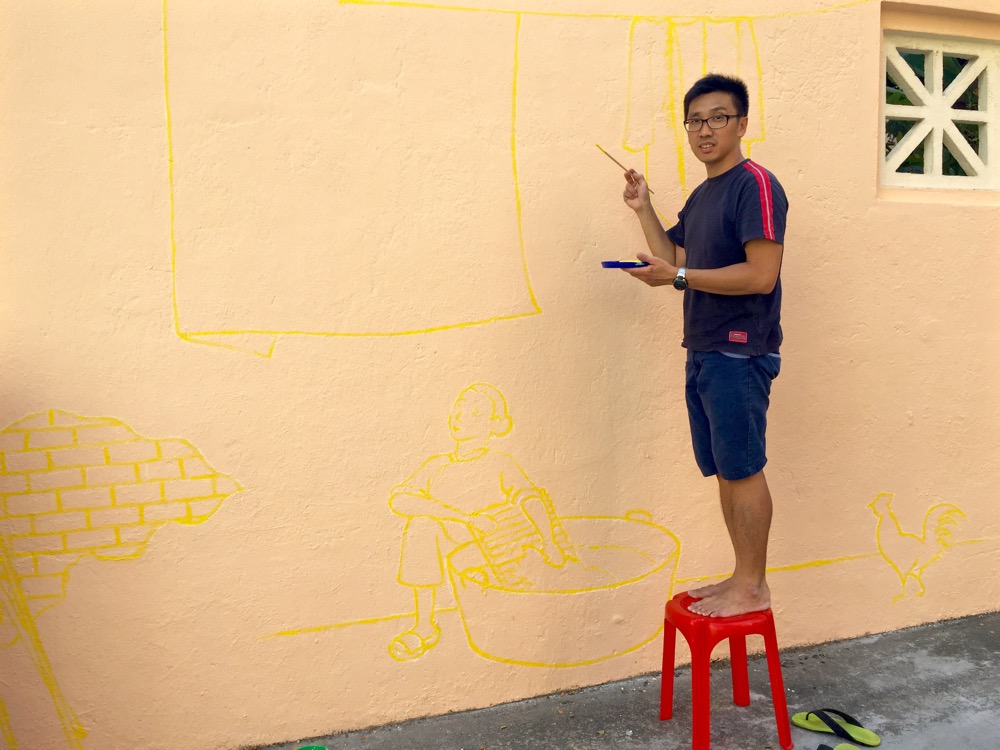
I spent about a week each painting the two murals. During the painting, many passers-by stopped to watch and took pictures. Words spread quickly in social media. The murals were popular! Thereon, many people came to view the murals, which further attracted the attention from newspapers, magazines and TV. The outcome was totally unexpected. Thereon, I received many requests to paint murals from other property owners and business owners in other parts of Singapore.
On my last day at the site, while adding the finishing touches and signing off, a family came by and we chatted. Little did I know the man of the family is a blogger, an outstanding blogger! until we subsequently befriended on Facebook and I got to read his very touching blog of his visit to my street arts : Life’s Tiny Miracles
The first stroke – “Amah” at Everton Road (Aug 2015) opened up to a whole new world of experiences
The first stroke of paint
A year ago, I made my first stroke of paint on a perimeter wall of an old house at Everton Road. It was a blessed stroke which opened up a whole new world of experiences and a full year of happiness.
It actually started over two years ago when I chanced upon a little mural painted by Ernest Zacharevic at Victoria Street. It inspired me to try mural painting. I even toyed the idea with a long time friend, Yuen Kum Cheong, but we were so busy with our full time jobs that nothing got started, until I quit my job in June 2015. (Subsequently, in April 2016, Kum Cheong and I painted 6 Heritage Murals at 51 Waterloo Street)
I vowed to try different things during the break because I am getting old! Mural painting was just one of them, amongst film-making, travelling, starting a blog, meditation etc.
With time and passion, I picked up the courage to make a cold call to the property agent who had advertised to rent out that Everton unit. It paid off! Without a portfolio, I was lucky to have managed to persuade the house owner (Professor Victor Choa) to let me paint on his house walls. I promised to whitewash it if he was not happy with the outcome. Subsequently, I learnt that Prof Choa was the great grandson of Mr Choa Kim Keat, after whom Kim Keat Road of Balestier area was named.
After the first two murals at Everton Road got a little exposure on social media and mainstream media, I received many congratulatory notes, requests and enquiries. The first commissioned work of my life was the “Kampung” mural at Tanah Merah, on a wall of a private bungalow owned by Mr Tan Dibjin. When I first met him to survey the wall, I wasn’t even aware he is an artist himself, a fervent art supporter and philanthropist, and also the grandson of philanthropist Mr Tan Kah Kee, after whom Tan Kah Kee MRT Station was named.
Working on weekdays, painting on weekends and squeezing in time for family
I painted two more murals – “Provision Shop” at Everton Road, and “Coffee Story” at A.R.C. Café at Kampong Glam area – while continuing to attend job interviews, ready to return to the corporate world. In late December 2015, I signed the employment letter to work for a UK based company to lead a finance shared-services department, at the roadside while painting “Coffee Story”! During the job interview, my manager told me that he had checked out my blog website and appreciated what I was doing. That assured me of the work life balance support I would receive from the company.
Indeed, I felt appreciated and recognised for the work I was passionately doing. I was motivated to continue to do more, improve on quality and aim for the next level. I was determined to continue to paint, build up my portfolio and evolve my style even after I returned to the corporate world. I knew it would be very hard work since I only had weekends to paint. Projects would also be prolonged. With that in mind, I cautiously accepted some assignments for the year ahead. The 51 Waterloo Street project was rather complex, so I invited my friend Kum Cheong to join me. Another friend, Trisha Sng, also volunteered to help me which sped up the painting. I was glad she told me she enjoyed the experience. Even with help and collaborations, at times, I felt a little tired due to the heat, humidity and long hours of standing and squatting. However, I totally enjoyed the process of transforming a blank wall into one which breathes life and connects with people. Knowing I was missing my family during weekends, I made an effort to dine with them after the paintings whenever I felt the project was not too rushed. During the June school holidays, I took some weekend offs to go hiking in Malaysia with my daughter.
Appreciation by the public opened up a whole new world
The journey was filled with interesting encounters, some of which I had never expected. I was particularly impressed by how the public came up with all sorts of unimaginably innovative poses at the murals when I saw them on Instagram and Facebook. Some of them even dressed up and brought props to pose with the murals! I was even more impressed when a blogger wrote that she cried upon seeing the mural “Home” in Tiong Bahru. I also got opportunities to meet and befriend many interesting people and organisations. They helped open up my view of the world and give me balanced insights on the arts and heritage scene in Singapore – its politics, values, history, business, family and people. I take this opportunity to thank everyone for your appreciation of my works.
I had the honourable opportunities to know a few great people who had done meaningful work for Singapore and I learnt much from them. We even exchanged ideas on how to make Singapore a better place. I had been approached by businesses who wanted to make merchandise from print of the murals, or sponsor me materials and other peripherals. Media and educational organisations approached me for content and social study research interviews. Non-profit organisations, charities and government-related agencies have also approached me to collaborate on charitable, educational or ambassadorial projects or events. One of the most meaningful and touching event I have ever participated in was to guide a “YC’s mural walkabout” for a group of families with their special needs children. It was heartwarming to see the courage and relentless care of the parents and caregivers, and the joy that radiated from their special kids.
Perception of “Art is free of charge” and bureaucracies
I wish I had time to do all of the above things but I have to be very cautious of over-commitment at the expense of my family time and personal health. I also need space for my other work and passions. Whenever I received a request or self-initiate to paint murals, I always tell the property owner, regardless of people or organisations, private or public, that I charge a fee. Although I am not making a living out of art, I hold a responsibility to the Singapore creative scene, especially to all my fellow artists, to uphold the value of art and craft in Singapore. Art has often been taken for granted with an incorrect perception by the public and even government agencies that by giving artist a canvas or a space, they are already giving them opportunities and exposure. Intrinsic value aside, the fact is that artists need to make a living too. I made sure not to become an unsustainable charity! However, I also expressed that I am willing to consider working pro bono only for genuine charities involving supervision of residents or volunteers carrying out their Corporate Social Responsibility (CSR) works. In a way, I contribute to the community by sharing my experience with the younger generations.
As glamorous as it looks, only a small fraction of the explorations to collaborate will normally materialise into real work. Sometimes, I spend late nights drawing up proposals for projects that did not work out. For one exploration, I was almost taken advantage of by a large corporation who first requested for me to provide sketch proposals and quotations, and then they thought that my fee was higher than if they bring in overseas painters to copy my proposed sketches on their walls. It was a good lesson learnt.
Regardless of the probability of materialising a project, by meeting and socialising with people from all walks of life, I learnt many important legal, financial and social aspects of the creative world. In general, I learnt that appreciation of such street art has risen in Singapore. However, few people know how to or even want to pay for them, unlike in Western countries. Majority of government-related agencies and grassroots are good at initiating structured, top-down programmes without truly appreciating the intrinsic values of the creatives. It is quite obvious that some of them have other community service agendas and initiate these “art” programmes only as means to the ends. Due to their top-down mindset and approaches, they were also often at a loss with regard to ground-up initiatives. On three occassions, I noted various government-related agencies pointing to one another and not knowing how to get together to review and support propagation of ground-up initiatives.
Not giving up on Chinatown and dreaming bigger
Back to myself, I’ve already expressed openly that I have two dreams to achieve before I want to slow down on painting street art and move on to try other media. I wish to create a heritage mural series in Chinatown, and one or two murals related to South Asian countries in Little India to let our foreign workers feel at home. I dream to paint in Chinatown because I was born and lived there for my first 26 years. I have strong emotional attachments to Chinatown, however the Chinatown in my heart no longer exists. Walking down its streets today, I no longer feel any strong emotional attachment to either the people or the streetscape which had changed so much. Sago Lane, the street where I grew up in, is now a carpark! The familiar sights, smells and atmosphere had all disappeared. I wish to bring back some of the everyday ubiquitous and memorable scenes. An initial toying of an idea to the Singapore Tourism Board, the Town Council and its Advisor returned a decline with a somewhat good reason concerning site technical limitation. It was the clinical response that was disappointing, but I have not given up. I will try other routes to achieve an even bigger dream. As for Little India, I’ll just keep it as a dream until the Chinatown dream is fulfilled.
Learning to be a better artist
And finally back to the painting. I’ve learnt to paint more efficiently and with bolder brushstrokes. I think I am improving on the layerings, colours and the figures. I knew my weakness was the over tidiness and my figures looked like the Har Paw Villa statutes. I’ve also started to use more brilliant acrylic paints over the emulsion paints. I may go back to some of my earlier murals to touch them up with brilliant acrylic paints. However, what has not evolved is my style of theme and composition. I’m not in a hurry to change that but if you follow my paintings, I hope you will notice and appreciate the changes over time. I’m still learning how to be a better artist through trial and error and lots of practice. When I have more time, I will properly study Art. I will improve in my art, in being an artist and in my thinking. If I continue to work hard and work smart, one day, I will be a great artist!
“Barber” at Everton Road (Sept 2015) was the first concept proposed to the house owner Professor Victor Choa.
“Barber” sketch concept proposed to Prof Victor Choa in June 2015.
However, Prof Victor Choa counter-proposed a Peranakan theme mural concept. Over night, I came up with this sketch. Ultimately, he asked me to submit both concepts to the URA for approval.
“Kampung” at Tanah Merah (Nov 2015) was the first commissioned art work of my life.
“Provision shop” at Everton Road (Dec 2015) was the toughest painting thus far due extremely hot sun in the morning and thunderstorms in the afternoons
“Coffee Story” at A.R.C. Cafe (Dec 2015). I signed my new job’s employment contract by this roadside.
Tiong Bahru’s “Bird Singing Corner” – scouting for locations
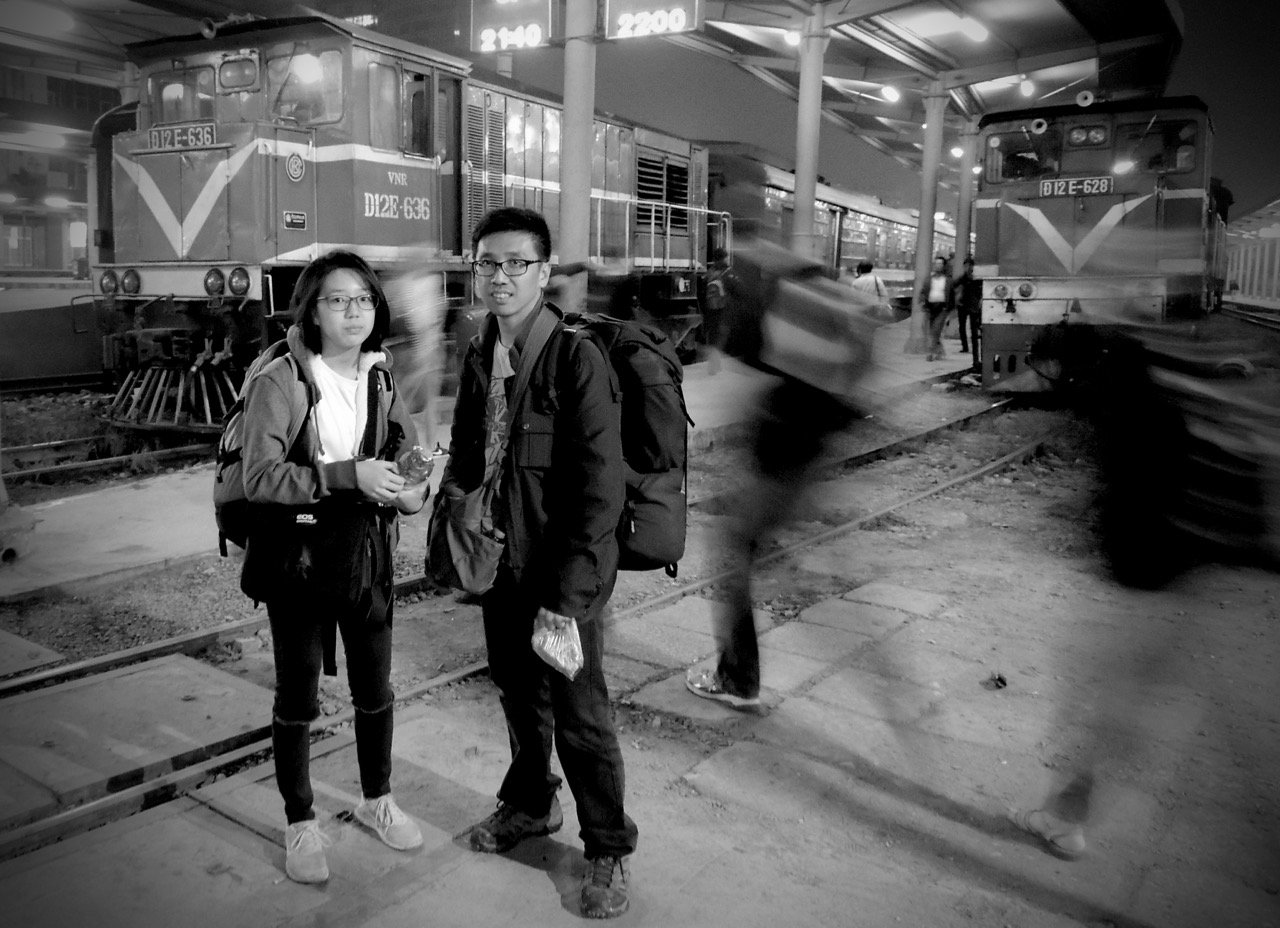
Earlier on, I posted several photos on Facebook and Instagram of our Father-Daughter backpacking trip from Hanoi overland to Shanghai. I only posted photos because no thousand words or poem could describe how beautiful the places are. Click here for Photo Album of Pop&Dob’s Hanoi to Shanghai For this blog post, I’ll focus on writing about the people we met on the journey, my reflection of what we learnt about the world through interacting with them; and lastly, expressing my feelings about this journey.
1. Hanoi – The couple
On the overnight train from Hanoi to Lào Cai (the Vietnamese border town with China), we shared a bunk compartment with a Swedish couple who was travelling across South East Asia. Before lights-off, we did the usual backpackers’ exchange of travel tales and suppers. My daughter and I sat on one side of the lower deck while the couple sat on the opposite side facing us. Strangely, as we were chitchatting, they started to hug each other and smooch away in their own world! We laughed away, but only silently to ourselves!
Travelling is often an education and appreciation of different cultures of our diverse world. At times, there was awkwardness and discomfort, but we learn to tolerate the differences and embrace diversity.
2. Yuanyang 元阳 – The backpackers
At 6am the next morning, we arrived at the Lào Cai train station (still in Vietnam). We saw a tall bushy-faced Japanese man talking rather loudly to some locals who were touting travellers to take their cars to the Vietnam-China border post. Though tall and mighty, he looked sincere and honest, even a little funny, enough for me to believe we could safely share a car ride with him to the border post. He spoke fluent English too, which is quite rare for Japanese, so I approached him to make the suggestion. Coincidentally, we were all heading towards the same next destination in China – the Yuanyang rice terraces, which were some 160km from the border. So for the next few days, we had a travel companion, and he turned out to be a god-sent funny one who truly spiced up our journey!
This Japanese guy (a doctor) had been travelling across the world with a backpack for four years. Greater China was to be his final destination before his return to Japan. He was impressively street-smart, probably due to his years spent on the road. Just observing him deal with people was quite funny, like watching a comedy show. A Vietnamese money-changer tried to cheat him by giving him 5-cent Yuan notes instead of 5-dollar Yuan notes but he outwitted the money-changer with his “calculator” mind and “gimme my money” meme. His big size and bushy Japanese face also attracted a lot of attention. On the streets, he could tease the kids till they ran wild giggling and hiding, while Chinese border guards and Tourist cops would stop and interrogate him. My daughter was especially appalled but amused by one of his comments about the many hens and chicks roaming around and clucking noisily in the guesthouse’s kitchen: “the chicks watching the mother being killed”! It was wicked but very true. All in all, his presence opened up our hearts to laugh at the beautiful people of this beautiful world. Just look at his face in this group picture!
Chatting over meals on a more sentimental level, we learnt that he was surprised to see an Asian father and daughter on a backpacking trip, behaving like friends. (In fact he thought we were brother and sister when he first saw us at the train station!) He explained that in traditional Japanese culture, the father is usually stern with few words, and the family hierarchical. Messages from a father to a daughter may even be relayed through a mother. Hmm!
Since we didn’t do any prior research for a guesthouse to stay at, we followed him and stayed at the backpacker’s guesthouse he had booked. It turned out to be a great choice. Besides being in an un-touristy local village in the middle of the spectacular rice terraces, the guesthouse offered opportunities to meet many other interesting backpackers from other parts of the world. We met Europeans who remarked that they felt Singapore looked “fake’, like a Disneyland. We also formed a group with the Japanese guy and another young chap from Macau to rent a van for two days to tour the rice terraces and villages. This combination of travel companions made travel so much more exhilarating. The Japanese guy spoke excellent English while the Macau chap who spoke only native Cantonese and Chinese, did not understand English. So I ended up being the translator for all their conversations. At times, I even mixed them up – for example, when taking a photo, I urged the Macau chap to shift his position a little but he just stood still, until my daughter prompted me that I had used the wrong language! Travelling truly transcends languages. It’s actually more fun to explore places which we don’t understand their languages.
3. Xijiang Miao village 西江千户苗寨 – The taxi riders
From Kaili train station to Xijiang Miao village, we shared a taxi ride with a middle aged couple from Shanghai. The man sat in the front seat next to the driver while his wife squeezed with us at the backseat. Phew!, for the man was a blaring loudhailer! For over an hour, he blared out nonstop about his life, his country, the world and China’s entire history. He was also quite boastful – he boasted about his rubbing of shoulders with senior officials from the Chinese Communist Party, but he also declared he didn’t like them at all. He even said Singapore was “killed” by China’s bureaucrats and China’s rising competitiveness, and that “Singapore is “doomed” (“新加坡被中国整死了, 他们死定了”), citing the Suzhou industrial park project and Singapore losing competitiveness to Chinese ports as examples. It was only when the taxi-driver told him we were from Singapore that he switched his topic to condemning other cities in China. But for Shanghai in which he lived, he praised it unreservedly, describing how cultured and family-oriented the Shanghainese are.
When we got off the taxi, my daughter heaved a sigh of relief as she unplugged her earphones. But she said that the man’s voice was so loud that it drowned her music! Irritating as he was, he was entertaining, and I could tell his renditions were unreserved and true from the bottom of his heart. I actually felt he was a good reflection of and insight to China’s middle class of today.
4. Langde village 郎德 – The villagers
Contrary to many horror stories in the news of uncaring and rude people who wouldn’t even help a child who was run over by vehicles, we found the Chinese people generally gentle, friendly and helpful – at least in the rural villages and even cities like Kunming, Shanghai and Kaili. It was very different from when I visited China for the first time more than 20 years ago, when I remembered people as being rough, vulgar and rude. Back then, we were often scolded with vulgarities over small matters.
We encountered first hand the warmth of the Chinese people in the tiny mountain village of Langde. At 5.10pm, we were probably the only tourists in the village as we scurried down the cobbled streets to catch the 5.30pm last bus to Kaili city. Along the street, villagers prompted us to hurry or else we would miss the bus. When we reached the bus park at 5.25pm, some people told us we had already missed the last bus of the day and advised us to walk 3km uphill along a narrow mountainous road to catch another bus on the highway. I ran around the bus park hoping to hitch a ride from a vehicle which might be leaving for the direction of the highway. Unfortunately, they were all going the opposite direction. Just as we were feeling slightly desperate, a bus suddenly stopped in front of us. The driver said he would make a detour to take us to the highway junction although it was travelling on the opposite direction. We gladly jumped on! On board, my daughter told me that while I was running around looking for a vehicle, she overheard an young man persuade the bus driver to do a special detour for us. It was so heartwarming!
Travelling opens up our hearts against prejudices and stereotypical perceptions.
5. Zhangjiajie 张家界 – The tour guide
We hired a dedicated day guide for our Zhangjiajie tour so as to better appreciate the many lively legends behind the rocks. Without someone to explain the legends, all the rocks would have just been meaningless rocks.
The guide was a lady from the “Tu” village. But she was as modern as us and spoke common Chinese like singing poems. She has a loud voice, so loud that her voice resonated through the valley and vibrated the rocks!
On a few occassions, she stepped aside to answer calls on her mobile phone. Because she spoke so loudly, I could hear from far she was arguing with someone over a matter concerning her kid. At one opportunity, I asked her if everything was alright. She explained that she has a 17 year-old son who didn’t show up in school for the mandatory Sunday remedial class, and the school teacher had summoned her to the school to discuss the matter. She argued with the teacher over the purpose of her going to the school since it was her son who had refused to attend the class.
Her only son had become increasingly rebellious, having played truant or refused to attend remedial classes several times. She lamented that the education system is intensely competitive so she had put her son in a private school, spending a large chunk of the family’s money. She felt uncertain and pessimistic about the future. Reminiscing the days when her son was so adorable and dearly loved by the family who had provided him with everything, she could not understand how he had become so rebellious. She added that whenever she asked him questions, he would give impatient one word answers.
As I listened, I thought everything she said sounded so familiar. I’ve personally experienced this phase to some extent and even heard of very similar experiences from friends and colleagues who have adolescent kids. Incidentally, these friends and colleagues were from different parts of the world. The world is as similar as they are different!
6. Huangshan 黄山 – The passenger
The train ride from Huaihua city to the legendary Yellow Mountain (Huangshan) was the longest train ride in the whole journey – 18 hours. To ensure better comfort, we bought “soft sleeper” tickets. In China trains, there are ‘hard seats’, ‘hard sleeper’ (6 beds in an opened compartment) and ‘soft sleeper’ (4 beds in a closed compartment). When we got into the compartment, we saw this plump, middle-aged lady leaning on her lower-deck bed surrounded by several large canvas bags and a large suitcase. By looking at her hairdo and dress, we could tell she was from a traditional village.
We didn’t talk much in the first few hours as she was busy watching dramas on her handphone. She had turned on the volume so loudly that it was hard for us not to follow the drama as well. After dinner (we all ate cup noodles), we began to chitchat. We learnt that she was travelling from Guiyang all the way to Nanjing, a 31-hour train journey. When asked why she did not choose to fly as it was faster and cheaper, she explained that she would not be able to hand-carry all her luggages onto the plane.
She was visiting her daughter and husband who lived in Nanjing. After her daughter had graduated from Nanjing University, she decided to work and live there, so her husband relocated there in order to cook for their daughter. However, she loved the village life and refused to move to Nanjing, hence she continued to live alone in her village house outside Guiyang. She sounded a bit disappointed and couldn’t understand why today’s youngsters would forsake the village lifestyle for the hectic life in highly polluted cities.
She proudly showed us photographs of her two-storey village house on her handphone. The concrete house was still surrounded by vegetable plots but I could see the “village” was slowly being encroached by development, with newer and taller concrete blocks being built adjacent to her plot. She lamented that her neighbours had turned their vegetable plots into public carparks to earn parking fees. Besides growing vegetables, she reared chickens on her house’s rooftop (so as to be away from the neighbours’ carparks). When I asked her who would be feeding the chickens in her absence, she smiled with a rather sinister wink: “I killed them all!” while pointing at her canvas bags!
When we alighted from the train, my daughter told me she was actually very frightened by the “murderous glint” in the woman’s eyes and had imagined her as a pyschopath who had just killed people and stuffed them into those huge bags! I thought that was funnily imaginative!
7. Shanghai 上海 – Pop and Dob
It was 8am on a cold morning. The train was scheduled to rumble into Shanghai Station at 8.25am. I stood at the train corridor outside our compartment while my daughter was still inside packing her bag to get ready for arrival. I stared through the window. The sun had just risen. Its rays pierced through the trees, electric poles and buildings as they raced backwards. The scene looked like a nostalgic flickering movie. The scene flickered my mind too. A sudden emotion welled up within me, choking my throat and watered my eyes. The journey was almost ending, a dream almost fulfilled.
We had thoroughly enjoyed this little backpacking trip. I say “little” because it was short, just over two weeks. It was shortened from a much more ambitious plan made in mid 2015 when I first quit my job and suggested that we go backpacking together after her O level exams. We had originally planned to travel from Singapore overland all the way to Beijing but due to various other commitments, we decided to shorten it. Although it was a “little” trip, our hearts and minds travelled far, deep and time-infinite – it was the greatest trip in our hearts. For me, it was an attempt to catch up with my kid, to know her better, to make up for lost time when the kids were younger but I was too busy with work. I say “attempt” because I don’t know if I had caught up. The kids have grown up and I felt the bonds I had once hoped for could no longer be achieved.
For my daughter, I hope she will remember this Pop & Dob journey for the rest of her life – our chasing the sunrises and sunsets, our hopping from one street food stall to another, our enduring the smoky and rickety bus rides, our suspicious hotpot dinner (we just prayed there was no dog meat in there!), climbing up and down the endless mountain steps, the “irritating” selfies, and many many more precious memories. One day, I hope these memories will inspire her to fulfill her own dreams.
Beginning of the Journey (at Hanoi Train Station)
Chasing sunset (at Yuanyang)
I stared through the window. The sun had just risen. Its rays pierced through the trees, electric poles and buildings as they raced backwards. The scene looked like a nostalgic flickering movie. The scene flickered my mind too. A sudden emotion welled up within me, choking my throat and watered my eyes. The journey was almost ending, a dream almost fulfilled.
A two-decade old travel sketch book uncovered un-dusted, its artwork re-appreciated, and memories cherished…
Tibet has always been my dream destination since young. I copied the palace straight out of a brochure I found in a travel fair in 1992. However, having the large empty square built by the Chinese government right in front of it would look boring. I imagined it would look majestic with an old city looking up to it. Strangely no yellow spots appeared on this 20 year old drawing.
I thought this sketch was too good to give away (actually took quite a bit of time to draw the details), hence I had kept it for myself. Unfortunately, yellow spots had stained the drawing. At the time of drawing this in 1992, I wasn’t aware which country had such beautiful architecture. I only saw some pictures of them and knew vaguely they existed somewhere in the Himalayas. This was drawn from imagination. Later, I learnt that the country was Bhutan (quite unheard of at that time).
This is a photocopy of a 1992 sketch. The original was given to a colleague in an Audit firm which I was attached to during internship. I liked the symphony of buildings that form the Registan Square in Samarkand, Uzbekistan. Inspired by the scene in the novel “Book and Sword”, I drowned the whole city with sand, except of course for the square!
This was another sketch which the original was given to a colleague in the Audit firm when I was an intern in 1992. You can tell that it was simple and would not have taken too much time to draw (that’s why I didn’t have a second thought of giving it away:-)! Looking at it now, I think the nomads looked oversized and the horses too small! The way the Gers (Mongolian tents) were tied to the ground was also not accurately drawn.
My first adventure was in Nepal in 1990. As with all first timers, the adventure was most unforgetable. Images of the places got etched in my mind. Here, I imagined the Kathmandu valley being shrouded in a thin veil of morning mist, exposing only the top of the monkey temple hill, with the medieval city in the foreground.
In 1990, Lawrence and I went for our first trekking adventure at the Annapurna santuary in Nepal. This 1992 drawing depicted us resting on a huge block of ice, admiring the Hiunchuli waterfall slotting its gush into the narrow gap between the ice block and the rockwall. On the return leg of the trek, we saw a beautiful rainbow. — with Lawrence Teh and Shiva Joshi.
The original sketch was given to a colleague in the Audit firm when I was an intern in 1992. This drawing looked grossly out of proportion. This was supposed to be somewhere in Ladakh in India.
This is a romanticised depiction of Thyangboche, a mountain village about 3 to 4 walking days from the Everest Base Camp. It probably looked more like this when Edmund Hillary walked through this village on his way to climb Everest in 1953.
The original sketch was given to a colleague in the Audit firm when I was an intern in 1992. This obviously looked out of proportion. In 2000, my wife and I took a ferry cruise down the Irrawady river and saw this view. There was no floating village at the base of the hill! Moreover, the place was wrongly signed off as Bagan, it should be Mandalay.
These designs of Changi Airport icons and Tiong Bahru sketches have been made into Coasters and Tote Bags. They are available for purchase at the Changi Jewel L4 “Gifts by Changi Airport” Giftshop.
Thank you ‘Living Sanctuary Brethren Church’ for creating this meaningful Year 2017 Calendars, which will be distributed as part of the 2016 Christmas goodie bags to the needy households and various communities living in the North East of Singapore. I feel really happy and appreciated to see the church’s members dressed up and posed with props in front of the murals, creating such charming scenes of Singapore’s past. Their “pop ups” have made the paintings come alive. The most inspiring part is their effort to bring joy and service to the community! (The following photos are taken from the calendar and de-colourised to give them a more nostalgic feel. The binder rings actually add to the charm of this album:-)
Had a day of fun joining a group of NTU students to redecorate the facade of the Henderson-Dawson Interfaith Goodwill Store. It’s actually is recycled metal container put to good use as a charity food distribution centre for collecting and distributing donated food stuffs to low income families living in the Henderson Road area. It’s at the the carpark facing Block 93 Henderson Road. The store was set up by a group of NTU student volunteers in 2015.
When we were little kids, my siblings and I always looked forward to the Mid-Autumn Festival. On that night, we could carry lanterns and play with our neighbours in the labyrinth of dark dingy back-alleys of Chinatown. In groups, our candle lit lanterns would float about in the darkness like giant fireflies. The boys usually carried lanterns with Ultraman, Batman, Superman and aeroplane designs, while the girls carried lanterns of rabbits, birds, fish and flowers. They were made the traditional way, using bended wires wrapped in colourful cellophane papers. Carrying our lanterns, we played games such as attempting to put out one another’s candle flames, making ghostly faces with the flames shining from our jaws, and even catching cockroaches from the drains!
Fast forward to the early 2000, it was our kids’ turn to carry lanterns. However, the lanterns they carried were no longer made the traditional way. Instead they carried mostly transparent “rubber floats” or translucent plastic toys lit by battery operated bulbs which also twinkle and emit kiddy music. Cartoon characters dominated the designs, such as Doraemon, Hello Kitty, Winnie the Pooh, Powerpuff girls and dinosaurs etc. Instead of the dingy alleys, our kids played in the void deck, playground, garden or the estate amphitheatre – safe, clean and bright.
Since young, I had made quite a number of lanterns. One of the earliest lantern I made was when I was in primary four in 1979. It was a huge red ball-like lantern made using wire and cellophane and painted with the words “Happy Teachers’ Day” on it. Teachers’ Day and the Mid-Autumn Festival both coincidentally fell on September of that year. The lantern was proudly hung on the ceiling of the classroom to celebrate both occasions.
There were various other smaller lanterns I made but I could only vaguely remember them as there were no photographs taken to memorialise them. For those fortunate few captured in photographs, I dug out their photos in a hike of nostalgia and festive mood and created this blog post as a memento. Take a walk down memory lane with YC, the “Lantern Maker”.
1983 – Together with a secondary school classmate KC, we made this lantern to take part in a lantern-making competition. In its time, it was probably the biggest lantern we were making. Looking back, instead of a lantern, it actually looked more like a big wedding cake topped with Singapore themed dancing puppets, models of iconic buildings and adorned with lots of flowers at its base. An uncle of mine helped to install light bulbs on it. He even helped us ferry it to the Kallang Stadium on the back of an open-truck. During the journey, the tail winds were so strong that the fragile “toppings” were almost blown away. When we reached the competition ground, besides it being in a mess, we also realised how small our lantern was compared to the other entries. Overall, it was a really humbling experience.
1988 – While serving my National Service as a cadet, one of my instructor and I jointly made a dragon lantern for our graduation “Dining-in”. We were in “Delta” Company, which was represented by “Dragon”. He made the dragon’s skeleton using wire while I put on its skin using paper. I’m very glad I managed to get a photo of it, because it was sheer hard work for me (I’m on the extreme left of the photo, next to the dragon’s tail). As a cadet, there was already very little rest time in between trainings, yet I managed to carve it out further to make the dragon, either during weekends or when everyone else was asleep.
1992 – Made this phoenix for an inter-block lantern-making competition during my boarding days at the university campus, almost single-handedly, again at night when everyone else was either dating, sleeping or mugging.
2003 – These two traditional cellophane lanterns were made for my kids when they were in nursery. They were literally “Made-to-order” because they got to choose the designs! On the night of Mid-Autumn Festival 2003, my extended family picnicked on the Padang field in front of the City Hall. While the elders enjoyed mooncakes, pomelos and tea, the kids were supposed to run around the field with their lanterns. However, the lanterns proved too big and heavy for their frame, so we ended up carrying the lanterns ourselves and walking the kids!
2010 – By this time, the kids had outgrown playing with lanterns, but that wasn’t true for making lanterns. Let’s watch how we made traditional wire and cellophane paper lanterns . . . step by step . . .
2010 – Home-made Spongebob Squarepants and Alfred the Starfish blended so well with other traditional lanterns bought from the market. We loved our home festive decoration.
2015 – We just had a mini reunion dinner at my mother’s house to celebrate the Mid-Autumn Festival. After the dinner, we had the usual mooncakes, pomelos, yams and drinks, but we didn’t have any lanterns since the “kids” have all grown up. Notwithstanding, I created an instant “lantern” from pomelo skin, which surprised even the grown up kids. When it was lit, everyone whipped out their handphones and began snapping photos.
As a little boy, I used to follow my second aunt to watch Cantonese operas (粵劇, more commonly called 大戏 , literally means “big wayang show”). She was a fan, she still is.
Growing up in Chinatown in the 70s and 80s, I had abundant opportunities to watch Cantonese operas. They were staged on the streets, almost all year round, by the many Cantonese clans and associations around Chinatown. During the seventh to tenth lunar month of the year, they were especially visible due to the various festival celebrations, such as the Hungry Ghosts festival (中元节), Seventh Maiden festival (乞巧节), Mid-Autumn festival (中秋节) and the Nine Emperor Gods festival (九皇爺诞). Beyond the streets, we also followed opera troupes from Hong Kong and China whenever they staged shows at the Chinatown Kreta Ayer People’s Theatre (牛车水人民剧场), Yeung Ching School at Ann Siang Hill (养正学校) and the National Theatre at Fort Canning (国家剧场). We had to buy tickets for these shows. I remember the halls were all open-aired so people could stand outside the halls to watch for free. Some organisers ended up putting black curtains all around to dissuade outside people from crowding around the halls. By the mid-80s, Yeung Ching School and National Theatre were demolished. Only Kreta Ayer People’s Theatre survived to this day as a refurbished and air-conditioned venue for Chinese opera, patronised mostly by the elderly.
I remember I had a secondary school friend EK, who also liked to watch Chinese operas. We even talked about the operas in school. Our other schoolmates must have found us weird! As late as the 1990s, my then girlfriend (now my wife) and I attended two paid Cantonese operas together with this friend EK. One show was held at the Conference Hall at Shenton Way and another at the Victoria Theatre. I still remember the shows were the ‘Magic Lantern’ (宝莲灯) and ‘The Carp’ (鲤鱼) respectively. Thinking back, they were such weird dates with a girlfriend!
Today, I still like Cantonese operas, however I don’t follow them fervently anymore, and probably only watch one show every 2 to 3 years with my mother and/or with my aunt. Honestly, I still don’t catch the lyrics of the songs and continue to rely on the Chinese and English subtitles usually beamed on the sides of the stage.
Backdrops, Props, Lighting and Fighting inspired me
Back to the old days. While my aunt was captivated by the songs, dance-like movements, stories and characters, I was more intrigued by the backdrop, props, lighting and the fighting scenes. I loved the 3D effect of the backdrop and props. I loved the play of lights, curtains and quick changes in scenes. I was especially impressed by the ‘blink-of-an-eye’ morphing of one scene to another as the light dimmed or when the curtain dropped. While the music continued to play, an ornately decorated palace would morph into a misty mountain top. I also liked operas with lots of acrobatic fighting with spears and swords. I remember a scene in which an artiste jumped over a huge burning cauldron. The scene looked so real and awesome. Actually, the cauldron was just a flat piece of plywood cut into the shape of a cauldron and painted in 3-D effect. A flapping piece of red cloth shone under a yellow light simulated the flames. Dry ice added to the boiling effect. As to the artiste who jumped over the huge cauldron . . . he must be real?!
As I wrote the above paragraph, it dawned upon me that it was probably these scenes which inspired my style of art – realism and 3D effect. My street arts at Everton Road now seemed a reflection of me, captivated by the hand-painted backdrops and props of those bygone days.
Wouldn’t the above drawing of the Cantonese Opera stage make an interesting street art too?
The Singapore National Theatre was completed and opened in 1963, built with funds jointly donated by the Singapore government and the public through “a-dollar-a-brick” campaign with song requests made on radio. Unfortunately, this beautiful icon was demolished in 1986 after it was found to be structurally unsafe due to defects discovered in its cantilever roof, as well as it was too close to the proposed Central Expressway Underground Tunnel. Its lack of air-conditioning also made it under-utilised. I had watched many performances in the theatre, particularly Cantonese operas. Hence its loss was heart wrenching to me.
In 1993, my then girlfriend (now my wife), 3 other friends and I, embarked on one of the most memorable road trips of our lifetimes. Feeling nostalgic, we dug up our photo album, now covered with dust, spotted with yellow and looking like a dinosaur. Though the photos had faded, they rekindled vivid memories of the sights, sounds and smell of the trip. We had flashbacks of some truly unforgettable encounters: a horrific night when we tried sleeping at the Guangzhou train station to save hotel costs, the heart-warming friendships we forged in Xi’an, the numbing cold of Kokonor, the pelting sandstorms during the 36 hours butt-breaking chicken bus ride across the Taklimakan, the angry melon vendor who wielded his knife when we did not buy his melons, the dirty and doorless toilets, communal bathings, mouthwatering kebabs, breathtaking sceneries of the Karakoram mountains, and many more. The images evoked a sense of time travel even at that time. Fast forwarding to 2018, we wonder how those mesmerizing places and their people have changed due to recent political situations in those areas.
I remember our research prior to the trip involved hours at the Stamford Road National Library and MPH bookstores. We made photocopies of Lonely Planet maps and hostel addresses. We heard about a mystical Labrang monastery said to be more Tibetan than Tibet, but we could only find limited literature and no pictures of it as it was opened to foreign tourists only in the late 80s. We conjured our own images of the utopia, and imagination was the very reason why the journey seemed closer to the Marco Polo experience. Today, few corners of the earth are remote enough to be untraceable in Google image, Google earth, Youtube or TripAdvisor. Even a chicken bus timetable in remote places could be found with a few clicks to make your travel more predictable.
I remember us having to ration rolls of bulky Kodak and Konica films, only to know how screwed up the cameraman was after we returned home. We also had to look out for IDD booths, post offices and banks, to call home, send postcards and encash travellers’ cheques. Today, with just a few SD cards and a mobile, we can take thousands of instantly viewable photos and videos and send live updates on Facebook to share with friends and even ask for help online if we run into troubles. If we run out of money, we can mobilise our plastic cards.
We have aged but are still curious to see more of this vast and fast evolving world. As places get better connected, they become more homogenous and the world feels smaller. We have more resources ($!) but less energy and less time, so we make full use of technology to make our journeys more predictable, safe and comfortable. Our journeys today are compact, less imaginative, and we focus on the destinations rather than taking time to savour the journey.
In the deep south of Ethiopia lies the Omo valley, the last frontier of thriving African tribal culture. Life in the valley is sustained by the Omo river, but it could be choked by a dam (Gibe III) when it is completed around 2017. I brought my whole family to visit Omo valley, to see the tribes and their way of life, before they vanish amidst encroaching development. For a week, we traversed the valley’s dusty dirt tracks on a 4WD driven by our super guide Mr Mathewos, at times with a ranger carrying AK-47. We visited the Arbore, Hamer, Dassanech, Banna, Ari, Konso and the ultimate Mursi tribes, the latter with their unique lip-plate culture.
We were lucky to witness a Hamer bull jumping ritual where a boy was initiated into adulthood by jumping over the bulls while his female sibblings and cousins got whipped by the boy’s best men to create scars on the girls’ bodies, the more the merrier they were.
In the harsh desert-like valley, we learnt how the tribes survived with their cattle and crops by digging water from underground. We also learnt their attitudes towards life and their perspectives of tourist, and some bizzare practices like mingi killings (killing of illegitimate newborns), female circumcision and scarring body art, some things we never imagined still exist in our modern world.
It’s not a vacation many families would do. The road journeys were harsh, electricity and water at lodges were limited to certain hours, and the kids certainly missed wifi and Singapore food. At each village, we were mobbed by the villagers to take their photos for a fee, to give them our shirts, bags, pens and even shavers, soaps and safety pins. Some of the tribes, especially the Mursi lip-plate tribes even touched and poked us as they followed us around (my daughter was indeed brave!). I certainly felt like we walked straight into a Hollywood Indiana Jones movie whenever we entered a village, with all the villagers peeping out of their huts, staring and then surrounding us.
Just when we thought the tough roads were over and all ready to enjoy ultra modern Dubai, we realised we were bumped off an overbooked plane and had a “great” experience jostling at the procedure-less Ethiopian capital airport! Nevetherless, this would be one unique once-in-a-lifetime vacation I hope my kids will remember in time to come when they pursue their own adventures.
For now, I wish the valley remains peaceful, development and tourism are managed sustainably and the tribes continue to be happy carrying on their traditions. Perhaps my grandchildren may still see their culture one day, live.
Unbelievable natural beauty right at our door steps… These are old photographs taken between 2012 and 2015. Sadly, some of these sceneries have disappeared. Lets treasure what we have, protect and conserve them for future generations.View the complete album of 70 photos on my Facebook here .
From the glistening streams of the Himalayan valley, the melted snow seeped into the barren Yunnan gorges, forming powerful brown gushes at the base of the cliffs. After dropping through thousands of waterfalls and cascades, the waters slowed down on the plains of tropical IndoChina, spreading themselves over wide rivers and lakes.Their thick silted brown contrasted beautifully with the lush greeneries on the river banks. Little boats floated about, along with islands of water hyacinth and water lilies. The sights calmed the hearts. By the river banks, villagers bathed, cooked, washed and played, their splashes added charm to the tranquility. Behind the greeneries, narrow paths connected villages, markets, cottage industries and orchards.
Cai Rang Floating Market
Over two days, we cycled, strolled and boated about the Mekong Delta. We also stayed over at a village homestay near the famous Cai Rang floating market. The authentic market, one of the largest amongst many floating markets in South East Asia, was a hustle and bustle of boats filled to the brim with watermelons, pineapples, dragon fruits, cabbages and pumpkins. Little sampans peddled minimarts and cafes, serving Vietnamese coffee, tea and toasted bread (Banh Mi). Little children lazed on swinging hammocks on the top of the boats, waving “hellos” as we passed.
On the cycling trail, I was particularly thrilled manoeuvring the narrow paths so close to the river banks and had to give way to oncoming bicycles, pedestrians and motorbikes!
Homestay
At the homestay, we had fun helping to pick guavas and pomelos, pluck morning glories for dinner and fry Banh Khot (miniature pancakes with prawns, wrapped in basil leaves). Dinner consisted of a homely spread of vegetables in abundance, pumpkin soup, cat fish and stir-fried chicken, topped with multiple toasts of rice wines. After dinner, as we munched rambutans, we were entertained by the very talented teenage elder son of the family with his amazing magic tricks, followed by a beautiful song and guitar rendition by our super guide. What a romantic evening with my wife!
Lastly, as with all our previous homestays, we tried to find out the demographic of the host family so as to prepare suitable gifts for the family in advance of our visit. We brought polo-shirts and some stationeries for the two kids. As much as the host family was touched, we were also deeply touched when our guide told us that we were the rare tourists who would prepare gifts in advance, all the way from our home country.
Whizzing through the haphazzard traffic on “our motor bikes”, the winds blew against our faces, carrying the aroma of Bánh mì (crispy bread), Phở (noodles), Sườn Nướng (grilled pork ribs), Xôi (glutinous rice) and Chè (tapioca desserts) to our noses. Our sights were smudged by the overlapping choices of colourful souvenirs. Our ears deafened by touting, bargaining and the noisy traffic. Well, we actually didn’t “ride motor bikes” but manoeuvred alongside thousands of them. That is enough for our Saigon experience to feel like bike riding – fast, chaotic and absolutely captivating!
Enjoy these street snaps of my recent getaway to Saigon. And yes, I still prefer the city’s old name ‘Saigon’ than ‘Ho Chi Minh City’, its new name after the war. ‘Saigon’ is not just easier on the tongue, but also imbues a nostalgic romance while embracing modern exuberance and eclecticism Enjoy Saigon!
Banh Mi is sold everywhere on the streets. I like the candour of this guy picking his tooth, as if he was still enjoying the after-taste of his Banh Mi!
At the Chợ Bến Thành market. Bargain hard. Great discounts, yet great profits.
Portrait of Ho Chi Minh, Father of Vietnam, is everywhere in Ho Chi Minh City
Playing on the streets, liven up the streets!
Street vendors wearing the typical Vietnamese straw hats
Crispy banana fritters
Since 2009, wearing of helmets became compulsory for motor bikers. Oh dear, will the kid be fined?
This doughnut vendor tried very hard to attract business by carrying the doughnuts on his head. Many tourists took photos but refused to buy. I bought 3 doughnuts for 20,000 dongs. See his smile?
Central Post Office
Patrol on skates
Is this a shop selling BBQ pork? a home? or a temple? I only noticed an old man was sleeping inside after loading this photo into my computer.
Going nuts
I had a a good laugh upon looking closely at this photo.
A dog selling cigarettes?
Bored
BBQ pork on the streets
Banh Mi
Sparrows outside the Notre Dame Cathedral
Millions of motor bikes whizzed through the city days and nights. A bike costs only about $300 to $400.
Saigon
I wonder how a technician knows which wire to repair? And look at that wardrobe on a pushcart!
Very skilled riders
Old shavers and military ID plates at the Dan Sinh Military supplies and relics market
Over a hundred devotees lined the floor of the elongated temple hall. Dressed in white, they sat cross legged and facing the Divine Eye altar, the men on the right and the ladies on the left of the hall. Whenever the gong sounded, they stood up, knelt and bowed. Their white flowing robes contrasted beautifully with the ornately motifed floor tiles and gaudy decorations of the cave-like temple hall. Two rows of nine pillars lined both sides of the long hall, and divided it into nine sections by shallow steps ascending towards the Divine Eye. The steps represent the Nine Steps to Heaven. Dragons twirled the pillars, puffing into the hall as if they had just descended from the Heavens above. On the ceiling, cosmic stars made from reflective mirrors shimmered against a painted azure blue sky.
Priests in striking yellow, blue and red robes sat in the front of the lines to lead the chant. Yellow represents Buddhism, Blue Taoism and Red Confucianism. Painted on a large sky-blue sphere resting on the altar, the Divine Eye observes far and wide. Above the altar hung a panel with carved figurines of the Buddha, Jesus Christ, Confucius, Lao Zi and other Taoist deities. They are the saints from the various religions which Cao Daism embodies. At the back of the hall, a mural depicts the French author Victor Hugo, Chinese independence leader Sun Yat Sen, and Vietnamese poet Nguyen Binh Khiem penning the foundations of the religion – God and Humanity, Love and Justice. At the rear of the the temple rooftop, Lord Krishna blows his flute alongside two Taoist deities on a pagoda spire.
As tourists, we were allowed to witness the chanting ritual at the back of the hall or at the second storey. Rituals are conducted daily at 6am, 12pm, 6pm and 12am. During the ritual, musicians play traditional Vietnamese musical instruments like the Dan Nhi, Dan Bau and Gong at the second storey to rhythmise the chanting. I felt the atmosphere was solemn, spiritual and even mystical.
Fairies
Mid way through the ritual, dark rain clouds gathered from nowhere and muted the bright sun. Gutsy winds blew into the back of he hall, bringing in the rain. A few ladies scurried about to close the windows and re-arrange the door mats. Their white robes flapped and rippled in the winds. They were gentle yet swift, appeared to float in a milky way. This was the moment – I saw Fairies!
Cai Daism
Cao Daism is an indigenous Vietnamese religion founded in 1926 by Ngo Van Chieu. a district head during the French administration. Cao Daoism embodies and fuses precepts of various major world religions like Buddhism, Confusianism, Taoism, Christianity and Hinduism in order to bring harmony to different religions and unite humanity through a common vision of the Supreme Being (God), represented by the Divine Eye. The Eye is a left eye, because Cao Daism believes God is Yang and Yang is the left side. Quite similar to Buddhism, the ultimate goal of Cao Daism is the total deliverance of man from the endless cycle of existence in order to realize a life of supreme perfection. Besides the Buddha, Confucius, Lao Zi and Jesus Christ, Cao Daism’s pantheon of saints includes Julius Caesar, Joan of Arc, Pericles, Victor Hugo and Sun Yat Sen.
Today, the religion has about 4 million followers inside Vietnam, mainly in the South and around the Mekong Delta area. During the Vietnam war, many Cao Dai temples were hit by bombs. Following the war from the mid 70s till the mid 80s, the religion was suppressed. But Cao Daism survived.
On a Sunday noon, we visited the Great Holy Cao Dai Temple in Tay Ninh, some 90km northwest of Ho Chi Minh City. It is the largest and most iconic Cao Dai temple in Vietnam. During the visit, I noticed that most of the followers were elderly. I thought perhaps the younger followers had to go to work. Deep inside me, I was hoping … I was really and truly hoping, that in the future, the people who come to the Temple are not only the tourists!
The Cao Dai “Holy See” Temple takes the shape of a French Cathedral
Yellow represents Buddhism, Blue Taoism and Red Confucianism
Mural of Dr Sun Yat-sen, Victor Hugo and Nguyen Binh Khiem at the temple entrance
Before the demise of the thick photo albums, I used to draw a personalised album covers to label and brand each photo album. Here’s a selection of my favourites. They were painstaking, but I enjoyed creating them. Nowadays, all our photo albums are digital. There’s no motivation to draw anything anymore. Missing the good old days!
From 1998 onwards, I began to develop a more linear style in both drawing and taking photograph. This was probably inspired by the colourful linear patterns consistently seen in Andean embroidery.
This 2000 Bhutanese series took a lot of effort. I had to imagine myself as the painter on the site, painting the actual columns, beams and parapets, making sure the colour tone, hue and patterns were authentic.
Another easy drawing except for the linear details. Took a while to match and smudge the colours.
The visit to the Kathmandu valley in year 2000 was like a “homecoming” after a 9 year gap. Blending the gold paint with the brown paint took some trial and error. Looking at this today, I am actually quite impressed with how realistic the brick wall looks.
You will notice that my whole family of 8 was captured in this 2002 map. My daughter was still being carried in the arm and my boy was carrying his favourite teddy bear! My aunt, my parents and my mother-in-law joined this trip just a month before the Bali bombing!
This 1996 drawing was supposed to give you a sense of “where you are in this big world”. The place we live in sometimes seem so big and complex. Actually with a bit more of imagination, it is really that small and simple.
This 1996 map was my first attempt in including city layout and and train routes in exactly the way we would see from the “google earth” view.
This must have been one of the easiest drawing, I believe it was done in 30 minutes. Year 2000.
This section of a 1996 map showed Venice’s layout but not to scale. The details included famous landmarks like Piaza San Marco and Ponte Vecchio.
This was one of my favourite cartoon pictorial map, drawn in 1998. The actual map was well laminated. This was one of the rare map in which the colour and ink did not fade nor smudge. The length stretched almost 1 metre long, depicting our South to North Americas journey. Shown here is half of the map.
This 1994 map tells the gruelling but unforgettable overland journey from Singapore all the way to the Karen villages beyond Mae Hon Son in Northwest Thailand. I wondered how I had the patience to draw the waves! Even more bewildering was how my then girlfriend and her two best friends survived the journey on those Thai local buses over 20 years ago!
I liked this 1996 drawing because the atmosphere created was much bigger than the effort. Mount Merapi, Borobudur, Prambanan and the Dieng plateau were simpily shaded on a green piece of paper.
During the COVID-19 Lockdown, I had a lot more free time. To add some fun for people who couldn’t go out, I digitally manipulated 4 of my more iconic murals to playfully reflect the impact of lock-down to the murals.