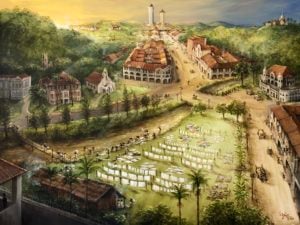
Old postcards often tell stories of how places have changed. Over 12 days, I painted these this 3-month pop-up installation at One Fullerton. There are 4 scenes: 1) Collyer Quay Waterfront 2) Esplanade Park 3) Change Alley 4) General Post Office (GPO).
These scenes were inspired by nostalgic postcards of Singapore’s waterfront. Thanks to Fullerton Heritage for commissioning this project in commemoration of SG60.
Collyer Quay Waterfront
This is the view you would have seen in the 1960s if you had taken a boat out and looked back at Singapore’s waterfront skyline. It is remarkable how much the skyline has changed since then.
EsplanadePark
This is Esplanade Park in the 1980s. Located at the mouth of the Singapore River, it looks out towards Merlion Park, against the horizon of the sea and Benjamin Sheares Bridge.
Esplanade Park was once home to the renowned Satay Club and continues to house the Tan Kim Seng Fountain, the Cenotaph, and Lim Bo Seng Memorial, which are collectively gazetted as a National Monument.
In 1972, the Merlion statue was installed here at the mouth of the Singapore River as a symbol of Singapore’s heritage and tourism. Following the completion of the Esplanade Bridge in 1997, the statue’s view of Marina Bay was obstructed. In 2002, the Merlion was relocated to its present site at Merlion Park, where it once again faces Marina Bay.
Change Alley
This is Change Alley in 1980s — a bustling 100-metre-long passageway connecting Clifford Pier to Raffles Place. Passengers arriving at the Pier could conveniently shop for souvenirs, exchange foreign currency, polish or repair shoes, tailor clothes, or even buy fishing gear for offshore trips.
Change Alley was demolished in 1989 during the redevelopment of its adjoining buildings. In 1993, it was revived as an air-conditioned walkway within a new mall, and extended into a shopping bridge across Collyer Quay, connecting to Clifford Pier.
General Post Office
The Fullerton Building, completed in 1928, once housed the General Post Office, the prestigious Singapore Club, and several key government offices.
When you dropped overseas mail into the mailbox, it was transported via a basement conveyor belt within the building, before being sorted and sent through a subway tunnel under the building to the nearby Post Office Pier for dispatch.
In 1996, the General Post Office relocated from the Fullerton Building. In 2001, the building reopened as the present-day Fullerton Hotel.
This 20m long mural is located at Grand Lane, Perth, Western Australia. Commissioned by the City of Perth, I painted this mural with my friend Indonesian Leonardo Yuwono’s assistance. We painted it over 9 days in May 2025.
The mural depicts olden day Barrack Street, inspired by the rich history of the place. Painted in life-sized, semi-realistic, yet whimsical style, it invites the visitor to take a slow stroll down the street, to immerse in the nostalgic sight, smells and sounds.
On the left, is a corner Deli with colourful flowers and cheeky signages displayed. In the middle, is an old-school grocery store complete with cabinets, fridges, weighing scale and coin phones reminiscent of the 1970s. On the right, the scene morphed to the early 1900s when trams plied Barrack Street. The spired clock tower of the Perth Town Hall identifies the scene unmistakably as Barrack Street.
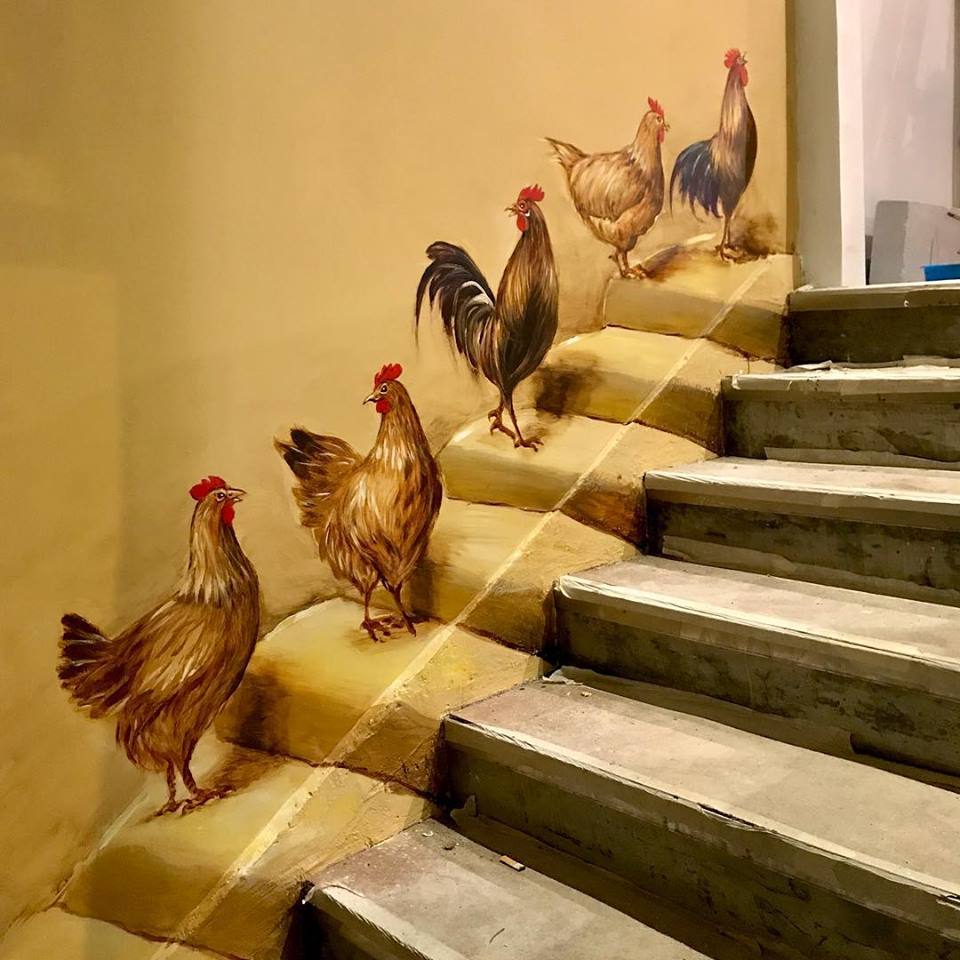
Cute animals peppered the scenes, such as the a grumpy cat sipping coffee and another leading a Quokka to jaywalk. The Possum, Australian Shepherd and even the Singaporean chickens are featured too, making the atmosphere lively and whimsical.
The mural also playfully incorporates all the existing structures into the design. It hides the real doors at exactly the doorway of the Deli and the front of the tram. It turns the water-heater into an ice-cream machine, and the utility boxes into a fridge and a post box. Real existing signboards are aptly incorporated into the murals too, such as the ‘Restricted entry’ sign positioned right at the door of the tram, and the girl at the window “showing” the ‘No Entry, fine $350’ sign to the boy.
We hope the mural’s nostalgia, colours, cheekiness and playfulness will altogether bring smiles to all visitors!
This mural depicts scenes of the old quays along the Yangtze and Han Rivers in Wuhan around the 1920s. This mural in fact was meant to be painted in 2019, when my mural friend 超级画咖 from Wuhan first invited me to come paint in Wuhan. Obviously it didn’t happen… until Oct 2024. We felt the 5-year delay is a blessing in disguise, because our skill and this site are now so much better. The site at Garden Expo Hankouli (园博园汉口里) is grand, with a huge flight of stairs and a gateway atop it, just like the olden day quays. Thus, we took the opportunity to recreate the scenes of the old quays. We consulted heritage experts to ensure the content is authentic and accurate. The outcome mural blended very well with the environment. As the mural’s popularity grew in social media, it has become a tourist attraction in Wuhan!
On the left wall, the labourers are toiling in the summer heat. A Han opera is being performed in a teahouse. People on the streets are peeping and enjoying the show for free. On the right wall, the late autumn chill is setting in. A mobile barber is climbing the steps carpeted by fallen autumn leaves. The people have put on thicker clothing and tucking in hot food. The stalls are selling steamy 热干面 (hot dry noodles), 油条(fried dough stick), 面窝(fried doughnut) and 牛肉粉(beef noodles). Above the stalls, the windows are decorated with laundry, waxed meat and waxed fish. Further down the steps, the fishermen are coming home with their boats full of catches while some men are fetching water from the river.
With the success of this mural, 超级画咖 and I have forged a deep friendship. We are dreaming of our next venture!
Take a stroll in the Painting. Immerse your senses in a colourful Southeast Asian market by the sea. Listen to the bargaining. Smell the salted fish, Taste the Nasi Tumpang. Play Congkak with the kids. Peek into the attap house but beware of a grumpy cat!
This roving installation is a collaboration with National Gallery Singapore and Frasers Property Singapore. The installation roved through 4 malls over July 2024 (North Point at Yishun, Waterway Point at Punggol, Tampines 1, and The Centre Point at Orchard Road). The scenes are inspired by two of Cheong Soo Pieng’s paintings – At the Market (1964), and Drying Salted Fish (1978), the latter which can be found on our $50 note.
At each weekend, I did a live painting at the respective malls. I painted myself painting myself painting myself….:-)!
This 30m x 8.4m high mural is located at Woodlands Health Campus’s South Event Plaza. It aims to capture the community spirit of Woodlands. There are scenes of the Campus, familiar scenes of the heartlands, glimpses of the Johore Straits with the Causeway and future RTS, and a scene reminiscing Woodlands when it was dotted with kampongs. The scenes are interwoven to form one timeless and whimsical scene. Look closer, and you’ll see little nuggets of daily life. An NS boy who has just booked out, is on his way to visit a loved one with a bouquet of flowers. In the heartland, while neighbours share food, groups of friends and pigeons gossip at the coffeeshop. Kids scream as they watch a flypast. At the park, chickens are as active as the park goers! They are all mundane yet familiar and heartwarming.
Staff from Woodlands Health and students from the nearby schools came to help paint the mural, adding to the community vibe. Woodlands Health aims to not just build a hospital, but a place that cares for residents in the Northwest region, both inside and outside its campus. During its construction phase, it set up Communities of Care that promoted healthy living and brought people together. The mural reflects this vision and the continuing journey.
In the design, I tried to blend the mural with the existing uneven wall structure and tall pillars fronting it. I painted two tall trees to match the 6 tall pillars in the plaza. When seen together, one can feel like being surrounded by tall trees.
I felt most honoured when Senior Minister Lee Hsien Loong came to open the mural by writing the letter “W” (of Woodlands) as a finishing stroke.
The Mural at Lau Pa Sat at Boon Tat Street, painted in Feb 2024.
This mural marks the 200th year of the establishment of the ‘Old Market’, and the 130th year of the building now known as Lau Pa Sat. From a fish market by the sea, it has evolved into an iconic day and night hawker market in the middle of Singapore’s business district, all which sit on reclaimed land. The panorama morphed whimsically across two centuries. From shoreline to skyline, from day to night, from local to international cusine options.
Try spotting these fun elements: the chicken ‘choping’ the seat, the run-away crab, the coolie Jacquermart striking the bells of the clock tower, naughty children “fishing” chicken wings, and a grumpy cat eating satay. Have fun!
“வாங்க சாப்பிடலாம் (Come, let’s eat)”, is a 4-storey high mural in Ukkadam, India, which features the local food of Tamil Nadu. I painted it over 9 days in Feb 2024, assisted by my friend from Gujarat, Hiren
I was invited by Street Art Foundation India (St+art India) to take part in their 4th Ukkadam edition. Upon arrival in Ukkadam, I visited the markets and residences to get inspiration for the mural. I especially paid attention to food and beverage stalls so as to paint their food culture. I also immersed myself and ate with my St+art India colleagues by eating with my hands over banana leaves and sitting on the floor. AsI progressed, I knew many in the community can relate and loved the mural because when they stopped by, they gave me the “Supera” hand signals. The residents also requested that I paint their pets. On the last day of painting, I added the Tamil words “Come, let’s eat!) to mimic the typographs I saw all over Coimbatore’s streets. A real typographer came by and helped us write it! And at the last few hours, a Pani Puri seller parked his cart in front of the mural. He inspired me to add him as a life-sized character to the mural, giving the entire larger-than-life mural a twist.
Thank you Ukkadam, thank you St+art India , Asian Paints, Coimbatore Corporation and RAAC for the support!
“Once upon a time, the legendary fish with red heads and dark bodies thrived in the clear waters of the Singapore River. Many years later, migration boats arrived. Many immigrants settled on the river banks. Villages, quays and bridges were built. Soon, the River was crowded and polluted. The fish was soon rarely seen and people forgot about them.
An old man who missed the fish. He was also inspired by the firewood he carried on his boat. So he decided to paint his boat with a bright red head and fiery eyes to look like the fish. It was beautiful! Many boatmen followed suit. Soon, the whole quay was filled with red headed and fiery eyed boats! But alas, the dirty River was slated for a big clean up. All the residents were relocated, shophouses vacated and the boats retired. Memories of the boats faded once again.
The River became clean again, and every now and then, there were claims of the fish’s sightings by anglers, swimmers and tourists. The accounts inspired more people to come to Clarke Quay to try their luck in spotting the Fish. In 2023, two Singaporean artists painted their reimaginations on the warehouses along the quay, re-igniting the Legend of the Clarke Quat Fire Fish.
This mural with a modern myth is jointly created by tobyato X Yip Yew Chong.The 90m long mural adorns the facade of the Clarke Quay Warehouses Block B at Tan Tye Place.
The Kampong Gelam Mural, located at 92 Arab Street, depicts the history and culture of Kampong Gelam. It was painted in a span of 25 days in Aug 2023.
On one wall, it depicts Kg Gelam’s early days by the seafront. Then, the Sultan Mosque had a Nusantara-style pyramidal-roof. The Istana was the Sultan’s palace. Traders from the Malay Archipelago, Middle East, China and India set up businesses in the area. The Mural’s lower parts showcase some of these trades such as textile and diamond trading, book printing, tombstone engraving, iron smithing. Kg Gelam was also once a Haj hub where pilgrims from neighboring countries transit before taking the steamships to Mecca. Pondok Jawa served as one of the boarding houses for the pilgrims, as well as a centre of entertainment, Wayang Kulit performances and food fairs. At the bottom left corner is the depiction of the iconic Gedung Kuning (Yellow Mansion). Next to the doors are 2 maps – an old map and a 2023 map, painted side by side, giving an interesting perspective.
The taller wall gives a peek of the inside of a typical house in the 80s before the place’s redevelopment. The ambeng (low wooden platform) is the centre of activities where families would gather to eat, watch TV, do chores and rest. The giant fabrics represent where their ancestors came from, such as Java, Kalimantan, Sulewasi… Lastly, the window with the two kids playing with a paper aeroplane symbolises the energy and aspirations of the new generations, topping a playful and whimsical touch.
This painting took 1.5 years to complete (Aug 2021 to Jan 2023). It is made up of 28 panels joined together, depicting panoramic scenes of Singapore in the 1970s and 1980s. The physical original painting will be exhibited from 30 Nov 2023 to 1 Jan 2024 at Raffles City Convention Centre. The exhibition entry is free of charge and everyone is welcome.
Meanwhile, you can view the online version at your own pace and read the stories via the following Straits Times Interactive link by scrolling up/down :Interactive viewing of the 60m Painting
You can also watch it as a video with the painting scrolling through its entire 60m. Here is the link to the video: Scrolling Video of 60m painting
Features 30 Canvas Paintings/Sketches of my imagination of olden day Singapore.They are panoramic yet intricate scenes, such that one can walk into the paintings, listen to the conversations, and watch as the stories unfold.
The mural is at the back alley of 58 Arab Street (off Baghdad Street). For a very long time, the units were filled with wicker and rattan basket shops. They were iconic and very photogenic. They all closed just before Covid hit. To remember the iconic sight, the house owner who commissioned the mural, requested for the theme of the basket shops. But I wanted to make it whimsical. So I made the scene realistic yet disproportionate – between the baskets, the 3 cats, the fisherman and the laundry. I also created a faux roof from the shape of the wall, a fishing rod from the earthing cable, and a laundry from the meter boxes. It’s a small mural but it is fun! “Look at the cat’s eyes! so killer, so cute!” was the most common comment I overheard from passers-by.
Lau Choy Seng (劉再成) was established on 10 Oct 1948 behind this mural. Half of the shop made and sold wooden clogs, while the other half sold kitchenware. Wooden clogs were popularly worn in the kitchen and wet markets then, but by the 1980s, rubber sandals became more popular and the clog business was closed. The kitchenware business was passed down to the family’s second and third generations and continues to thrive to this day. Mural is at 25 Temple Street, Chinatown.
The Hindustanis are a community who trace their roots to the present-day Indian state of Uttar Pradesh in the Gangetic heartland, which was known as Hindustan in the early colonial era. They are a small minority who have been present in Singapore since the island’s establishment as a British trading outpost in the early 19th century. From a predominantly subaltern role in the early years, comprising dairy farmers, dhobis (washermen) and jagas (watchmen), the community has transformed into one where the younger generation is now made up mainly of educated professionals and entrepreneurs. This mural presents the historical journey of Singapore’s Hindustani community and their contributions to the development of Arya Samaj Singapore and the DAV Hindi School.
Spanning 36m x 8m, across two buildings located at 113 and 114 Syed Alwi Road, this mural is one of the largest in Singapore’s Little India. It takes us on a trajectory from past to present. On the left, you see illustrated the community engaged in its traditional occupations. While the early migrants were mostly men, by the second half of the 20th century women had joined them, and the mural draws attention to this. Next, while it is common knowledge that many Sikhs were employed in the army and police force, few know that the Hindustanis were the earliest sepoys (soldiers) posted by the British to Singapore. A towering sepoy figure to tell this tale, concluding the story on occupational profiles by portraying a Hindustani educator seated at his desk. Bending around the wall, the roots of the community in the Gangetic heartland is told by incorporating a scene from temple life along the ghats (riverfront steps) in the ancient city of Varanasi at the banks of the river Ganga. This scene gradually juxtaposes with sights of their new home in Singapore, particularly the neighbourhood of Little India where many of them settled. The establishment of the Arya Samaj and the centrality of the DAV Hindi School are evident in the images appearing next, pointing to the community’s sustained involvement in the shaping of these institutions. The mural ends on a celebratory note inspired by the festival calendar observed by the community. The colours of Holi are strewn across the walls, showing today’s young Singaporean Hindustani community in all its vibrancy and solidarity, ready to achieve greater heights in the future.
This small mural at the corner of Arab Street (123A) and North Bridge Road depicts a traditional Mamashop and a Money changer. For a change, I painted the mural in monochrome, so that it can focus on the portraits in a more artistry and poetic style.
Mr Hamid ran the mamashop at that exact spot. He sat at the busy five-foot-way all day and night manning the store selling snacks, drinks and newspapers. In his teens, he arrived in Singapore from Chennai, India, in 1952 to take over his grandfather’s mamashop. He believed the shop was at the same spot for over a hundred years. He rented a living space directly upstairs, reachable via the ladder which still exists today. A few years ago, he fell ill and returned to Chennai upon persuasion from his grandchildren there. He passed away a few months after his return.
All these stories were told to me by various people who knew him for many years. As they passed by the mural when I was painting it, they spotted “him” and that ignited our conversations. Many of them are long time shopkeepers and residents of Kampong Glam. As words and photos of his portrait spread in their whatsapp chat groups, more came by. Many of them call him “the old man who always sit here”.
Similarly, when the money changer portrait appeared on the wall, various people stopped by and told me about him. They said he was the earliest operator of the money changer shop at that exact spot more than 50 years ago. The shop has evolved and moved into the shopping mall just across the road. A few of the past and current staff came by to say hello.
A young lady came by. She told me “he” looks exactly like her grandfather. She was teary eyed and choked with emotions. She said “thank you sir for painting my grandfather”.
Asian Civilisations Museum (20 to 31 May 2023, part of Singapore Heritage Festival)
This installation reimagines the river teeming with bumboats ferrying goods between the ships anchored offshore and the warehouses that lined the river bank. Between the bumboats and the warehouses, the goods were carried either by coolies manually on their shoulders, or using lorry cranes.
In 1984, this scene disappeared when the last phase of the Singapore River clean-up exercise started. The bumboats were relocated to Pasir Panjang, the warehouses resettled to industrial parks, and residents resettled in HDB flats.
This painting was done partly in a goat & horse stable in Cicerale , and partly in a vineyard in Benevento. It depicts an imaginary dream scene of the Sannio Wine Festival happening at the Singapore River. The river bank is lined with restaurants. People are enjoying food paired with wine. The festival also features mobile snack stalls and a traditional stilt tentage stage where an Italian Opera is performing. The place is brimming in a festive mood!
The charming Sannio wine region surrounds the city of Benevento in Southern Italy. The region produces the ancient Falanghina white grape wine. On the last day of painting this artwork at Sannio, the Italian national TV channel TGR (RAI) came to film the pairing of wine with art for the evening news. It was quite surreal to watch a glimpse of myself appearing on Italian TV in Italy! You can watch the 2min coverage here:
The painting depicting children from different parts of the world playing in a Wonderland. The painting was acquired and presented to the Autism Foundation of Italy in Rome.
This is the second of 3 paintings I did during the one month I stayed at a goat farm in the Cicerale Alento lake area.
The top left of the painting shows Cicerale ancient town sitting atop a ridge line overlooking the lake and looking up at the Cilento mountains. The ancient building with the tall wall will be the Cicerale Degas Museum after its restoration. The painting will be kept there. Edgar Degas was a French impressionist Artist (1834-1917). Before the museum is ready, it will be kept at the Cicerale Municipal Hall, where I visited and had the honour to meet the Mayor.
The bottom part of the painting shows the place I stayed – I Filadelfi 1828, a goat dairy farm with a family run country house. It is a beautiful place surrounded by nature, like a dreamland. I painted what I saw everyday there – the family’s daily life.
The farm owner Marco is milking his goats. His wife is picking lemons, olives and berries. The children are playing. The owner’s dad, Claudio is harvesting grapes at the family vineyard. I painted myself too, painting this very painting, surrounded by the cats. I also painted the worker herding the goats on a horseback.
As dreamlike as it seems from a urban Singaporean’s eyes, there is a lot of hard work in managing a goat farm and living in the countryside. There are wildboars, health of the goats, weather and accessibility (such as water and garbage collection services) to be concerned about. But overall, I see Marco is a happy man doing what he likes!
Claudio told me that I transformed theirs and my dreams into something we can see every moment. I told him I just painted what they built – the dreamland.
On my last day, I did a mini painting and gifted it to the family. In that painting, I painted myself playing with Marco’s son flying paper aeroplanes. May all our dreams come true!
I am honoured to be part of this rather unusual Arts Exhibition. I contributed 8 digital illustrations to accompany 8, out of about 120s poems and stories written by Migrant workers. There are a hundred more illustrations and photos contributed by other artists. The poems and stories were originally written in Bengali, Tamil, Chinese etc and have been translated into English. They express the Migrant workers’ experiences daily commuting on the back of lorries.
Whenever I did murals which required heavy machineries, or at worksites under construction. I had the opportunities to interact with Migrant workers. One of the most memorable was when I was painting a tall mural using a scissor lift. My benchman was from Bangladesh. He was in his early 20s. He was chatty. We chitchatted a lot. It was funny that he kept comparing me with his dad (same age as me). He said his dad would never speak with him like that. I said I don’t speak with my own children like that too! I soon realised he was actually well educated, knowledgeable and aspiring. When our work ended, he asked if I can hire him for more days!
With my limited interactions, I can’t say at all that I understand the Migrant worker community. But I learn empathy. Many of them have worked in Singapore for many years, away from their families left behind in their own countries. I counted my blessings and considered myself so lucky to be born in my time and place. I wondered how I will feel if I am in their shoes.
If you have missed the exhibition and are keen to learn more about their thoughts, you can order the book published with the poems, stories and illustrations here: “A Journey by Lorry” Book Order Form
The exhibition and the book is a unique platform that allows them to express their feelings through Art. It changes our stereotypical visions of them working at construction sites, cleaning our estates, pruning our trees. They are also authors, poets, storytellers, photographers, curators and musicians. Join them for a some time, sitting at the back of the lorries, at A Journey by Lorry.
10 days after the war in Ukraine erupted, a friend contacted me to do a painting to express our wish for Peace. As it is a meaningful message, I readily agreed. My friend is a Russian living in Singapore.
We explored various ideas and feasible ways to deliver the message. Things moved quickly. Other friends gave logistical support and arranged to auction the artwork for refugee relief efforts. I think the overall effort itself is symbolically meaningful – regardless of nationalities, races and geo-political viewpoints, people can work together for humanity causes.
On that day, we spent 6 hours doing the painting. “Can we fly kites?” depicts children of different colours, from various places, flying kites in a sunflower field. Everyone painted the sunflowers, thus the flowers have different styles. The sky is blue with wavy white clouds. The sun shines subtly. A mangrove blue and yellow flycatcher (a native bird in Singapore) flutters around the sunflowers.
The scene represents the wish for Peace, so that the children can fly kites again. Joyful scenes are my usual themes, as this painting is; but I changed the style to be kiddy, like a children’s book cover. Children are naturally innocent, pure and are our future. The joyful scene is what should be happening in the sunflower fields.
Personally, I have several friends currently in Ukraine and Russia, and friends from there living in Singapore. I have also been to both countries for business trips a decade ago. I now feel empathy for all my friends. Thinking back, I cherish the dinner I had in a rooftop restaurant in Kiev with Ukrainian and Russian colleagues in 2013. I cherish the weekends I went hiking in the outskirts of Kiev and Moscow. Some photos on my website: Ukraine photos
The symbolic painting was auctioned. The proceeds went to that Singapore Red Cross humanitarian relief efforts in Ukraine.
These 2 digital paintings, painted exclusively for the Fair, showcase the two beloved Singaporean elements in whimsical settings – wild garden city and food.They were animated, but here I can only present still images. The first painting is a day scene depicting nature like otters, fowls and hornbills roaming freely in our modern city. I also reimagined the ‘Esplanade Theatres on the bay’ as a pair of durians, the ‘Gardens by the Bay’ as seashells, and the ArtScience Museum as a lotus!The second painting is a night scene of the same place viewed from a ‘flying batik’. While riding on the batik, enjoy the glittering city lights below and feast on a variety of local favorites!You can also view my Japanese-translated interview explaining the two paintings on YouTube here: https://youtu.be/kZc-Ul88OlM
This wet market scene is the 5th of 6 scenes I conceptualised way back in 2016 to paint as murals in Chinatown. It is located at the gable wall of 30 Temple Street, Singapore’s Chinatown. I self-initiated the project following the warm public reception to the murals at Everton Road and Tiong Bahru. I called it “Dreams of Chinatown 牛车水昔日情怀“ to pay tribute to the old Chinatown I grew up in with fond memories in the 1970s/80s.
I painted this three storey high mural over 24 very wet days, and hot too at times. On the ground level, it depicts a traditional kopitiam, a dried seafood cum soy sauce shop, hairdresser, facial services along the five-footway, and a wet market scene selling vegetables, fish, and even snakes and monitor lizards. On the second level, I dressed up the real windows with laundries and their stuffs like overhanging birdcages, vegetables, baskets and potted plants. On the third storey, I painted a larger than life uncle pouring tea from his teapot into cups below. The overall vibe is a busy and whimsical scene. I hope visitors will feel they are transported into another world!
You can watch the final week of the painting process in this videocreated by Chen Chee Meng, who filmed me for the entire final week.
This 13m long mural depicts the Hougang Hainanese Village around the 1950s/60s. It is within the private compound of ‘The Serangoon Khiung-Jai Co-villagers Association’ (102 Lorong Ah Soo). “Khiung Jai” (瓊崖) is the traditional meaning of “Hainanese”. Up to the 1980s, many Hainanese families lived in Lorong Ah Soo, thus it was also called “Hai Lam Hng”. The village area was also known as “coconut grove village” (椰園村) due to the abundance of coconut trees.The visuals of the mural were pieced together mainly based on oral descriptions by the Association members, a couple of old photos, and lots of my own imagination. Several members took turns to orally describe the layout of the village. They described the school 公立化蒙學校 as an L-shaped building with a basketball court. There was a temple 水尾聖娘 in the middle of one block and a canteen at one end. The temple faced an opera stage, which was used as a classroom when operas were not performing. They also described the market layout, including the positions of the variety of stalls and shops. At the end of the street was the Association’s former building. It was a fun reconstruction process!
The half-submerged Tiger is a reminder that continuing deforestation not only robs the Tiger of its homeland and life, but also that of ours (human), with floods and rising sea-levels. On a more cheerful side, the beautiful Tiger is emerging from its bath in our clean and green waters of the Singapore River.
This flash installation was set up for just an hour for photography purpose. It was a hit on social media! The chickens and ducks were subsequently invited to grace other locations.
This playful mural is my 4th mural in Kampong Glam. It is at the rear wall of”Heritage Collections on Arab” at 78 Arab street (Gelam outdoor gallery alleyway). I titled it “Kampong Jemput” (“welcoming village” in Malay) an almost forgotten name that was used for this area in front of the Sultan Mosque in the olden days. I painted three village children climbing ladders up to a house to play. The view must be great up there – of the Sultan Mosque’s gleaming dome towering above a sea of roofs and Gelam trees blossoming with white flowers. Ladders like these leading to upper stories of houses were commonly seen along Arab Street five-footways up to the 1990s. There is one such ladder left at Arab Street if you can find it. Pulley systems to bring goods up and down were also common. Join the children and help them pull the basket and cat up to the house!
I specially painted this acrylic-on-canvas painting of Amah washing laundry for our migrant workers to symbolise my very first charitable canvas painting. It was sold with 100% of its proceeds donated to the “One Bag, One Book” cause (hosted by Sing-Lit charity), to buy books and Lungyis (South Asian men’s sarongs) for our quarantined migrant worker communities during the pandemic. It was sold within two hours of the offer on social media! My friend, Zakir, a Bangladeshi migrant poet penned a poem to accompany the painting.
Part of my first solo exhibition features 9 triptychs, all inspired by 9 of my street murals in Everton Road, Chinatown, Tiong Bahru and Kampong Glam. See section in “Exhibitions”.
These three digital paintings were created for an educational video to students to appreciate life during the kampong days. The video used scenes from my existing street murals, supplemented by these three digital paintings, to tell the story of a man reminiscing his growing up years in the kampong.
This Canvas Painting was specially painted as my donation to an charitable Auction organised by the Rotary Club of Singapore, to raise funds for struggling orphanages in Malaysia, Indonesia and India during the pandemic. It depicts my mother and I wrapping dumplings in my old Chinatown home kitchen. This warm scene reminds me of how fortunate I have been to have loving parents. I hope the funds raised would make a little difference to the lives of orphans during this trying times.
“My Mother and I” Acrylic-on-Canvas 61cm x 61cm. 2020
Commissioned by the National Museum of Singapore (NMS), these 7 digital sketches were designed after the actual murals animated for the Museum’s “Moving Memories” animation series. They were designed as sketch outlines for colouring. We hope you will enjoy colouring these sketches. Visit NMS website to download the higher resolution individual sketches and enjoy the colouring!
These digital artworks were created as part of the NHB’s promotion to thank our Hawkers, whose culture was unscripted as an UNESCO intangible heritage. They were were printed on banners and displayed in Hawker centres around Singapore.
Adobe Fresco has a series of raster oil painting brushes that create life-like oil painting. I tried it and really enjoyed it. This is my first ever “oil-painting”.
Many people are aware that the present day National Gallery was once a Supreme Court and City Hall. However few people know the site once stood a beautiful hotel – The Grand Hotel de l’Europe. When I was asked to create a representational painting of the National Gallery as part of a NAC-Plural Art project, I chose to paint its predecessor building nstead because I found the two buildings were strikingly similar, except for the hotel’s square crown versus the gallery’s green dome. To make sure the National Gallery is represented, I painted an artist sitting on the Padang painting a scene of the present day building!
“Jalan Singapura” Acrylic-on-canvas, both 122cm x 152cm, are part of a series of paintings that will depict a fictional place in Singapore over different times of the day, season of the year and era. This enables the viewer to feel like one is living in the place, experiencing the changes and having attachments to the place. This post shows the Day and Night scenes.
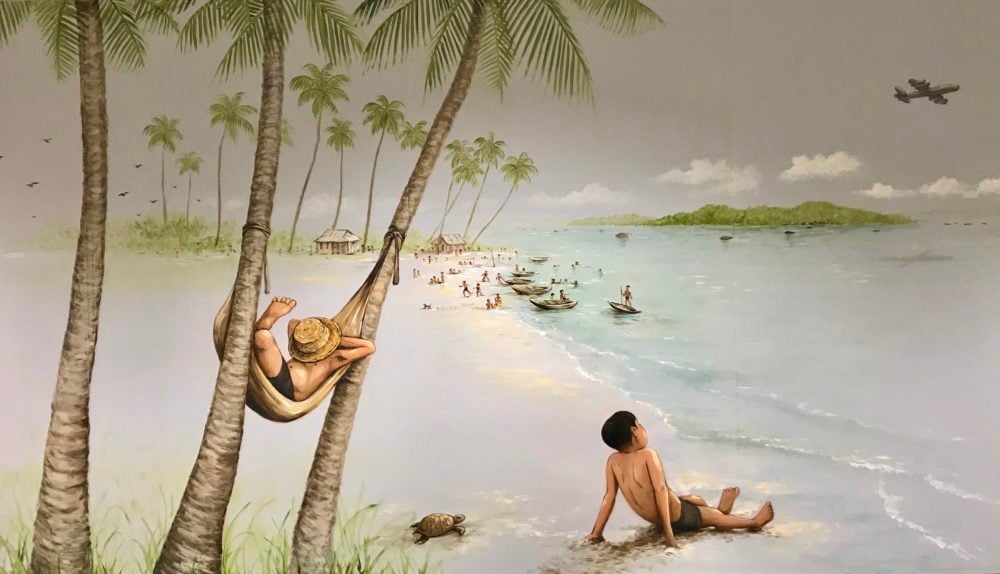
This painting was specially done for a music video “Di Tanjong Katong”, an endearing song many of us sang during our childhood days. It was also an unusual collaboration with Gendang Akustika, a Malay musical ensemble, who invited me to join them to create this little National Day gift. As in the song, my mind pines for the old Tanjong Katong beach, its idyllic kampong and kelongs. The clear blue sea merges with the azure blue sky, Villagers fish, relax and play nonchantly. I hear the waves lap and coconut trees rustle. I hear the tune of ‘Di Tanjong Katong’ singing in my heart.
My first ever digital Illustrations for an e-book “Ramayana”, presented by the Indian Heritage Centre for the CultureFest 2020. It is a commissioned collaboration with my friend Kamini Ramachandran, a talented story teller. You can download the free pdf e-booklet (15 pages) from : https://go.gov.sg/ramayana
On the seventh day or the seventh lunar month, a loving couple separated by the Milky Way, will reunite and be able to spend a day together. Look up the sky, spot the Milky Way and the two brightest stars. The Legend of the “Cowherd and Weaver Maiden” (牛郎织女), is a well-known ancient folklore known amongst the Chinese, Korean and Japanese communities around the world. It tells the story of a loving couple, a mortal Cowherd and a Fairy from Heaven, who are separated by a Silver River (Milky Way) but are allowed to reunite once a year on the 7th day of the 7th lunar month. On the 6th night, thousands of magpies start to form a bridge across the Milky Way to help them reunite. This day of enduring love, longing and reunion is celebrated with a colourful festival – 七夕节 by the Chinese, Chilseog by the Koreans and Tanabata by the Japanese. Join me at the Milky Way to give the couple our support! Let’s also pay remembrance to the many families and loved ones who are separated by cruel wars and politics, many whom may never see each other again.
Up till the late 1970s, on the seventh day of the seventh lunar month, a colourful Chinese Festival 七姐诞 (Seven Sisters Festival, or Double-seventh Festival 乞巧节) would turn Singapore Chinatown into a fairytale land of colourful paper arts and crafts. As a child, I remembered thronging the streets with my grandmother to view the colourful displays and offerings. Every shop and household would display a circular paper-made pan (七姐盆) decorated with colourful paper-made flowers, mirrors, combs, jewellery and cosmetics for ladies. On some streets, a few shops would combine effort to set up a tent to display elaborately made paper dresses, cone-shaped floral pots and offerings. My mother would also buy a small paper pan to display and pray at home on the seventh night.
This Festival was brought to Singapore from China by the Cantonese migrants. It was popularly celebrated by the young ladies and especially the Majie maid servants (妈姐). Majie often wore white blouse, black pants and combed their hair into a bun as a vow of celibacy. Majie were known to be trustworthy and hard working servants for rich families. Have you seen my very first public mural at Everton Road which depicts a Majie doing laundry for a Peranakan family? There is also a Majie Temple at Chinatown Keong Saik Road.By the late 1980s, with development and modernisation, the Seven Sisters Festival has vanished without a trace, save for the Milky Way and the often untold legend. This quick digital sketch was drawn based on my memory. It depicts my grandmother and I thronging the streets of Chinatown on the Festival’s heyday night in 1975. As it is quite hard to find online coloured photos of the Festival in Chinatown in its heyday, I hope my re-imagination allows you to feel the mood of the Festival!
This acrylic-on-canvas painting (122cm x 91cm) depicts a scene of preparation for the Haj at Kampong Glam in 1972.
Before the early 80s when commercial flights were less accessible, most pilgrims would take a two-week steam ship journey from Singapore to Mecca. The whole pilgrimage duration would be around 2-4 months. Kampong Glam was a centre for pilgrims to gather and prepare for the Haj. Many Khaji shops lined Haji Lane, thus its name. The shops were like travel agencies, as well as boarding houses for pilgrims from neighboring countries transiting through Singapore.
I painted this busy scene at Bussorah Street, blessed by the grand Masjid Sultan (1824, reconstructed in 1928). The street was then filled with residents, cottage industries and push-cart hawkers. Based on old archived photos of the Haj preparation, I composed this scene of men loading luggages onto trucks, and ladies bidding farewell for a safe journey. In those days, pilgrims had to bring cooking and eating utensils, food and mats along.
Can you spot the Chinese lady at the five-foot way? Kampong Glam, like Little India and Chinatown, was not mono-ethnic. Many other races lived and set up businesses there too. There were even Chinese shops that carved Muslim tomb-stones!
Kampong Glam was also heavily influenced by Middle Eastern culture due to early Arab traders living and working in the area. Thus, several streets in Kampong Glam were named after cities in the Middle East, such as Bussorah Street (Iraq), Muscat Street (Oman) and Kandahar Street (Afghanistan).
The 2020 Haj season is expected to be a quieter one due to COVID-19. Nevertheless, we wish all Pilgrims a blessed journey and all Muslims a blessed Hari Raya Haji.
Here are two fairly similar digital paintings depicting a mother and a child preparing food together.
The first depicts a Malay mother and child making pineapple tarts for Hari Raya Puasa in their new flat, in the 1970s. They sat on the floor (covered with vintage vinyl mat) and used banana leaves, traditions they brought over from their Kampong days.
The second painting below depicts my mother and I making dumplings in our old Sago Lane home kitchen in 1980.
Making dumplings or any food specialty for festivals wasn’t my family’s tradition (it was so easy to just buy the food from the streets at our doorstep); but we occasionally tried home-making street food just for the fun of it. I remembered we tried making dumplings, yam-cake, laksa, mee-siam, salt-baked chicken, mooncake, sticky new year cake, and different types of desserts and kuehs. It took a lot of effort because in those days, ready-mixed sauces were not available. We had to buy and grind raw ingredients. Most times, the food tasted close enough to those sold on the streets (or even better!), but at rare times, they didn’t. A lot of trial and error😅.
The setting is my memory of my old Chinatown home kitchen. It was covered in black soot because we used firewood. The floor was always wet because we descaled fish, chopped meat, washed clothes, dishes and brushed our teeth with basins placed on the floor. That was also why we wore wooden clogs in the kitchen. We kept a cat named “Mary” to catch rats that run around the kitchen! Can you spot Mary in the painting?
View the painting process in the accompanying video. The third photo is “My Chinatown Home” mural painted at 30 Smith Street. Can you see the similarities from a different angle?
My mother and I making dumplings in our old Chinatown home kitchen.In this mural at 30 Smith Street, Chinatown, my mother is frying sticky new year cake in the same depicted kitchen.
The flight is about to land in a few minutes, a breath-taking view unfurls below. Flying past over that familiar huge blue cylinder, I could see the street life below – buses, trishaws and people moving about. I could see a huge stadium and the tiny airport building on the left! The rivers are winding and converging into a large bay. A village in between, of attap houses, boats with tall masts, taking me back to the 19th century. As the plane flies over the long bridge, I could see a stone lion below a column at one end. On the sprawling bay teems boats, ships and seaplanes. Further beyond, another huge bridge seems to be under construction, and some strange seashell-like buildings glittering afar. A timeless view I wish would last forever….but alas we’ll landing.
“Kallang” (123cm X 91cm), the third and final artwork of a trilogy (along with “Dhoby Ghaut” and “Pulau Saigon”) whimsically combines layers of histories of the Kallang Basin in one painting. The trilogy aims to evoke and inspire people to share their own memories of these almost forgotten icons of our ever evolving land. What are your memories?
Kallang Airport (1937-Present, ceased operation in 1955) was the first civil international airport in Singapore. The airfield sat on the huge ground where the present day Sports Hub, Indoor Stadium, Leisure Park and Kallang Theatre stand today. The runway once extended from the then waterfront Oasis Restaurant all the way to Old Airport Road. Dakota aeroplanes used to park at present day Dakota Cresent. (Now we know how these places are named!) Can you spot the seaplane and the slipway?
Another icon much missed is the endearing National stadium (1973-2011) where many events like the Malaysia Cup and National Day Parades were held.
Can you spot the two amusement parks -Gay World/Happy World (1936-2000) and Wonderland (1969-1988) and the Kallang Leisure Drome tower? They were the equivalent of the Universal Studio of present day.
Golden Mile Complex and Tower (1973-Present) along the eastern end of Beach Road are the few remaining Brutalist architecture in Singapore. The Complex, also known as little Thailand for its array of Thai shops, was put up for enbloc redevelopment sale twice but failed to be sold. It’s one’s guess how long it will survive.
Can you spot the St John Singapore HQ building (1960-Present)?
Ever wondered how Beach Road got its name where there isn’t any beach? The beach was reclaimed since 1840! A unique 3-carriageway Nicoll Highway was built on the reclaimed beach, with the middle way direction reversed during peak hours.
The whitish spire that stands out amongst the red roofed houses is the minaret of the Masjid Hajjah Fatimah (1846-Present). It is also uniquely known as the “leaning tower” of Singapore for its slight tilt, and one of a rare mosque named after a woman. A traditional dome was added in later years.
The bridge in the centre is the Merdeka Bridge with the columns and stone lions at both ends (1956-Present). The columns were demolished in 1966 when the bridge was widened. The stone lions were relocated several times, and today stand in SAFTI Military Institute.
That narrow strip of land jutting out of the airfield is Tanjong Rhu, before it was reclaimed to become part of Marina Bay East. The Geylang River ends at this part of the Basin too. Shipyards dotted the strip and the eastern bank of the Kallang River. My late dad was a fitter at the Vosper Shipyard for many years. I hope he will see this painting from where he is now (Happy Father’s Day!)
Further out, the Benjamin Sheares Bridge is seen here under construction. Do you remember the fear when rumours spread about its construction requiring skulls of kids?!
Kampong Bugis – the Buginese people first came to Singapore from present day Indonesia around the time of Raffles’ landing, to escape from the Dutch persecution in Sulewasi. They once settled along Beach Road, moving further East over the years, including settling at present day Bugis Junction, ICA Building and finally at the confluence of the Rochor and Kallang River. Depicted here is their 19th century village with their iconic Phinisi boats with tall masts. The unique boats had to relocate to the front of Golden Mile Complex when the Merdeka Bridge was built since they couldn’t go under the bridge. They were seen up till mid 1980s before relocating to Pasir Panjang and thereafter disappeared. The Buginese people have been assimiliated and recognized as ‘Malay’ race in Singapore’s IC registration.
Can you see the Biduanda Kallang Orang Asli people on their house boats on the Kallang River? They probably gave the river and the whole place it’s name! If we trace forward, perhaps we can find their descendants in present day Johore
The famous, or infamous, Kallang Gasworks plant (1862-1998), also known as “Fire city” 火城, was a towering landmark of the area when most houses were only 2 to 3 stories high. The huge blue cylinder was often feared for its smell and potential explosion! Its smell lingers to this very day in the soil after rain, whereas the chicken smell of the many live poultry shops opposite it had long gone.
On its left is the Sri Manmatha Kuraneshvarar Hindu temple (1888-Present), the oldest standing building on that plot between the two rivers. On the opposite bank of the Kallang River was the Firestone Tyre Factory during the time when Singapore was a significant rubber tyre manufacturer in the region. Can you see the tyres being loaded on the barge?
Crawford Bridge (1926-Present) and the Police Barracks next to it. The arches of the bridge are so climbable from the road level that they have become climbing hotspot for crazy tourists and protestors. Had the police barracks right next to it been not demolished, it could have been a deterance!
Final look before landing….on the sea…yes on the sea! We are on a seaplane!
The sun rays pierced through the clouds, the warmth lifted the morning mist. I heard the school bell ringing, I doubled up the slope, I’m late!! But I can’t resist looking back to catch a glimpse of the grand view below. View from my primary school – Pearl’s Hill School 1876 to 2001. Enjoy the view!
This is another “whimsical” painting, similar to Dhoby Ghaut”, for its mixture of times in one single painting. It shows a view from my primary school, the Pearl’s Hill School (1876 to 2001). The sprawling view takes you back to Singapore River through the last 150 years.
There was once an island in the middle of the River, which is fairly unheard of today, almost forgotten. But it was an important island at a crossroad of transportation and ethnic settlements. Even the historical Railway track ran through this river island around 1906 till 1932. The island was called Pulau Saigon, but I could not find verifiable sources as to how this name came about. It was believed that there was a company owning many warehouses along Havelock Road with the name “Saigon” which gave its name. The island was gradually merged to the South bank of the Singapore River around 1972 to 1991. In 1984, I even walked through the island daily for a whole month while doing school holiday work in a warehouse wrapping hampers, but I didn’t know it was an island. Today, The Central Expressway tunnels underneath the expunged island.
I have also included some popular but expunged landmarks in the painting – such as the old National Theatre (1963-1986), Van Kleef Aquarium (1955-1991), Ellenborough Market (1845-1995) and Oberoi imperial Hotel (1968-1997). The bridges, except for the two Saigon bridges, largely remain intact. The first mosque built in Singapore – the Masjid Omar Kampong Melaka (1820), the Tan Is Chong Su (1878) are still around and visible in the painting. Stamford Raffles’ tutor, Munshi Abdullah once resided in Kampong Melaka near the mosque. In 1847, an unfortunate fire burnt down his library, resulting in loss of many treasured manuscript. Hope you enjoy scanning through this busy painting to discover more stories of our rivers and land.
This painting whimsically mixes layers of history of the familiar “Dhoby Ghaut” precinct, smack in the heart of the city. Dhoby Ghaut is a busy place today. It hosts the biggest MRT interchange and the President’s Istana. But many people do not know why the place is called “Dhoby Ghaut”.
This painting peels off layers of times to expose what Dhoby Ghaut, Orchard Road and Bras Basah Road was like in their early days. I call it whimsical because it is an impossible scene – the landmarks depicted in the painting did not exist at any one time, as some were demolished before the others were built, and so on. But in art, anything is possible!
The view is seen from a prison (Gaol) which used too sit on present day SMU site. It overlooks a sprawling field dotted with white linen drying under the sun. The washermen from India are seen here washing the laundries in the stream (Sungei Bras Basah). The stream still exists today, but hidden underground as the Stamford Canal, used to drain storm water off the Orchard valley. The washermen are called “Dhobi” and the step leading to the stream is called “Ghat” in Hindi, hence giving the name “Dhoby Ghaut”. This washerman scene existed around mid 1800s till early 1900s.
Scan the painting for familiar or unseen-before-landmarks. Go google them to find out more. The tall Mandarin hotel and former Dynasty Hotel (current Marriott) should give you orientational clues. Of interest to note are the circus, the Railway track crossing Orchard Road from Emerald Hill to Penang Road, and the grand old dames atop and at the foot of Mount Sophia, something you won’t see today. I won’t let the cats out further here, so you can better enjoy the view and your “treasure hunt”.
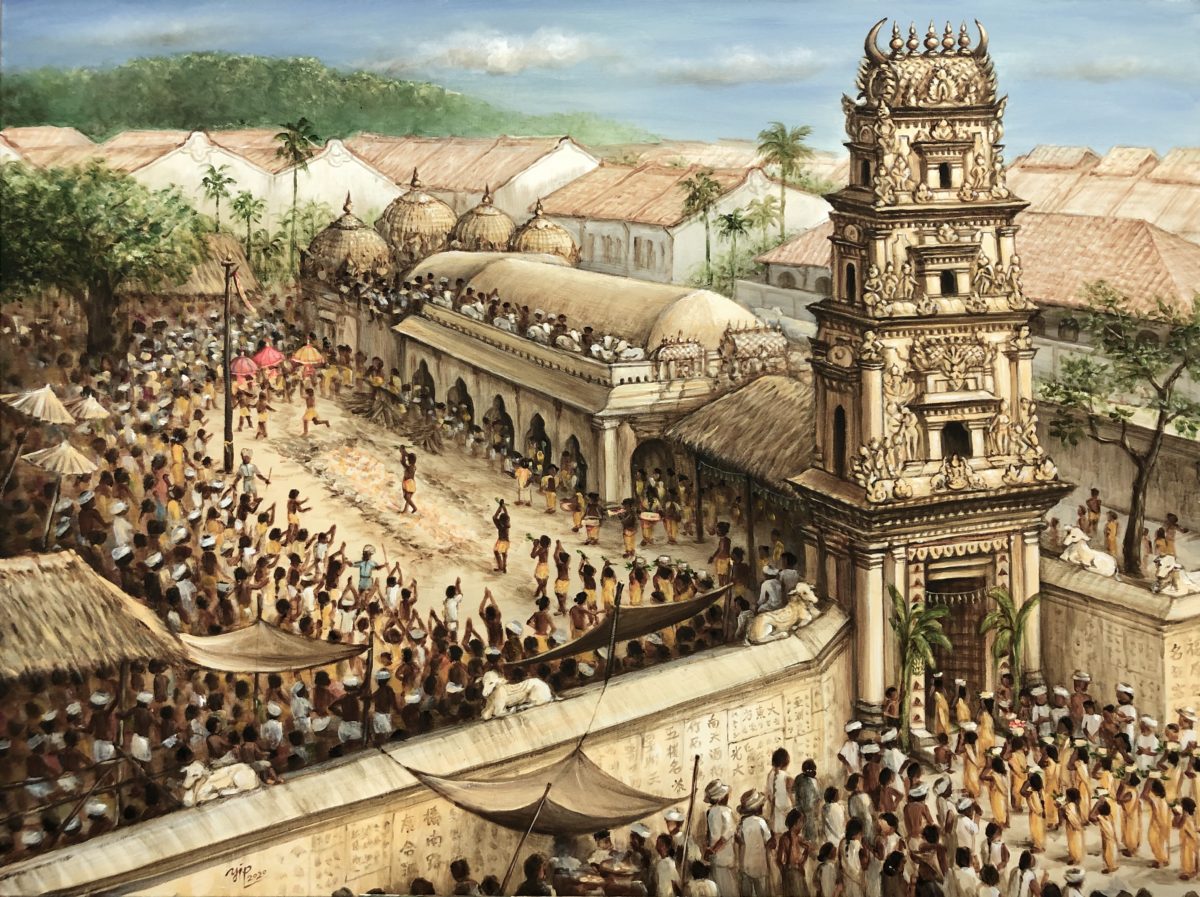
This painting,“Timithi” (122cm x91cm) done in Jan 2020, is part of my series of scenes from Stories of yesteryear. It depicts the annual fire-walking festival at the Sri Mariamman temple in the heart of Chinatown. When my family was resettled in 1983 from an old shophouse to a HDB flat, we were lucky to be allocated a top floor with a panoramic view. We could see all the activities and evolution of our city. We could see the annual fire-walking festival in all its pomp (with binoculars:-)! To make the painting more flavorful, I turned the clock back to 1909, and imagined how the temple and Chinatown looked like. This 3-tier gopuram was demolished and rebuilt with the present day 5-tier gopuram, with more statues added over the decades. The thatched roof linking the gopuram and the main altar caught fire in 1909 and was replaced with a cemented roof. Although the pomp, splendor and sequence of the ceremony remain largely unchanged over the hundred plus years, the infrastructure has improved, and the audience are no longer allowed to climb onto the roofs and wall parapets as depicted in this painting.
Set in 1970 Geylang Serai, the painting captures the atmosphere of the Ramadan Bazaar at the blue hour. The sun had just set below the horizon, its warm apenglow still lingering on the faces of block 2 and 3. The mosque’s prayer call permeated the air – it’s breakfast time! The bazaar was like a sea , with waves of people rippling its surface; the stalls like sailing boats, with smoke from cooking puffing above, its smell thickening the air. “Lelong! lelong!”, “Bunga, bunga!”, “Kueh Lapis, Kueh Raya!” People of all races came to buy, sell or just soak in the atmosphere. The lights of the bazaar, the streets and moving vehicles began to illuminate the whole place like fluttering fire flies. Above, at the flats’corridors, decorative fairy lights and kids’ playing cracker sticks flickered like stars of the sky. It was a sight to behold, a moment in the heart held close, a memory kept and retold. A lady was singing “Geylang si paku Geylang” on the 4th floor corridor, a song so sweet and nostalgic, bringing everyone back to the their childhood days. Let’s go home, Let’s go home, everyone lets go home…” Selamat Hari Raya Aidil Fitri! Acrylic painting on canvas + video production – Yip Yew Chong Vocal – Mahani Mahmud Music – The TENG Company + Syafiqah ‘Adha
Once upon a time, there was a seaside settlement in Southern Singapore called ‘Tanjong Malang’ (literally means “unlucky cape” in Malay), somewhere between Tanjong Pagar and Telok Ayer. Watch this 2.5min video to find out more about this lost place and its treasured relics, some of which we can still find hidden in our central business district today. The story unfolded with rolling images of my Acrylic painting, accompanied by a Pantun recital (Malay poetry) by my friend Sarafian Salleh. The background music “Getaran Jiwa” composed by the late P.Ramlee added to the nostalgic ambience. I hope you enjoy and also learn something new about Singapore’s history in this 4th of 10 Singapore heritage paintings I painted recently. Thank you!
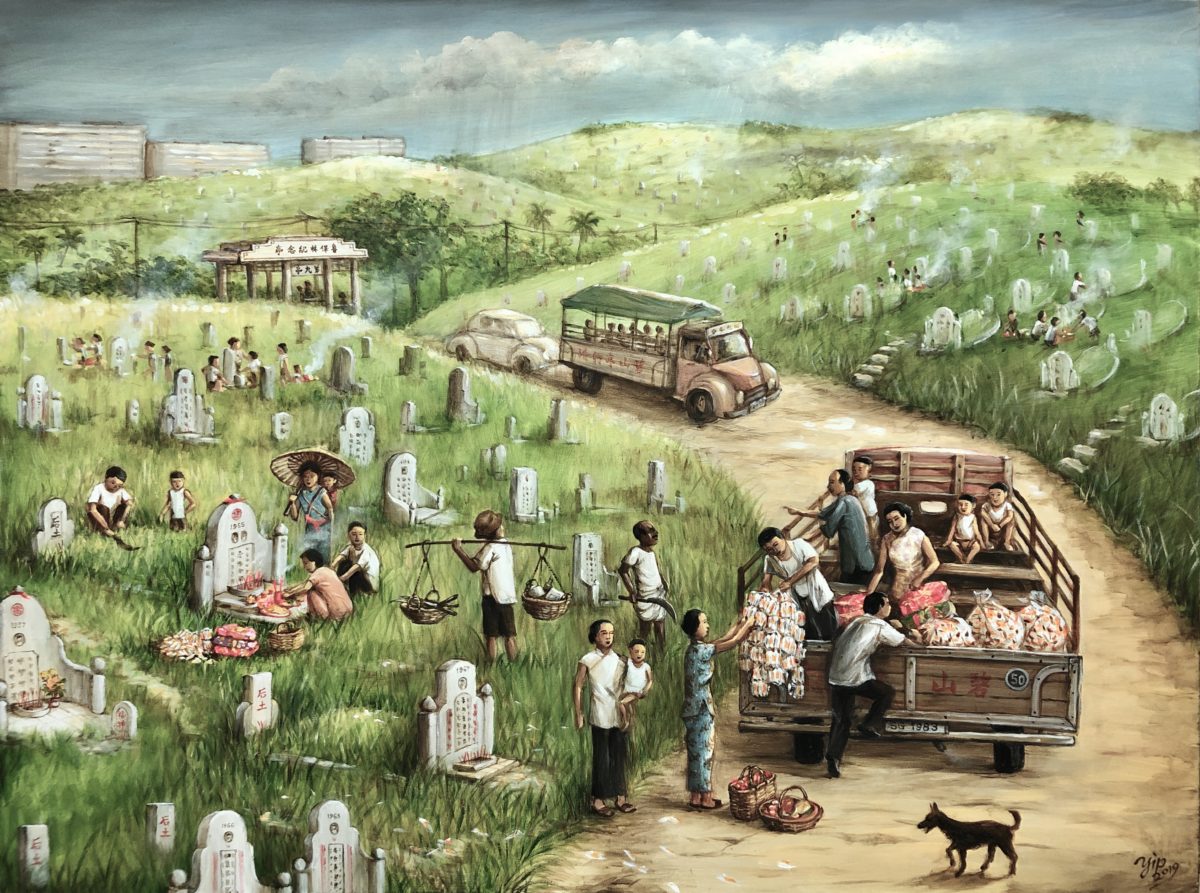
In 1981, my family rented a lorry, drove up to Pek San Teng cemetery to do our annual Tomb Sweeping tradition for the last time. I made this one minute video story to showcase not just the details of my acrylic painting on canvas, but also to tell a personal story of Singapore’s past.
Set in 1978 Chinatown, it was an endearing scene close to my heart. Growing up in a Chinatown shophouse, New Year’s Eve was always full of simple delights and joyous anticipation – it was a joy to do spring cleaning, to decorate the house, to gather for reunion dinner, and wish for everything a child would dream of for the New Year. While enjoying the reunion dinner with my big family, I never fail to observe my family’s co-tenant, an old lady, who would sit alone, longing for her graduate son to come home with his wife to have reunion dinner together.
The imaginary digital painting depicts a Hari Raya Puasa Tea Party held at the former Tanjong Pagar Railway Club in the early 1970s. The Club was located at present day Kampong Bahru area. Can you see the turntable which was used to manually turn train heads around? A remnant circular crater of a turntable still exists today at the site, but the metal structures had all been dismantled and returned to Malaysia.
The painting also showcases the dressings of the people in the early 70s. Can you see the standing man who styled his hair and moustache to look like P.Ramlee? The Baju Kurungs, Kebayas and Songkoks were commonly worn. The Bugis elderly ladies would pile their scarves on their heads. Special thanks to Aishah Jaffar for helping me in my image research. Ramadan Mubarak!
With the ongoing stay-home restrictions, many people are showcasing their artworks online. I’ve given a shot too, at creating my own virtual gallery, to display some of my old-styled canvas paintings.
Painted between 2017 and now, these acrylic paintings tell stories from Singapore’s yesteryear, mostly of scenes I have a personal connection with.
I have shown most of these 11 paintings before on various platforms but this is the first time they are “displayed” in one “gallery”. A 12th piece depicting Hari Raya Puasa celebration in the 1970s will be painted at home during this extended restriction period, hopefully in time for Hari Raya. To view close-up details of 4 of these 11 paintings, visit my YouTube channel for their individual video stories (Playlist ‘Singapore Heritage paintings‘) https://bit.ly/2yFpm1a
To be able to create this virtual gallery, I watched YouTube tutorials to learn how to turn flat photos into 3D spaces using Adobe Photoshop (“vanishing points”) and After Effects on a ZBook. The outcome looks raw and amateurish but I thoroughly enjoyed the trial and error creative process. Finally, I overlaid it with a royalty-free ‘Canon in D’ rhythm by the late Johann Pachelbel, adding tempo and delight to the “walk through”. I hope you enjoy this 1 minute walkabout at my gallery. Thank you
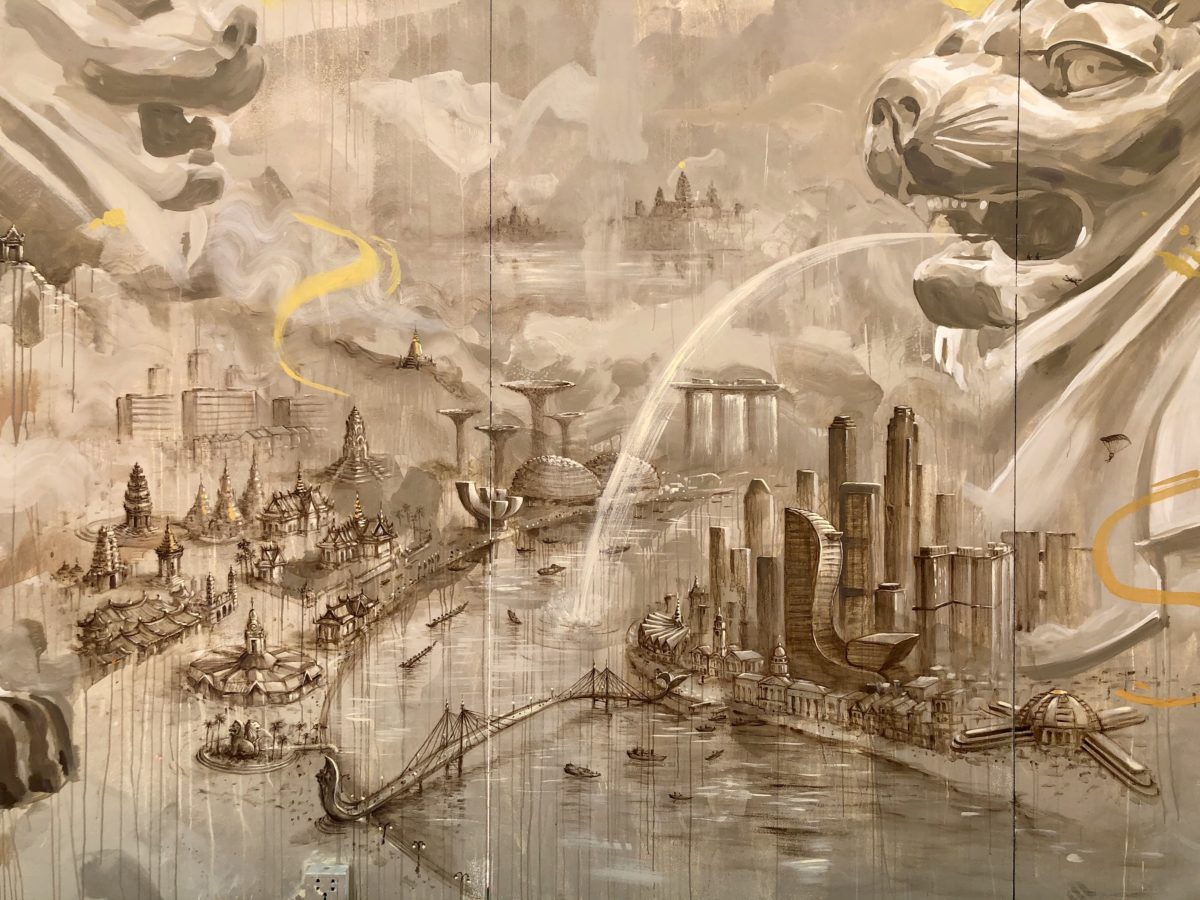
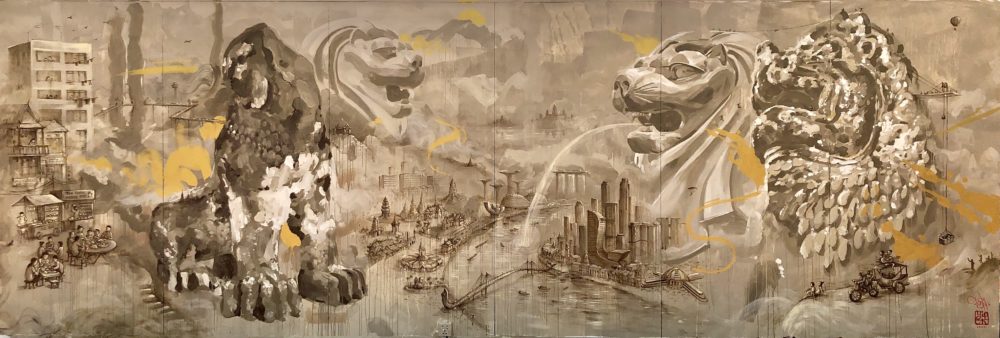
In a unique collaboration, Cambodian artist Fonki and I created this mural to celebrate 55 years of diplomatic ties between Cambodia and Singapore. It is a symbolic portrayal of the longstanding relations between the two countries, and the warm friendship between the two peoples.
Fonki’s bold abstract neo-expressionist brushstrokes and my detailing through intricate brushstrokes are a harmonious contrast of our styles.
Fonki rendered the majestic imageries of the Khmer Lion from the Angkorian era – the Khmer symbol of peace and prosperity, royalty, strength and courage; and the Merlion – the national symbol of Singapore, the Lion City. The Angkorian lion with the missing head symbolises the resilience of the Khmer people; that despite years of wars and battles, and tragic attempts to eradicate their culture and people, the rebuilding of Cambodia with the support of close friends, has culminated in the Khmer Renaissance of a rich heritage and a bright future. Alongside each Angkorian lion is a Merlion, a symbol of the steadfast friendship and constructive partnership that bind the two nations and peoples together. Fonki said “You can try to cut the head of the lion, but the soul will always remain”.
The four lions tower over a miniature city in the centre of the mural, a surreal depiction of the capital city of Phnom Penh and the island city state of Singapore. At a glance, the scenes are distinctly Cambodian or Singaporean, but on closer look, they are as similar as they are distinct. The juxtapose of modern skyscrapers and historic buildings tell of the challenges in retaining the heritage and identity amidst the pursuit of modernity and development.
The Vattanac Capital Towers in the foreground, an iconic landmark of modern Phnom Penh, and Singapore’s own postcard icons of the Marina Bay Sands and Gardens by the Bay in the background, are featured on either sides of a fast flowing river thriving with commerce and industry, represent the success, prosperity and dreams of the two countries and their peoples.
The playful scenes of everyday life and common architecture styles represent the shared lifestyle and aspirations of the two peoples. The pair of Angkorian Lion and Merlion sculptures in the bottom left-of-centre of the mural and the Naga-Merlion bridge in the bottom centre which connects the two sections of the metropolis represent the many more successful collaborations between Cambodia and Singapore and their peoples in the years ahead
This mural was painted as part of a Street Arts Fest in Cambodia, which included street art, music, dance, food and various arts workshops. The festival celebrates 55 years of diplomatic relations between Cambodia and Singapore.
Painted like a commemorative note, it whimsically combines the Cambodian 50,000 Riel with the Singapore 5 Dollar, with elements of both notes popping up. The Baby elephant of the Koh Ker Ruins, the Tembusu tree of Singapore’s Botanic Gardens,invite the viewer to “walk” into the note. The little boy blows soap bubbles into the air, bringing his many wishes and dreams high into the sky. Not all will be fulfilled, only those with strong roots like the Tembusu Tree and sure-footedness like the Elephant, the best of his dreams will come true. Wishing continued prosperity for Cambodia and Singapore!
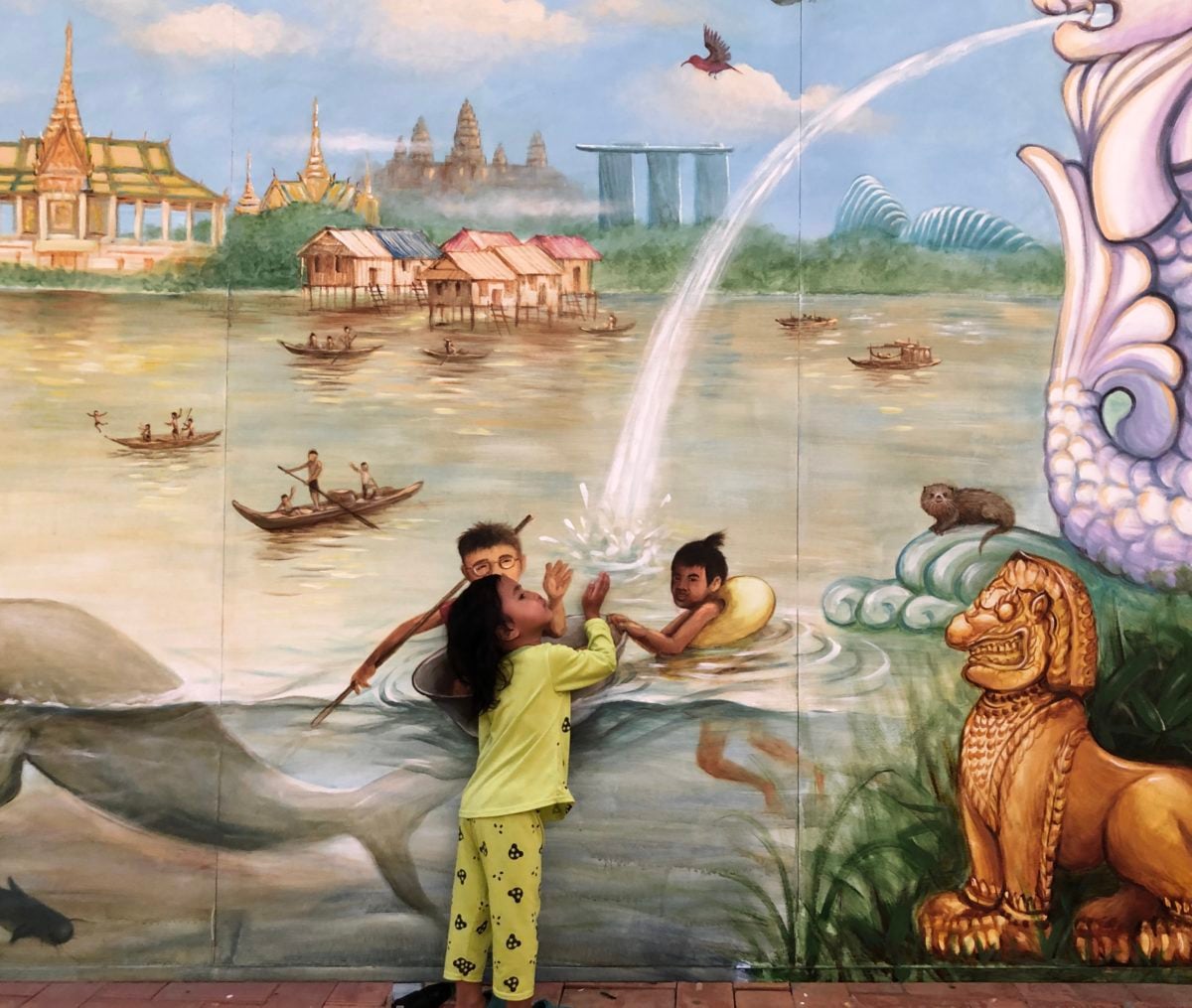
This mural was painted in Cambodia, as part of its Street Arts Fest 2020, which included street art, music, dance, food and various arts workshops. It was organised to celebrate 55 years of Cambodia-Singapore diplomatic relations.
Inspired by the beautiful Bassac River behind the mural, the mural whimsically extends the river’s horizon and combines the Tonle Sap, Mekong and Singapore’s Marina Bay into one magical scene. Iconic landmarks of both countries decorated the waterfront, such as the Grand Palace, Changi Jewel Vortex, Angkor Wat, Gardens by the Bay, Phnom Penh Central Market and the Merlion. Furthermore, the people (Artists :-), flora and fauna of both countries have come together too, showcasing the friendship at all levels; can you identify all of them?
This mural was painted as part of a Street Arts Fest in Cambodia, which included street art, music, dance, food and various arts workshops. The festival celebrates 55 years of diplomatic relations between Cambodia and Singapore.
I painted this colourful and playful mural with the hope to make the viewer crave and dance :-p. I roamed the streets, food markets and tried a variety of Cambodian cuisine in order to paint this mural. From Nom to Amok, Kampot durians to grilled frogs, the colours and floating dishes jumped about and invite the viewer to join in the dance. Watch out for the live crabs, leaping frog, chicken and cat!
I’ve written various types of languages on my murals in different locations, to reflect the local culture there. Here, I have tried writing in Khmer language, it means “Khmer Street Food”. Savour Khmer!
Aug 2015: I like travelling, especially to new places. While most travel buffs have a TripAdvisor, Matador or similar digital travel maps with their “been there, going there…” pinned on the digital globe, I have made a very special one for myself. Special because it truly reflects my personal experiences seeing the world with my wife, my kids, my extended family, my friends, strangers-made-friends along the way, or just by myself. Special also because it is not digital, it is hand-drawn and therefore cannot be updated easily whenever I visit a new place.This drawing encapsulates the places I’ve been to between 1988 to 2015 (My first time on a plane was in 1988 on the way to Brunei for National Service training:-) My first time on a plane for a true leisure trip was in 1990 to Nepal:-)
Can you identify the places, landmarks, people, food and activities on my travel map? Do scroll through, enlarge the areas and see how many places you can identify. If we have been travel companions, you probably will remember or even appear on the map!
Fellow travel buffs will understand why we can spend hours staring at a map or Atlas. We scour the map like a big playbook or mind-map, to dream for unique destinations, routes or entire adventure opportunities. We hatch images, sounds and smells of our dreams on the map. But we dream just enough to allow for some twists and turns which will make the actual journey more exciting. I particularly like rural areas with colourful markets, festivals, homestay opportunities and spectacular sceneries. Lakes and rivers below high mountains usually thrive with unique lifestyles by the waterways. Homestays offer short interactive glimpses of how local people live. Even though at most homestays, we could not speak the host’s language nor they spoke English, we thoroughly enjoyed the interaction (part of the fun!). Communication truly transcends languages. In 2008, I had the pleasure to stay with a Berber family in the Rose Valley of Morocco’s Atlas mountains. At dinner time, the whole family and I sat on the carpeted floor, encircling a large pan of Tangine (rice with mutton) and we ate with our hands. Before and after dinner, the family’s youngest son would go around with a kettle of water and basin to let everyone wash our hands. I still remember the family members’ blue eyes sparkling under the dim light. The family didn’t want their photos to be taken, which made it even more special to draw the occasion on this map.
Throughout these travels, I’ve also learnt the world is actually as similar everywhere as it is different (so the saying goes: same same but different!). Some are more explainable, such as in modern day African cities, the infrastructure looks very much like those in Chinese cities! Some are less explainable: Have you ever noticed the similarities in traditional costumes between the Andean and Himalayan highlanders? They are two continents apart, separated by a huge Atlantic Ocean, yet the Peruvian and Tibetan highlanders bear strong similarities in their facial features, colourful costumes, braided hairs and even their festival mask dances.
Here, I also play a bit of cheat. I have pinned two countries on my “going there” priority list – Iran and Cuba. Firstly because they will imminently undergo rapid changes, hence “more urgent” to pay them a visit; and secondly because it is so hard to update this hand-drawn map!
Happy travelling.
Update: In Nov 2019, this sketch was screened in a digital tunnel in Los Angeles’ largest Creative technology convention – the Adobe Max 2019. I represented Singapore as part of the HP ambassadors’ group for Asia Pacific. Totally unimaginable at the time of drawing it in 2015!
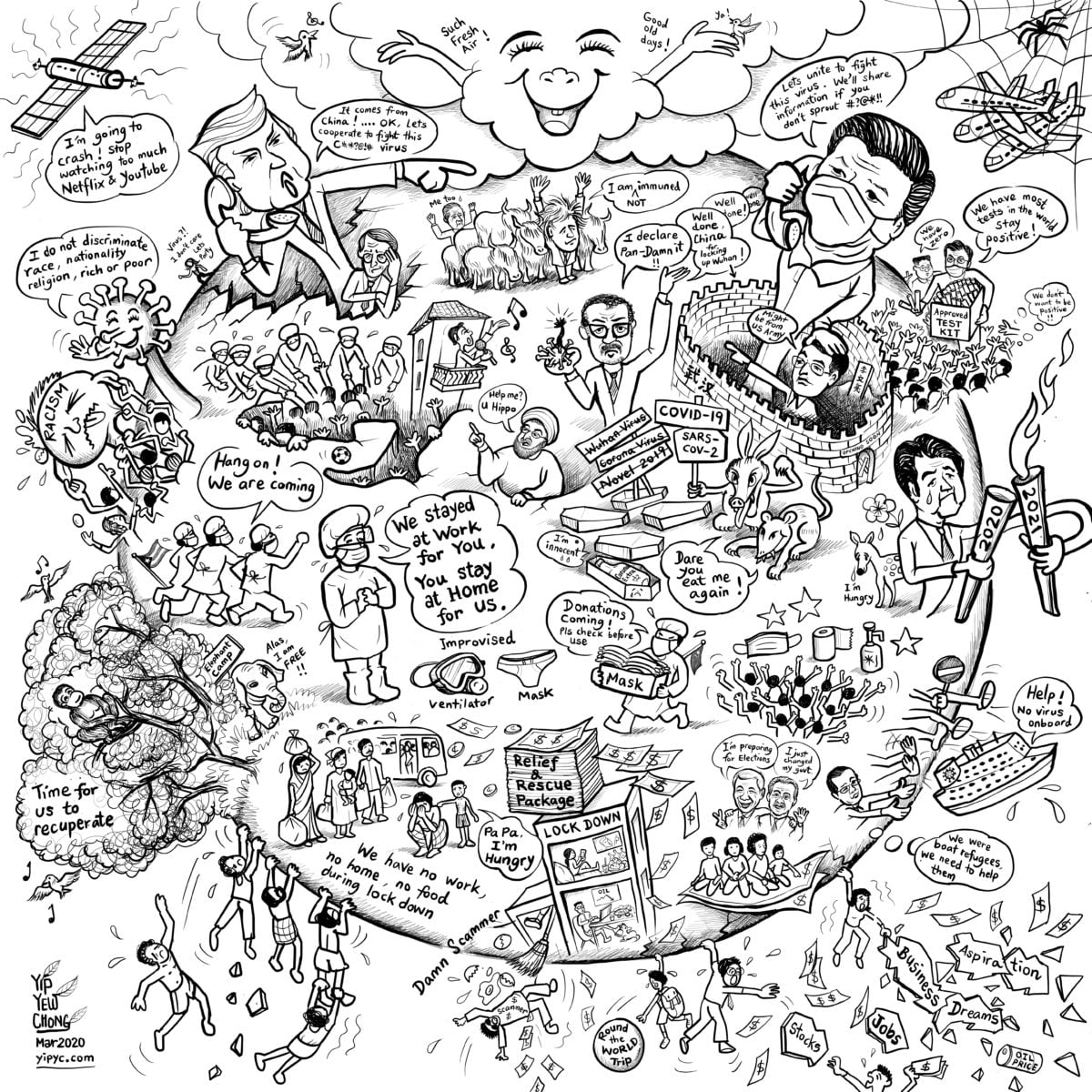
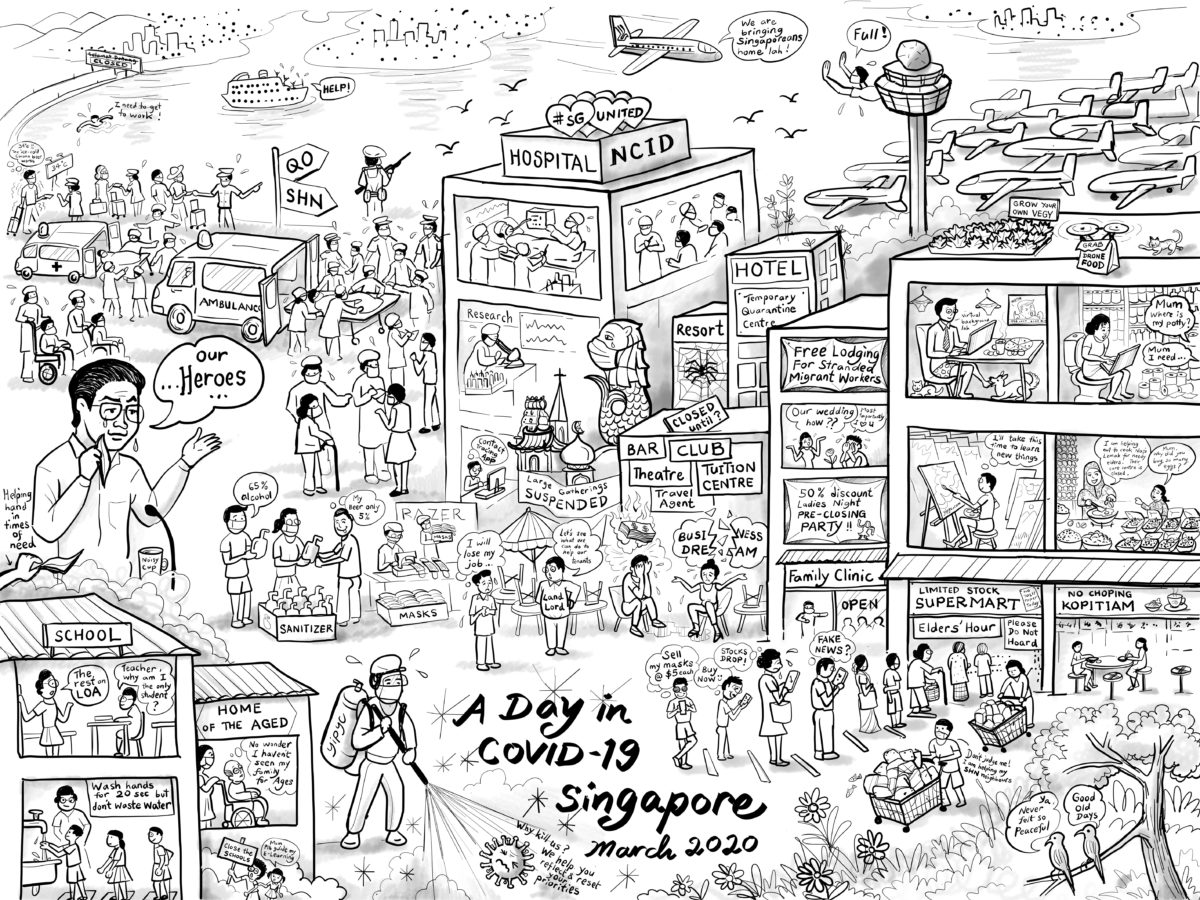
Due to COVID-19 crisis over the last three months (Jan-Mar 2020), many stories have surfaced of our world’s unbelievable politics, of life and of death.. Some were comical, some heart warming while others were just heart wrenching.
I’ve compiled a selection of the headlines and drawn them onto one sketch. Interesting, the sketch doesn’t just retell the news’ headlines, but also exemplify the messy state of our current world order, make stark our rich-poor differences, and highlight our uneasy coexistence with so many conflicting priorities that don’t make sense.
OK, OK, If all these sound too deep, just run your eyes over the details and laugh to kill your stay-at-home time lah! Again, feel free to share, download the high resolution sketch (click in) to view the zoomed-in details, or use it as a wallpaper. Thank you!
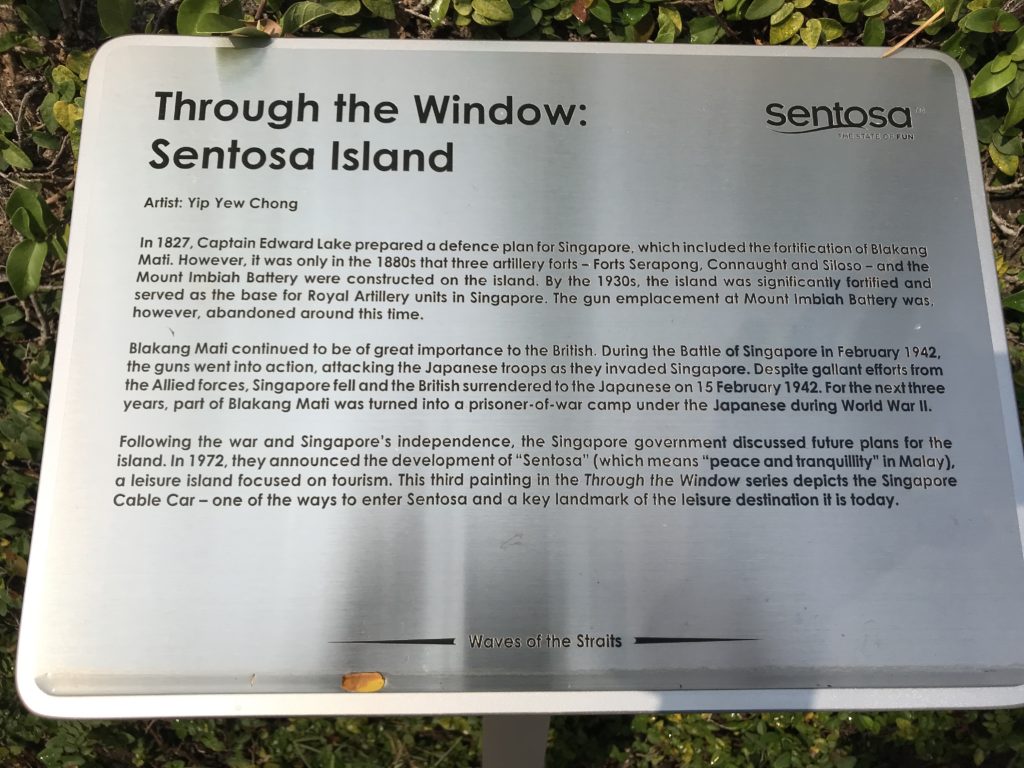
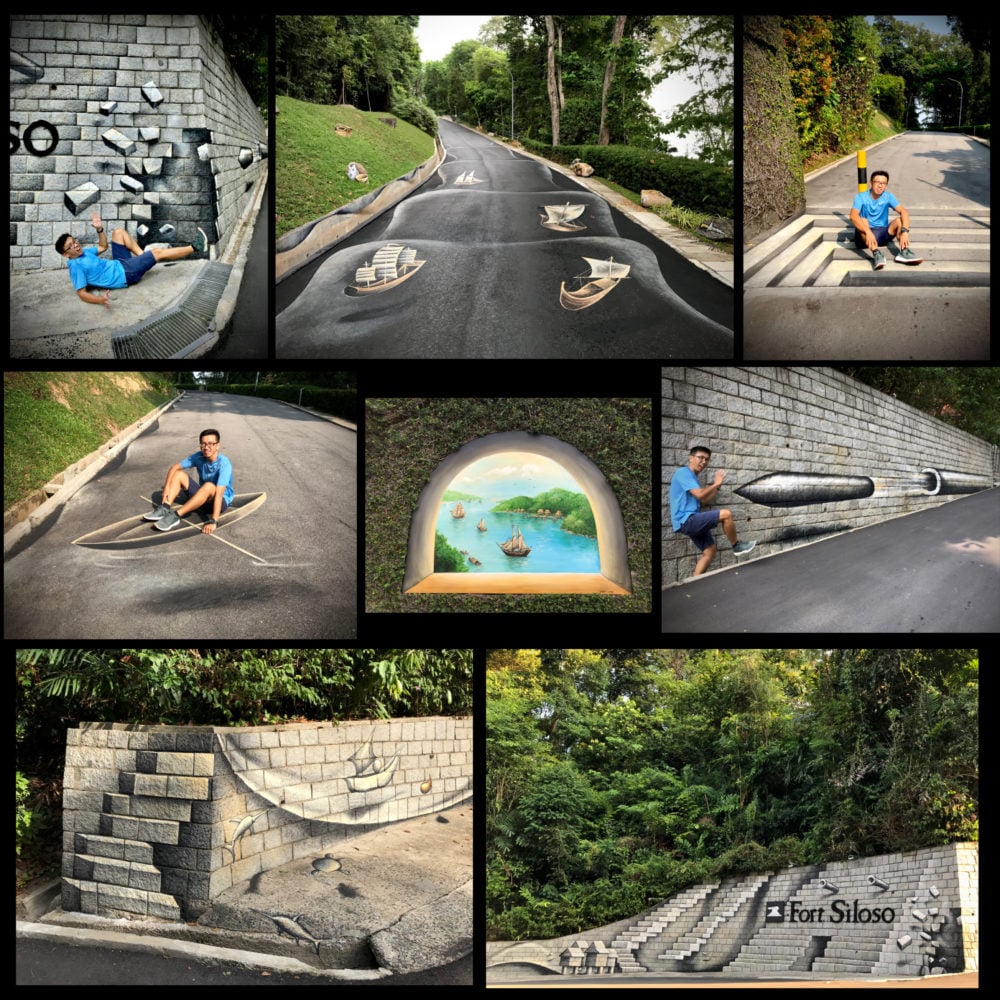
Rippling over the 230m long Fort Siloso Road, “Waves of the Straits” unfurls the historical timeline and legends of the Singapore Straits, the stretch of seas and shores between Sentosa and the mainland. It is my largest physical artwork ever created, in conjunction with Singapore’s Bicentennial commemoration, comprising of a series of paintings on the walls, the road, and rocks.
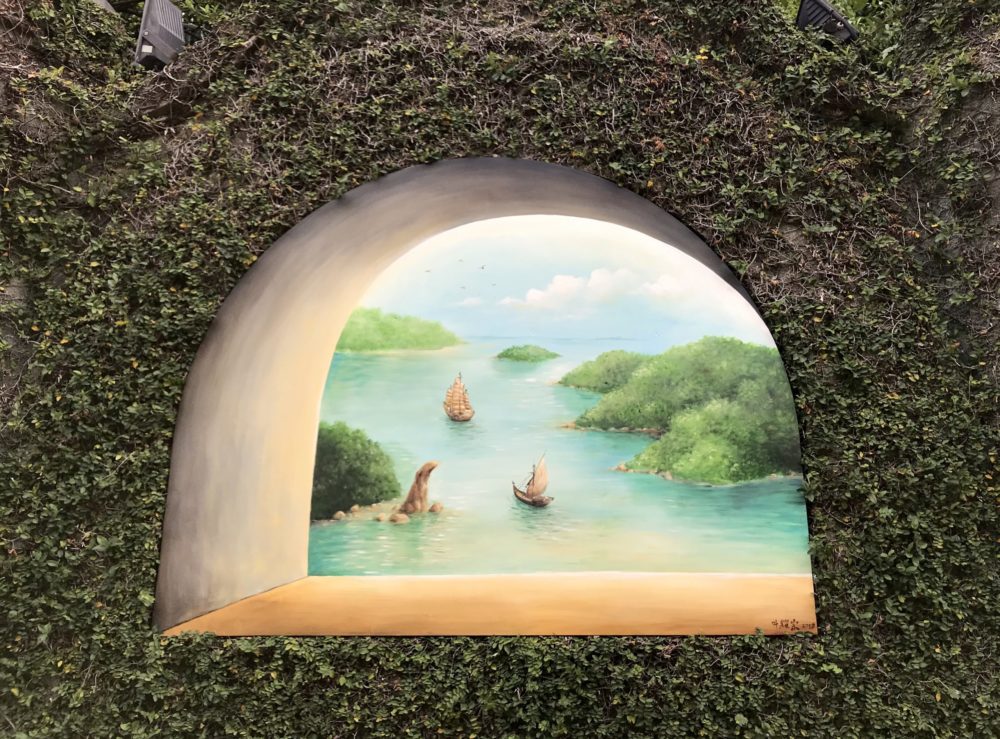
Before entering the fort, three large “windows” prelude views of the Straits in the 1300s, 1800s and 1970s. Try spotting the legendary Dragon Tooth Gate rock which once stood near where Vivo City stands today.
At the narrow Gateway, don’t be afraid to step “into the well”. The stepped well brings you back to the 1300s Srivijaya and Majapahit era. When you see a boat, catch it and paddle up the strait. Look out for “Singa” (lion in Sanskrit), the same lion spotted by the first King of Temasek, Sang Nila Utama. Paddle on gently as you pass by Orang Laut fishing villages dotting the tranquil seashores.
The waves rise and the Strait gets busier. Large ships have arrived from the Malay archipelago, Europe, Middle East, China and India. These ships brought people and their cultures onto the land. It becomes a melting pot of cultures. Spot the Malay Annals, the Singapore Stone, Silver Keris, Chinese maps & porcelain wares, Javanese jewellery etc…many of these original artefacts are displayed in the National Museum today!
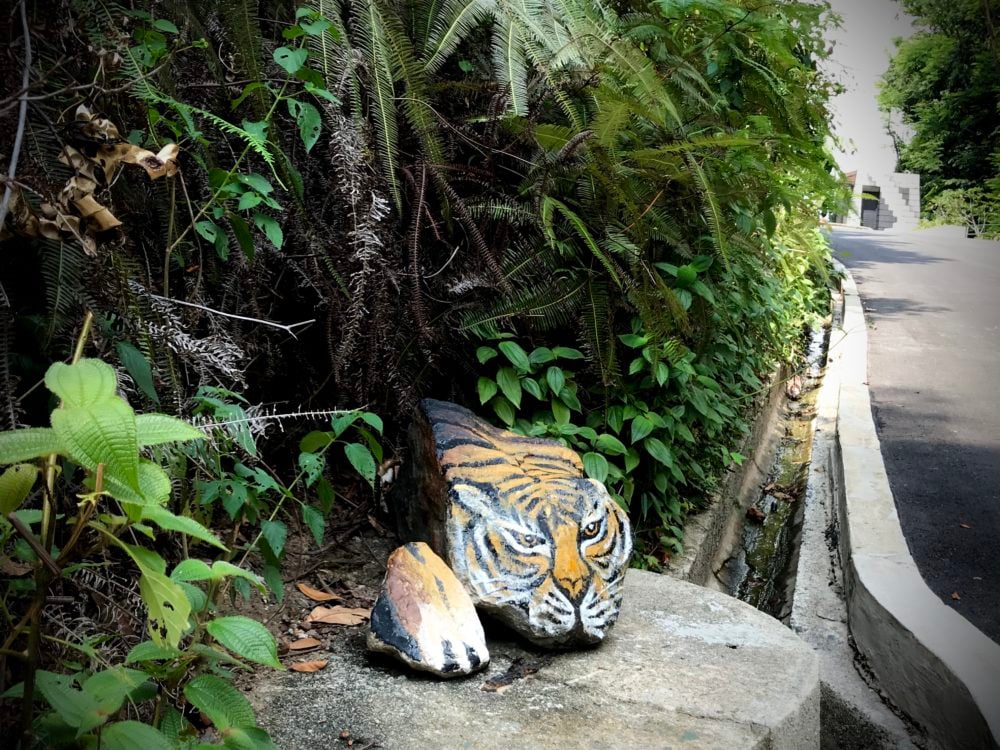
The waves soon calmed. The people settled. The spices and agriculture they brought to this land took roots, settling alongside native flora and fauna. Can you spot the market scene found on the S$50-note? And beware of the Tiger! Fort Siloso was once called ‘Sarang Rimau’, Malay for ‘Tiger’s den’!
The road opens up at the roundabout. The waves rise again dramatically, unfolding legends of the Telok Blangah swordfish and the Kusu Island turtle. The waves hit hard on the shores of Sarang Rimau, but it is now heavily fortified by the British. Deceptive staircases and tunnels lead to the mysterious depth of the Fort. If you dare, enter the subterranean tunnel behind the sentry post. Who knows, you may exit on the mainland at Labrador Park?!
This 37m long mural at Changi Airport Terminal 4 Basement level reminisces the old Changi days before Changi Airport was built in 1970s. From aeroplane-watching at Changi beach, to peeking over the fence of the Royal Air Force Station; From playing ‘tarik upih’ with village kids, to shopping and dining at the variety of shophouses lining Changi Village; The mural transports you to a charming old world brimming with new aspirations.
Note: This installation+Mural is no longer on display. It was a temporary display in 2019 to promote the gazetting of Eglin Bridge as a National Monument.
During the 1970s, the Boat Quay area of the Singapore River teemed with bumboats, cranes and lorries. Coolies carried sacks of goods on their shoulders, balancing on narrow planks laid between the boats and the embankment. “View from Elgin Bridge” is an artwork that aims to recreate this bustling scene in the present day Singapore River. It juxtaposes the miniature tongkangs made from wooden clogs, with the real scene of modern skyscrapers in the background, to form a surreal view that combines both past and present.
A painting done live during the 16th China-ASEAN Expo held in Nanning, Guangxi, China. It depicts a scene juxtaposed with scenes stretching back to 1819 (including the Indiana, the ship which brought Stamford Raffles to land in Singapore) and scenes of present day Marina Bay.
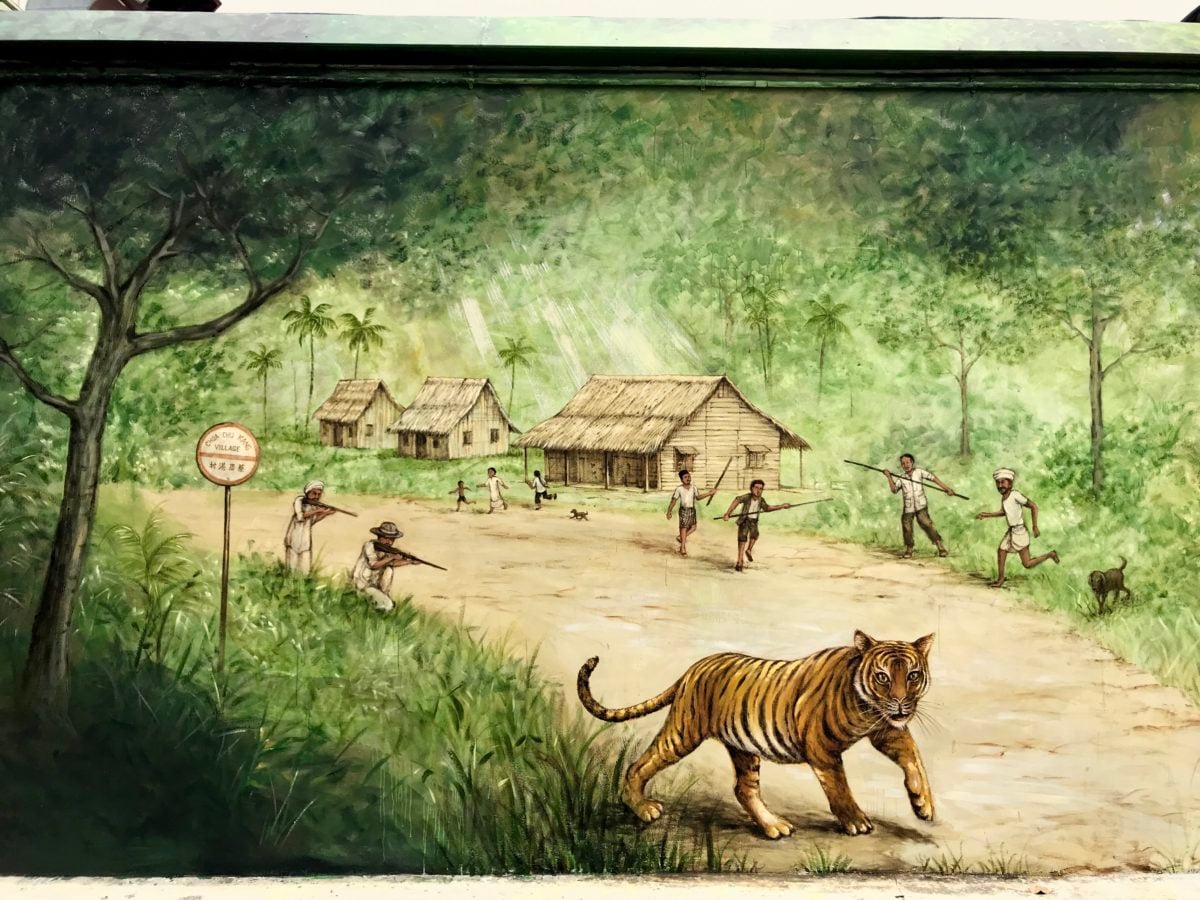
The Gambier plantations in the Bukit Timah corridor were carved out of jungles infested with wild tigers. Deforestation forced the tigers to prowl the plantations and villages. When the incidents of tiger attacks on plantation coolies increased, the then British government gave rewards for capturing the tigers. The last wild tiger shot in Singapore happened on 26 Oct 1930 at the 10th Mile Choa Chu Kang Village.
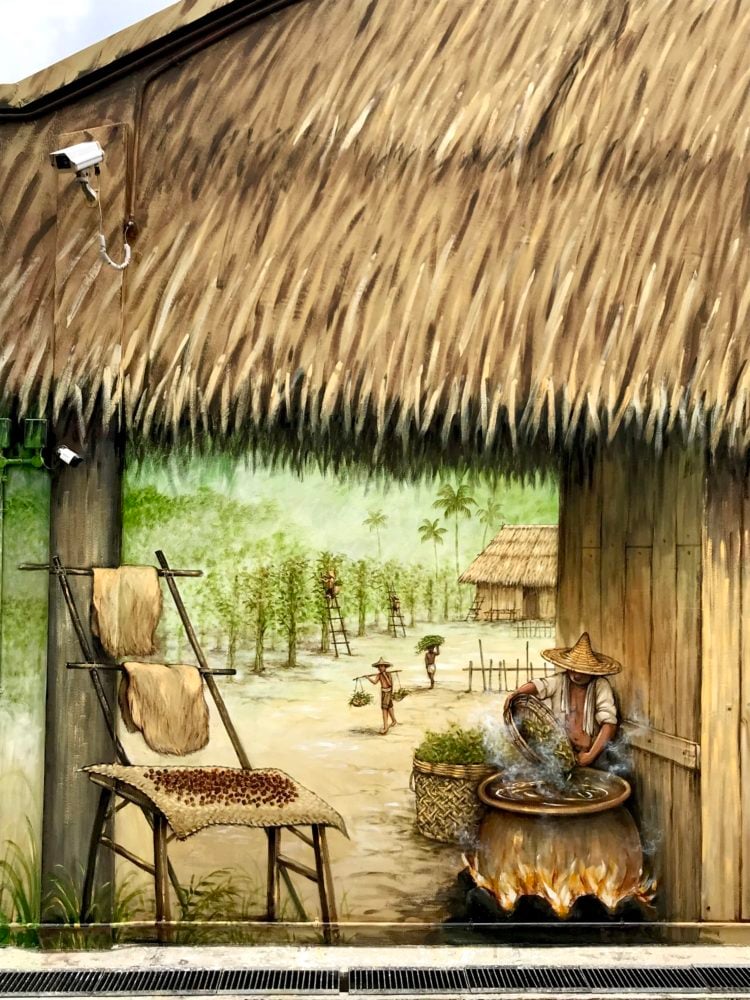
GAMBIER
Gambier, a crop used to make medicine and dyes, was widely cultivated in Singapore in the 1800s. Many Gambier plantations lined the Bukit Timah corridor leading to Woodlands. This mural depicts a typical Gambier plantation where coolies plucked the harvest, boiled the leaves and sun-dried the liquid extracts. By early 1900s, Gambier plantations were gradually replaced by the more lucrative rubber and pineapple plantations.
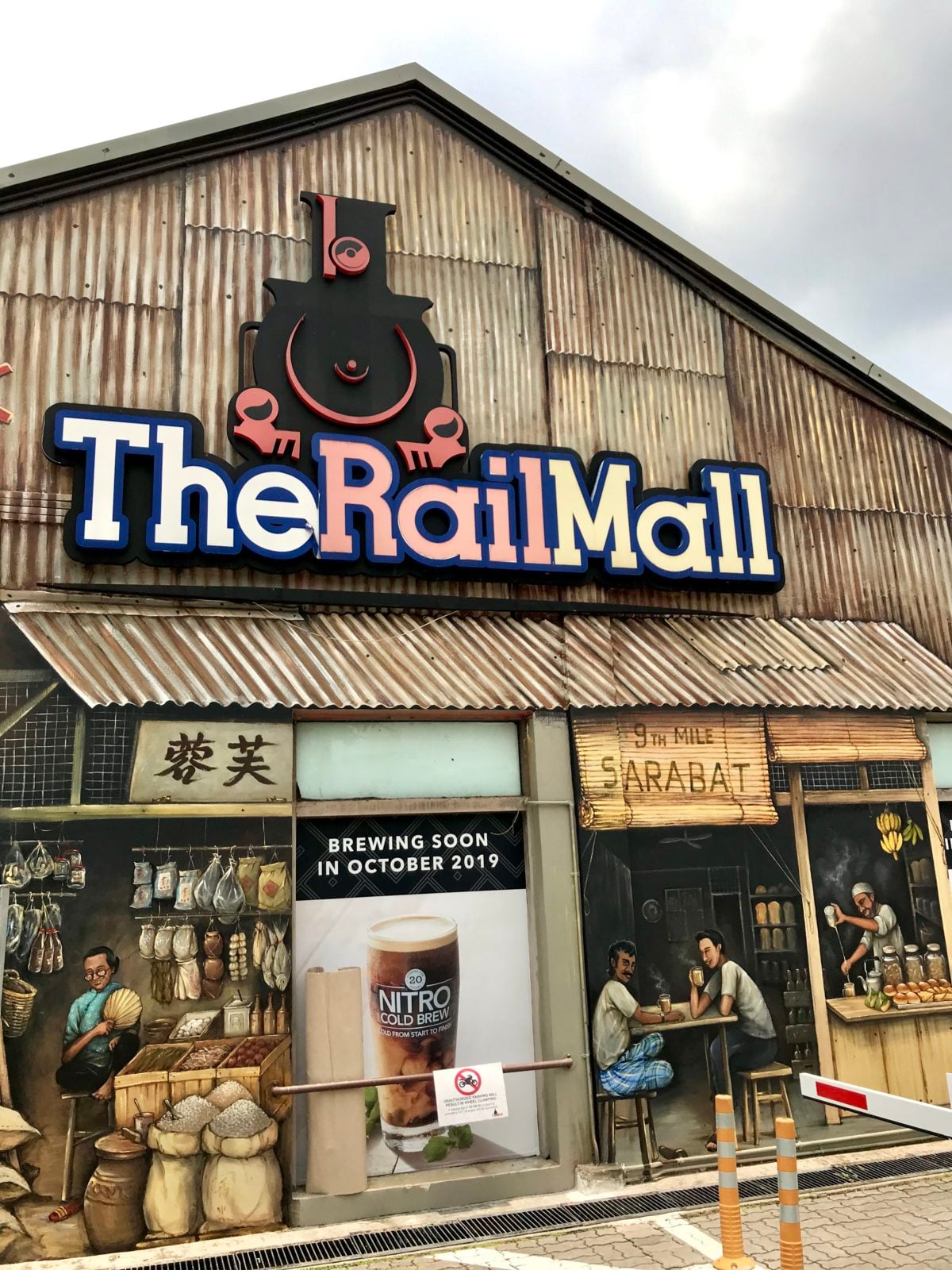
A railway used to run the corridor between Tanjong Pagar and Woodlands, with one stop at Bukit Timah Station. The train crossed the truss bridge in front of the Rail Mall. On 30 June 2011, the last train travelled this rail corridor and ceased operation thereafter. The train’s number plate was 6543.
9TH MILE FUYONG ESTATE
Philanthropist Mr Lee Kong Chian developed the Fuyong estate in 1950s to provide affordable modern housing. Mr Lee named it “Fuyong “(芙蓉) after his birthplace village in China. The estate was at the “9th Mile Stone”. In early the days, Singapore had a milestone system of marking places leading to the General Post Office (present day Fullerton Building).
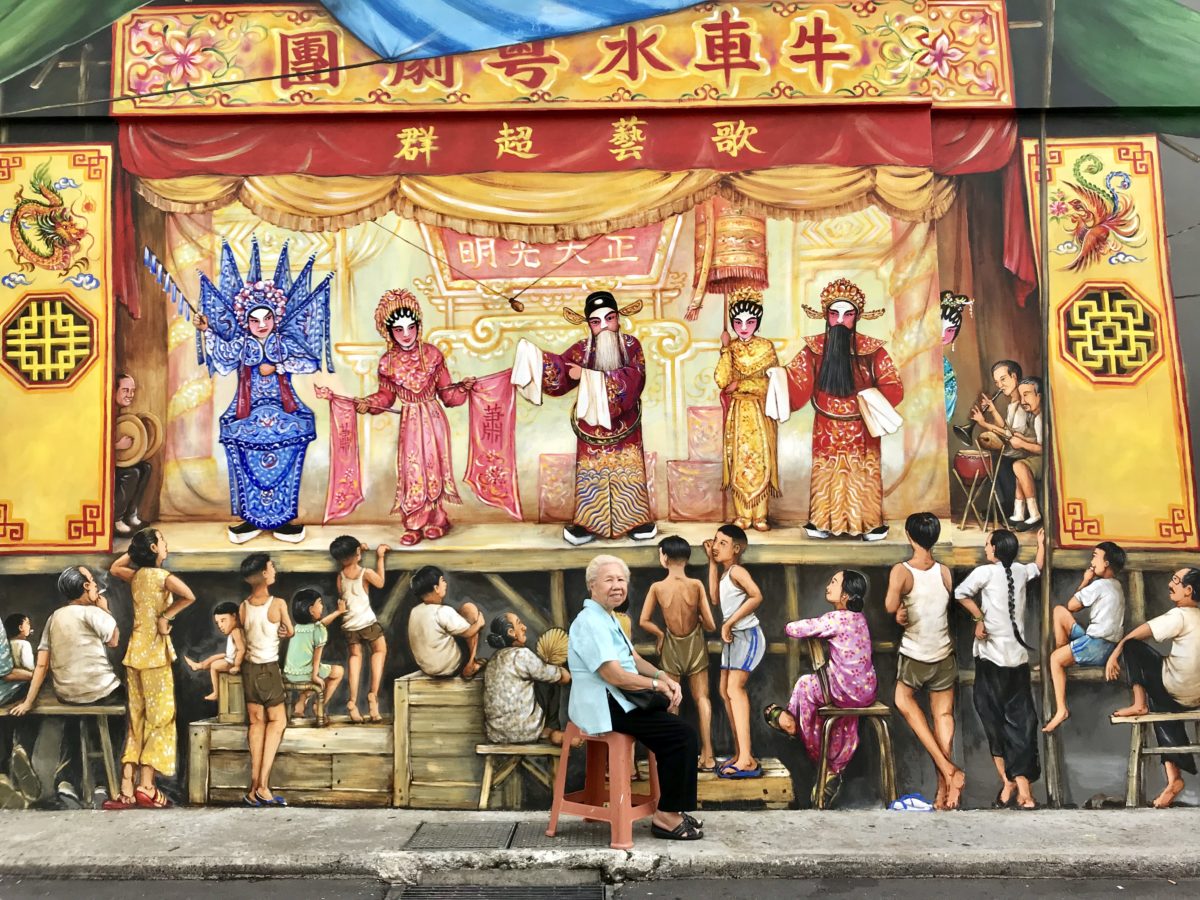
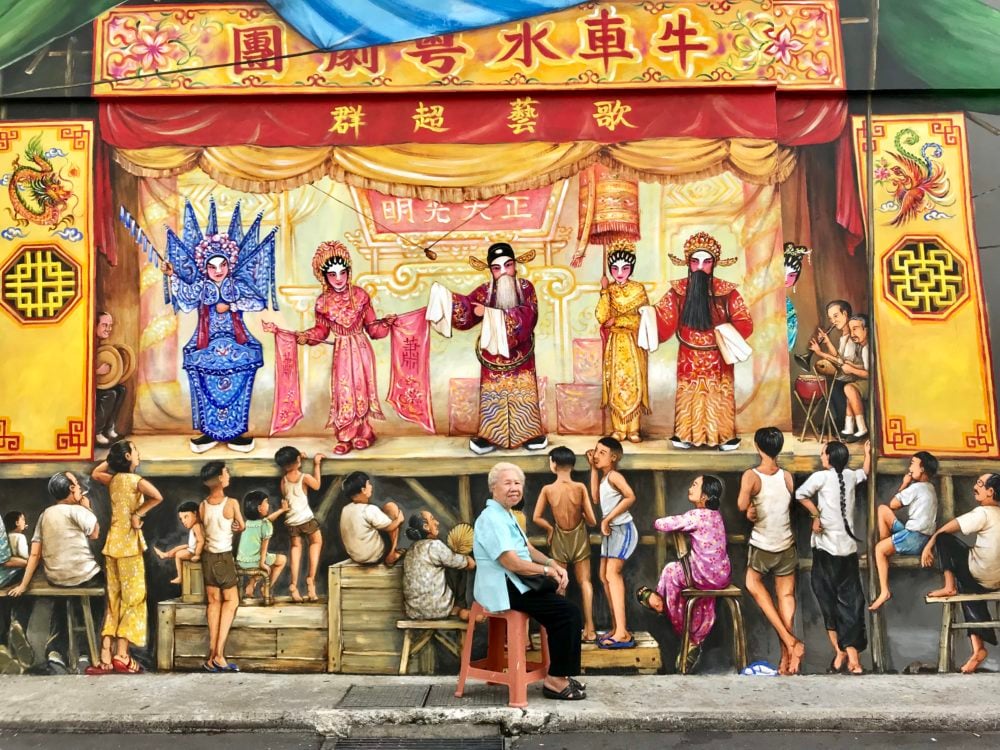
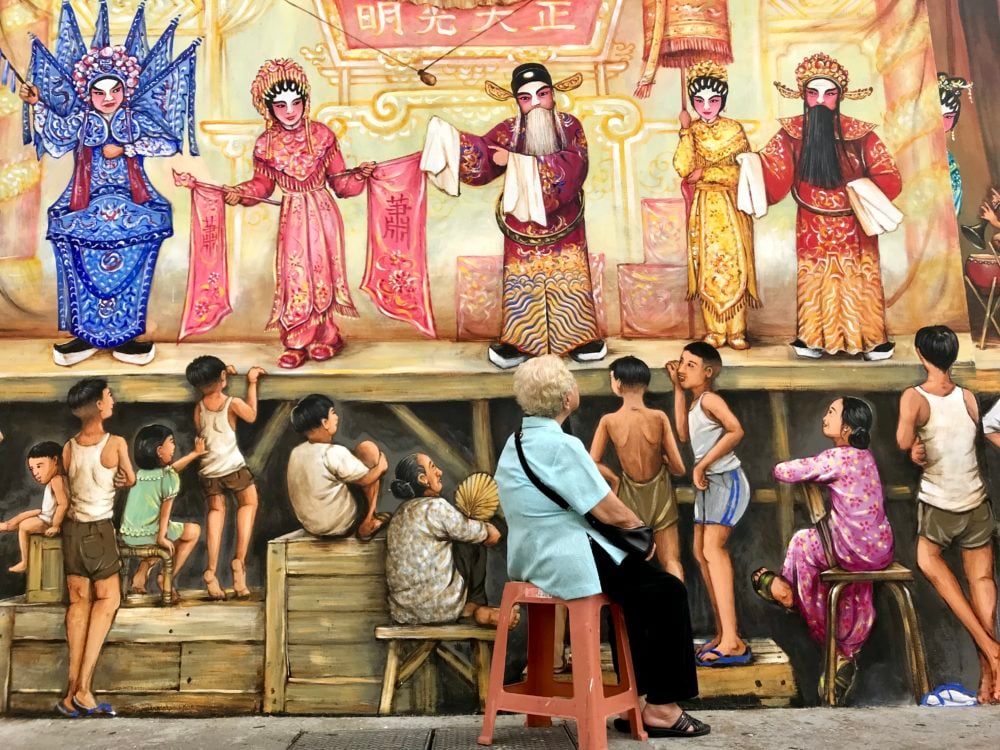
I dreamt of painting this mural in Chinatown way back in Sept 2015, as a gift to my beloved Chinatown. See my blog Inspiration from Cantonese Opera. As a little boy, I followed my aunt to watch Cantonese Operas all around Chinatown. I had fond memories of the dazzling costumes, the realistic backdrops and props, and acrobatic fighting, all of which inspired the style of my art.
It took me three years to discover, navigate and connect with the right stakeholders in Chinatown before the painting could start. I remembered the beginning was hard when my cold calls to house owners and the authorities with my proposal was rejected. However, I was lucky to meet and made friends with people who believed in the idea. They helped me connect with the right stakeholders and rally for their support. Finally in April 2019, I painted the mural over 10 very hot and wet days. To make this dream come true more meaningful, I collaborated with the Community Chest to make this a fund raising event for various charities they support. As I had initiated and self-funded this project, 100% of all donations will go to the charities. To donate, please visit http://www.comchest.sg/yipyewchong
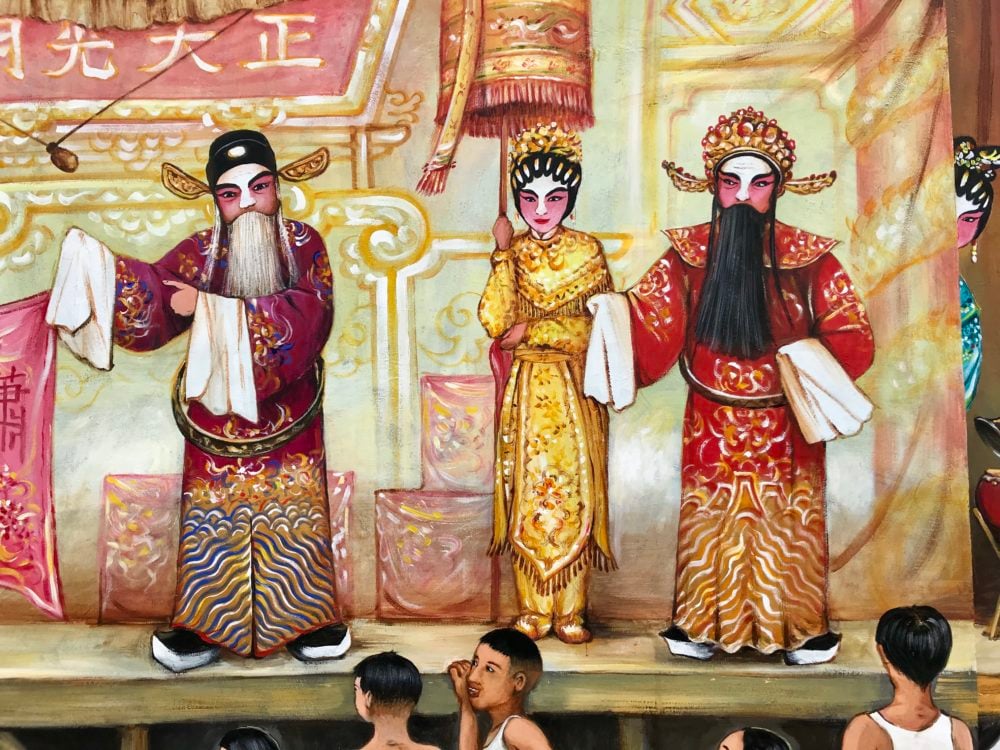
There are plenty of intricate details to appreciate in the mural, such as the actors/actresses’ costumes, the backstage activities, the postures and expressions of the spectators, and the mobile food stalls that had arrived to catch the businesses of the spectators. I hope this colourful mural will delight both locals and tourists, the young and old and people of all races. I hope it has made Chinatown culturally more interesting and the street more beautiful. Thank you everyone for your support!
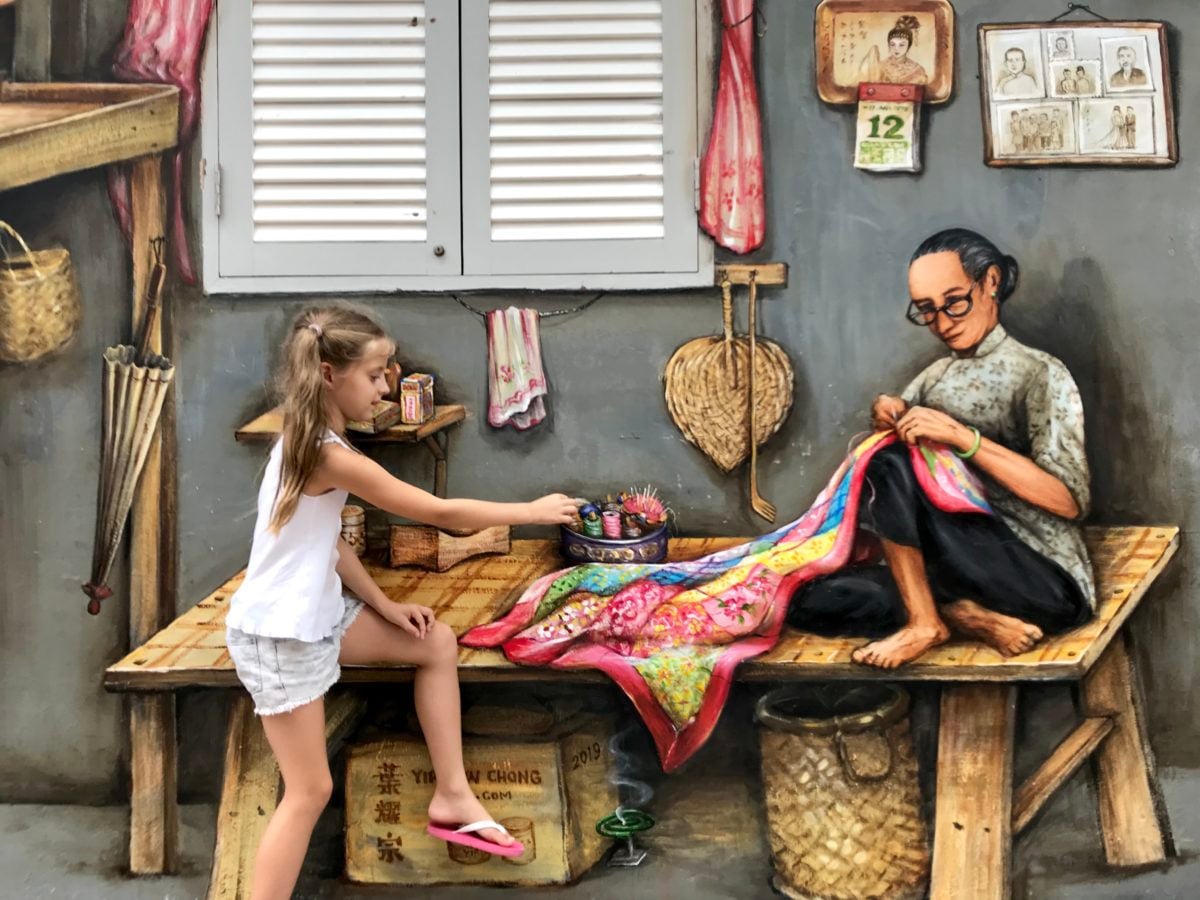
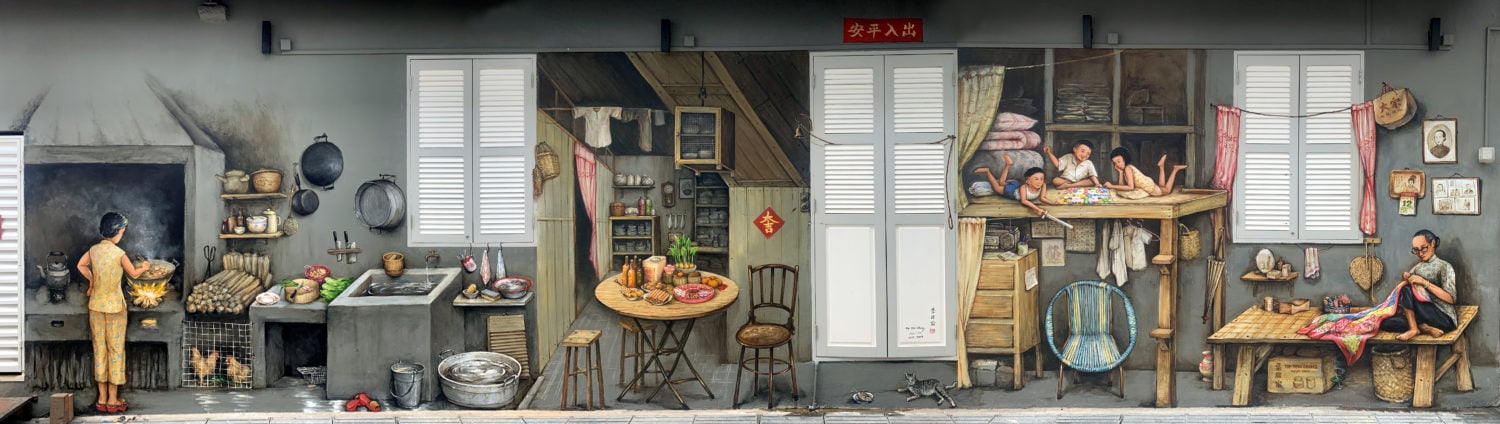
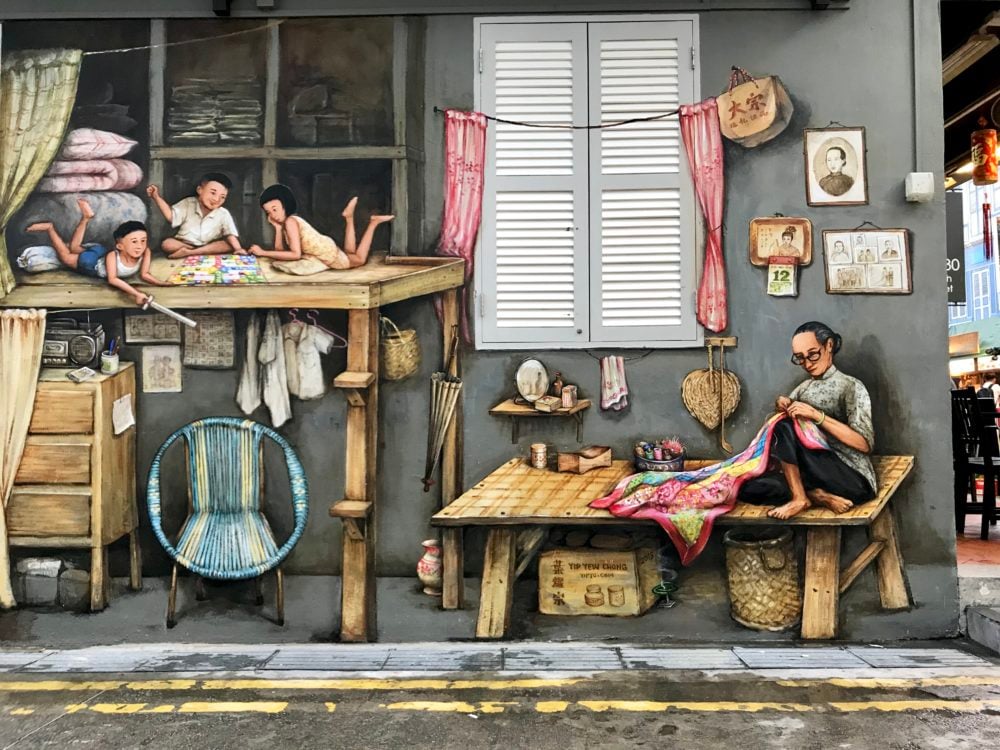
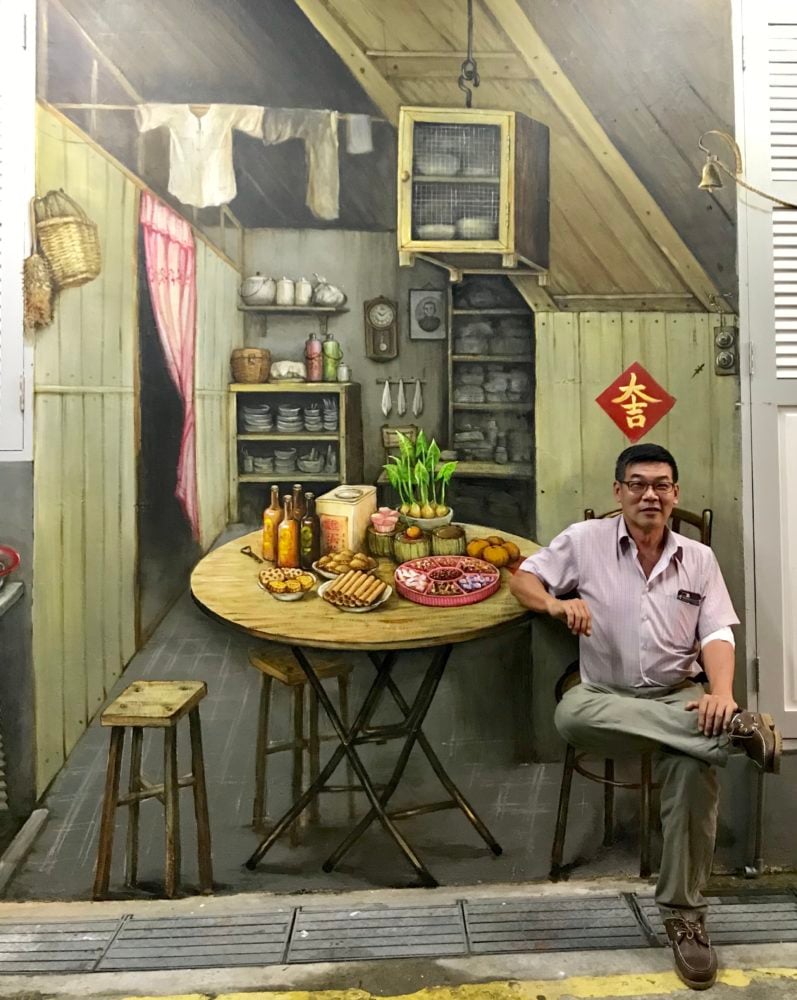
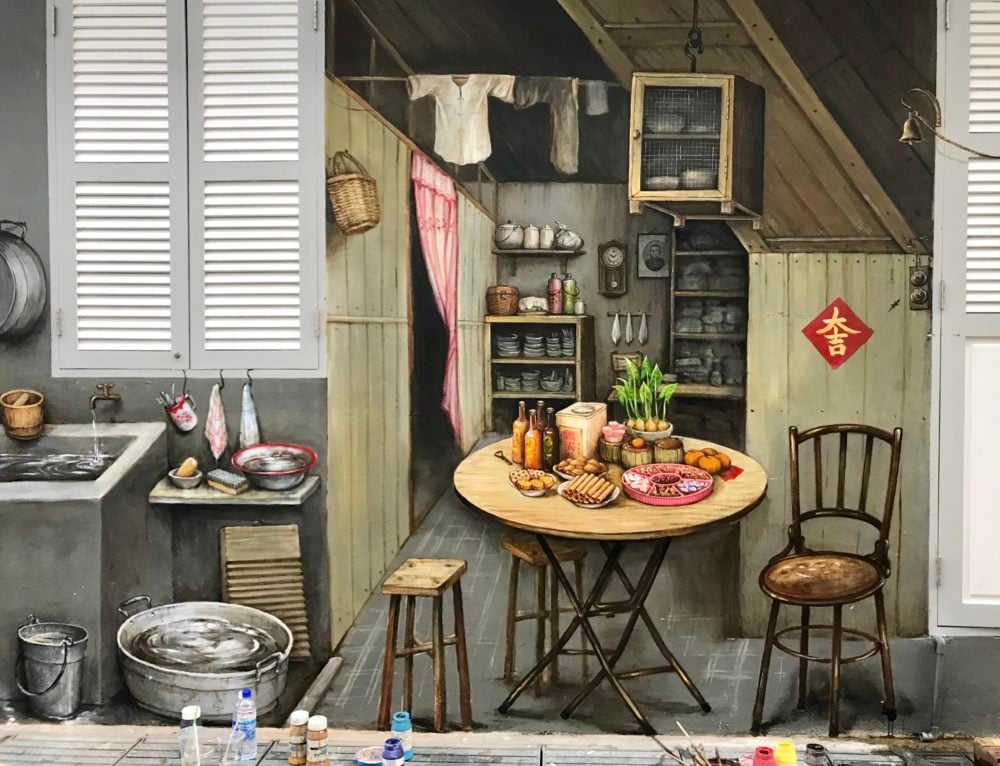
This mural has got to be my most intimate mural ever painted, because it depicts my very first home in Sago Lane, Chinatown. Every detail and object in the entire composition was painted based on my fond memories of the home – from the common living room, the common long wooden bed where my siblings, aunt and co-tenants slept on, the dining area, to the kitchen. I also painted my late Grandmother, who was a seamstress, sewing a patchwork blanket. On the long bed, my siblings and I were playing the “aeroplane chess”. At the kitchen, my mum was frying the new year sticky cake. Can you spot the cane, the mosquito coil, the cassette player, door bell, wall gecko and the rat trap? Do you know why is that cabinet hanging from the ceiling?
My family was the anchor tenant of the house on the second storey, just above the funeral parlour on the ground floor. We rented it from an Arab landlord and sub-tenanted smaller units to 4 other co-tenant families. In 1983, my family had to move out when the entire street was slated for demolition as part of the big Chinatown cleanup. Apparently, all the waste water from the street markets and households in Chinatown flowed into the Singapore River. My family moved to the HDB block above the Chinatown Complex market at Smith Street. Ironically, the plot lay empty for over two decades until the Buddha Tooth Relic Temple was built in 2007. My dear home is now a carpark next to the Temple. In a few years time, it will be the entrance to the Maxwell MRT Station.
Painting this mural in Chinatown was a dream come true. This mural is special for three reasons: Firstly, Chinatown is where I grew up and have fond memories of. Secondly, for 2 years, I pursued the opportunity to paint murals in Chinatown, experiencing many hurdles, but also learnt many lessons and made many friends along the way. Finally, this is the first mural I painted with my two children!
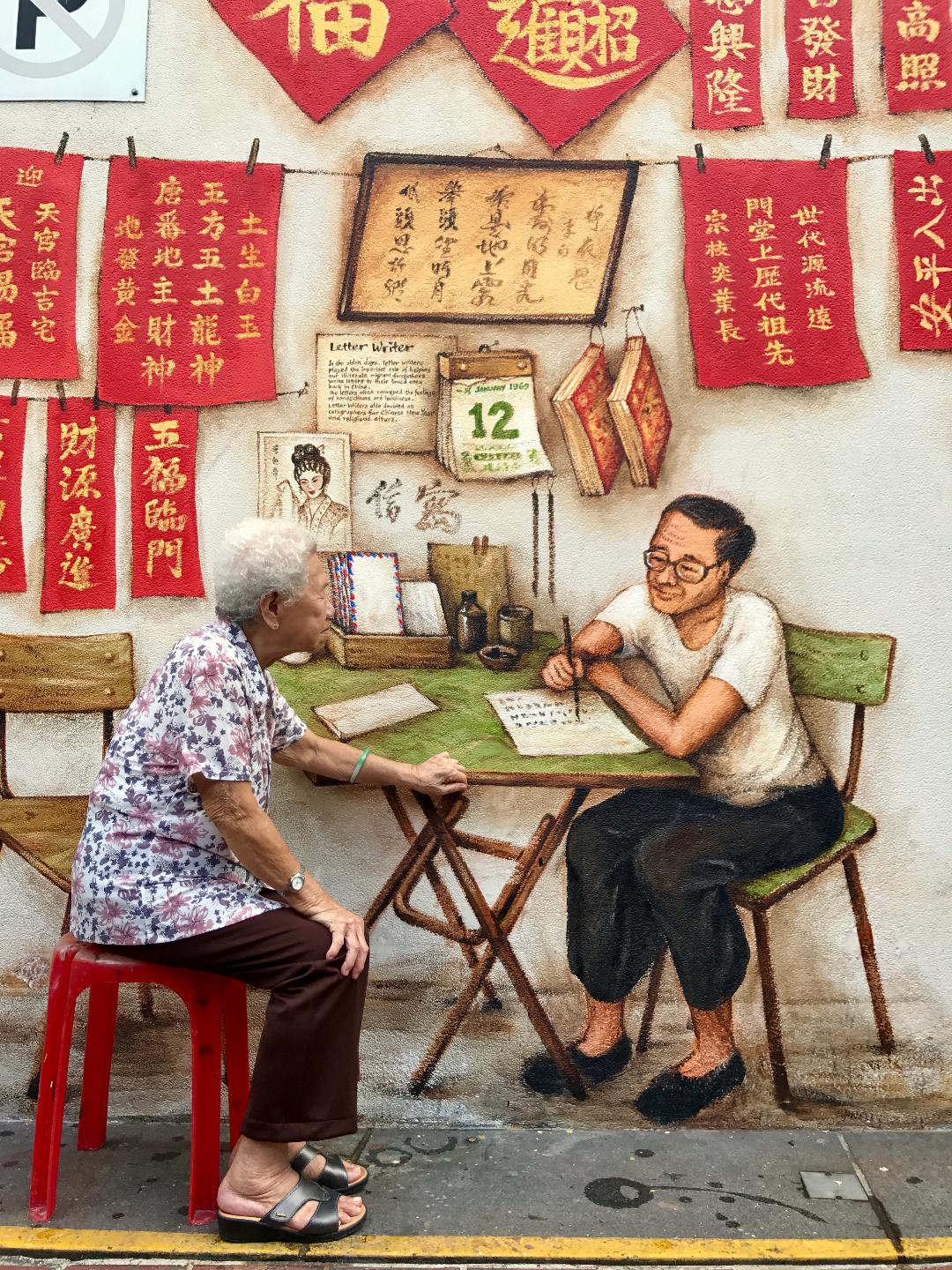
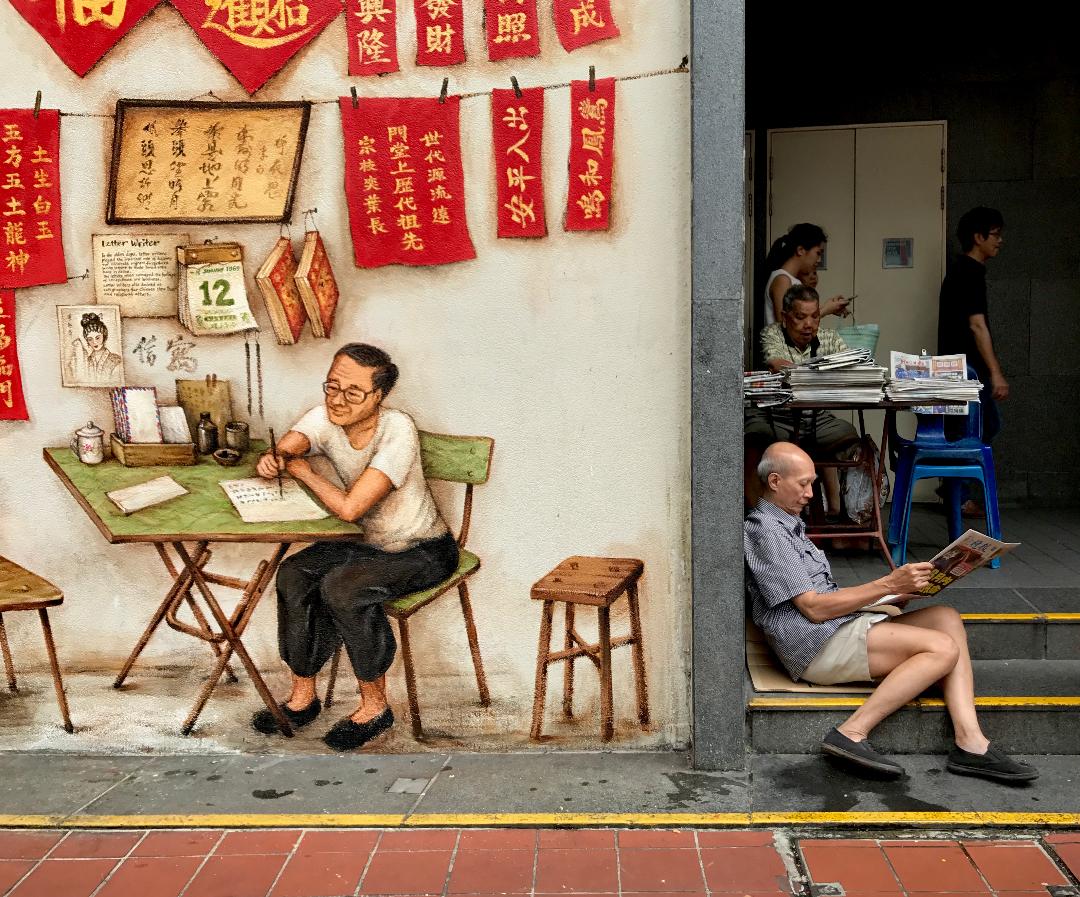
In the olden days, Letter writers played an important role of helping our migrant forefathers write letters to their loved ones back in China. They also doubled as calligraphers for Chinese New Year couplets and ancestral altars. This was a common scene in Chinatown up till the 80s before the big Chinatown cleanup when the street markets, hawkers and traditional traders were resettled inside the mammoth Chinatown Complex (completed in 1983). I missed those scenes!
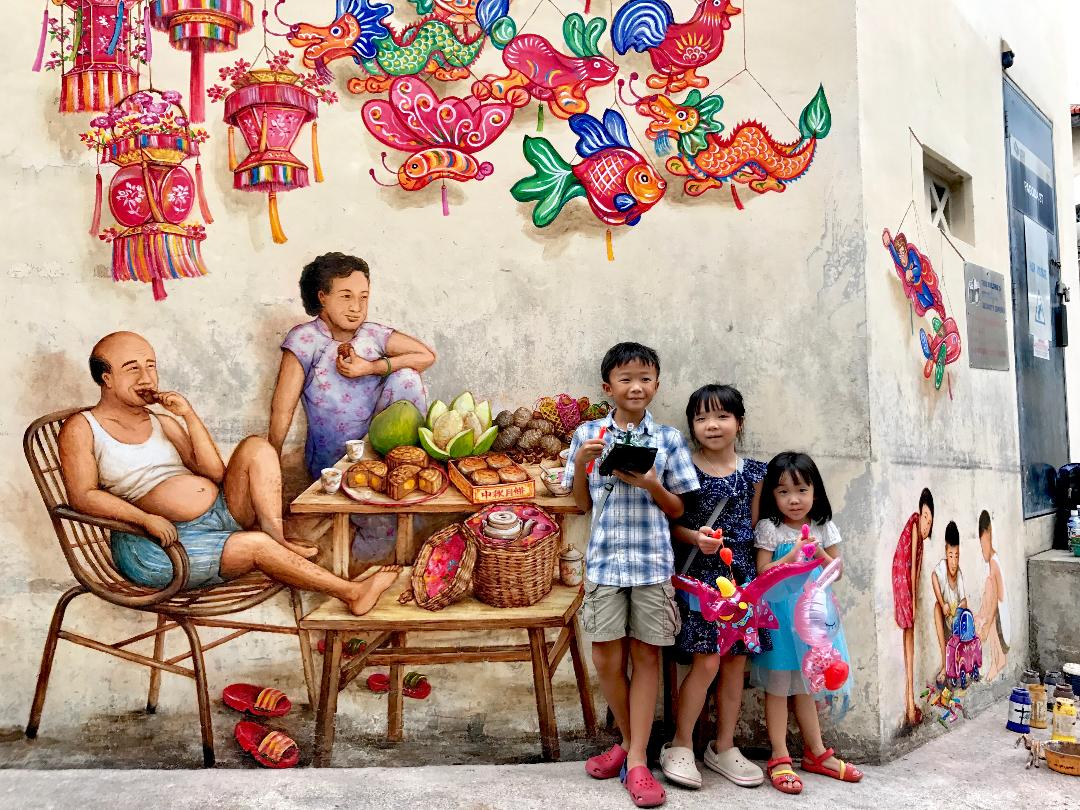
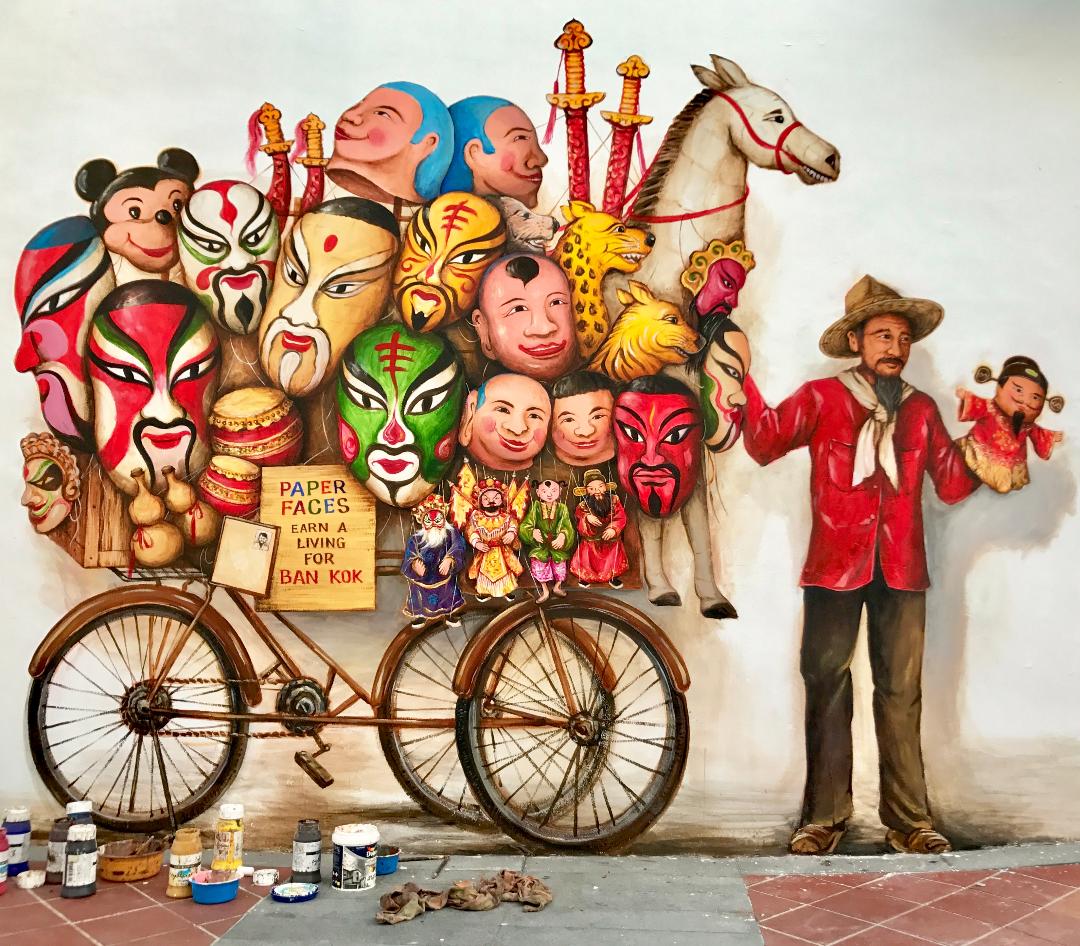
Actually, painting the Letter Writer is part of a bigger dream to paint 6 murals in Chinatown – Letter Writer, Wooden Clog Maker, Cantonese Opera Stage, Chinatown Wet Market, Paper Mask and Puppet Seller, Lantern Festival. I am so happy to have fulfilled part of my dream. Thanks to everyone who helped me get the approval. I hope to fulfil the rest someday! Thank you!
The mural is located at Singapore Chinatown, 336 Smith Street, on the side wall of New Bridge Centre, just outside the CK department store.
This was what I late dad did towards every Chinese New Year up to 1983 before we moved to a HDB flat. We had various altars in our old shop house in Chinatown Sago Lane such as 天宮(heavenly god), 土公(earth god), and 灶君(kitchen god). He would write new calligraphies for all the gods to replace the old ones covered in soot after a year of incense. He also wrote a few good words to decorate the house. He wasn’t trained but just did it!
Void Decks don’t need to be void. The Void Decks of Block 683 Woodlands Avenue 62 have been transformed into a whimsical world with three zones – the Farmland/Kampung zone, the Modern/Futuristic City zone, and the Nature zone. The place-making is ready to welcome residents to use the space for community activities.
Void Decks don’t need to be void. The Void Decks of Block 683 Woodlands Avenue 62 have been transformed into a whimsical world with three zones – the Farmland/Kampung zone, the Modern/Futuristic City zone, and the Nature zone. The place-making is ready to welcome residents to use the space for community activities.
Void Decks don’t need to be void. The Void Decks of Block 683 Woodlands Avenue 62 have been transformed into a whimsical world with three zones – the Farmland/Kampung zone, the Modern/Futuristic City zone, and the Nature zone. The place-making is ready to welcome residents to use the space for community activities.
I had the honour to create one of my largest mural ever, and more uniquely, it is in Delhi, India! The mural concept was inspired by the sights, sounds and smells of the Lodhi Colony, a residential area which has become an open art gallery for all, with its many large murals painted by both Indian and international artists. I painted the mural as part of an Art Festival organised by St+Art India Foundation and sponsored by Singapore Tourism Board. Several Singaporean Artists participated in the Festival.
I decided to use my usual semi-realistic painting style and chose a local life theme because I wish the mural to connect with people on the streets. On my first day of arrival in Delhi, to gather inspiration, I visited all the artworks in the district, walked the markets and strolled the Lodi Garden. After taking many photographs, I made a final design composition overnight. After one night and eight days of painting with the kind help and support of the very hardworking staff and volunteers of St+Art, the 10m high by 30m long mural was successfully completed!
The mural featured larger-than-life images of a Bansuri wala (Flute seller, a scene which has disappeared on the streets in Lodhi), a cow, a sweet shop (Mithai), Chai (tea), school/bookshop, carpet, shawls and garlands. I was very glad about the choice of design concept because I had noticed the locals were able to immediately connect with them. Though there were many beautiful murals in Lodhi, they told me this one rare one that focused all about them. I also painted a little barbershop at the bottom right corner of the large wall. Unlike the other larger-than-life images, the barbershop was painted life-sized. A boy sat on a raised chair “having his hair cut”, however the barber is missing! As expected of the reaction, the locals and passers-by immediately knew they they had to “fill in” as his barber. The locals had fun posing for photographs!
I hope this mural will bring a smile to both locals and visitors when they see it. I also hope the mural has brought about a good exchange of cultures between India and Singapore (thanks to STB and St+Art India :-), as well as a better appreciation and understanding of our world’s similar and diverse cultures…same same but different!
Mural is at Lodhi Colony, Block 13 (street between Block 13 and block 16, off Meera Marg), Delhi, India. On the same lane, you will find the murals of fellow Singaporeans Eugene Soh, Samantha Lo and Sheryo (of Yok & Sheryo)!
Just as Singapore’s Kampongs are fast disappearing, a new yet rustic Kampong has mysteriously sprouted up on mainland Singapore!
Nestled within a coconut grove, A Malay family and a Chinese family live side by side in their traditional air-cooled wooden houses. The fragrance of durians, rambutan and bananas fill the air. A lazy cat nonchalantly naps on amidst the noisy crowing of the roosters and barking of the dog. Nearby, swaying coconut trees rustle in the breeze above an idyllic pond teeming with egrets, herons and kingfishers. The whiteness of the egrets contrast with the rippling green pond like floating white clouds against an azure sky. A pair of squeaking otters play peekaboo amongst floating water hyacinth blooming in purple flowers. A crimson sunbird perches on a fence, chirping sweet melodies, adding to the symphony. On the opposite side of the pond, there is a papaya plantation and a banana plantation. A glistening longkang (dialect for a stream), its shores decorated with yellow creeping daisies, meanders through the plantations. A father teaches his little boy how to pluck papayas using an improvised container and stick by cupping and twisting them, the traditional Kampong way of plucking papayas. Three boys sit on a bridge planking the longkang, chatting, fishing and just enjoying the Kampong life.
Those were the Kampong days….
I spent a week recreating this idyllic bygone Kampong scene by hand-painting the above details and blending them into the environment. I really miss these scenes. I think many of us miss them too. Such scenes were so common in olden day Singapore, but they have all been buried in our rapid development. Although Kampong Buangkok or the Kampongs in Pulau Ubin are still present, their village atmosphere are more muted due to fewer residents and activities. I hope this commissioned heritage mural helps bring back good old memories for the older generation, as well as let the younger generations have a glimpse of Kampong life, without the need to cross the Straits of Johore. Do bring your elders or kids to visit this new Kampong before nature takes over and the elements fade its colours. The elders can relive the old days of munching durians at the verandah while the kids can get up close with the birds and otters. I take this opportunity to thank the owner for the opportunity to create this “Kampong” for all to enjoy.
Can you spot the Crimson Sunbird perching on the fence? One of the Otters playfully poses for your photo, but take your time, it won’t turn away.
An egret preying on an insect. The sun rays are real (come at around 4pm to see the phenomenon).
Encik and his grandson
Macik and Ah Soh, can I have some rambutans and durians too? The jackfruits look sweet as well!
Longkang fishing
A Grey Heron having a free buffet.
Remember that you can only pluck the papayas in the front of the wall but not those behind the wall.
Taking photos from behind the trees by the roadside give a surreal perspective.
Can you spot the Common Kingfisher? Its sister, the Collared Kingfisher, was the star on our Singapore One Dollar Note in the seventies.
Visiting the Mural
The Kampong is located at Tanah Merah area, along Upper Changi Road just beside the main gate of Palmwoods Condominium and perpendicularly opposite the row of ‘East Village’ eateries. The mural is very visible as it faces the main road (Upper Changi Road). It’s along a shady public walking pavement, hence it is a nice and safe way to enjoy the “scenery” and “birdwatch”. When you visit it, please note the wall belongs to a private property along a public pavement and grass verge, hence I urge you to please speak softly so as not to disturb the real residents and wildlife (you will hear real chirping birds). Please take only pictures and do not pluck any real papayas and bananas, lemon grass nor trample on the plants (you may bring your own real fruits to pose for photos, but please help keep the place clean by not littering). The best time to visit it is 4pm, when the afternoon sun rays pierce through the canopy and light up the mural with a bit of the trees’ swaying shadows, giving it a surreal effect. After visiting the mural, you may like to walk around the quaint ‘Bedok Marketplace’ or “East Village” vicinity. There are abundant eateries, shops, a Giant Hypermart and an old styled Post Office. The whole vicinity has a village atmosphere.
Directions:
By MRT – At Tanah Merah Station, cross by underpass to the bus stop going towards Expo Station direction, take Bus No. 2, 9 or 48 and alight at the 3rd bus-stop. You will see the mural on the opposite side of the road.
By Car – Park at “Bedok Market Place” carpark (not to be confused with Bedok Central, a different place altogether). Walk about 200 metres along the perimeter of the Palmwoods Condominium until you see its main gate. The mural is just beside the gate.
Lastly, if you like my work, please share it in social media. Please also feel free to contact me for any future mural ideas or opportunities by leaving either a Facebook private message or a comment on my Blog, after which I will respond. Thank you for your support and enjoy visiting the “Kampung”.
Hidden inside a newly opened mall, which is in turn surrounded by tall buildings, right in the City Centre of Kuala Lumpur, is a gigantic Banyan Tree. This rare lush greenery in the most unexpected place inspire me to create a mural which evokes and celebrates the coexistence of Nature and Mankind. The mural aims to immerse the building back into the Tree, mankind to Nature, and the present to the past. The hanging roots of the Tree particularly inspired the dripping-paint technique used throughout the painting. Have fun spotting the variety of flora and fauna! Here’s a little poem I have composed to compliment the mural:
Long before our times,
thick jungles covered the land from coasts to coasts.
Across the land and sea, mankind arrived in droves while Nature played host.
Where mankind consumed in abundance,
Coexistence became a burden
Nature receded to the interior, to give way to the future.
Hidden inside a newly opened mall, which is in turn surrounded by tall buildings, right in the City Centre of Kuala Lumpur, is a gigantic Banyan Tree. This rare lush greenery in the most unexpected place inspire me to create a mural which evokes and celebrates the coexistence of Nature and Mankind. The mural aims to immerse the building back into the Tree, mankind to Nature, and the present to the past. The hanging roots of the Tree particularly inspired the dripping-paint technique used throughout the painting. Have fun spotting the variety of flora and fauna! Here’s a little poem I have composed to compliment the mural:
Long before our times,
thick jungles covered the land from coasts to coasts.
Across the land and sea, mankind arrived in droves while Nature played host.
Where mankind consumed in abundance,
Coexistence became a burden
Nature receded to the interior, to give way to the future.
Meet the Kadir family (of the “Abdul Kadir Mamakshop” mural) and the Lee family (of the “lion dance head maker” mural). This mural gives a glimpse of how different tenant families, regardless of race, language or religion, once lived together in the same shophouse. This was how I lived during my childhood days until 1983. My family was one of five tenants co-living in a second-storey shophouse in Chinatown Sago Lane. We shared long wooden double-decker beds or lived in compartments in the long hall. We rented the floor from the Arabs who owned many of the Chinatown shophouses. The tenants sometimes squabbled but always cared for one another like a big family! I remembered a co-tenant bought me a yellow toy tortoise, try find it in this ‘story’ mural at Mohamed Ali Lane:-)
This mural of a Lion Dance Hard Maker Shop ate Mohamed Ali Lane (side wall of 227 South Bridge Road), is based on the actual shop at No. 3 Ann Siang Hill in the 1980s.
The Abdul Kadir “Mamak Store” mural at Mohamed Ali Lane in Chinatown is based on my fond memories of the actual Abdul Kadir’s store in Sago Lane. My family used to call him “Tami” (Tamil). I remembered learning my first Tamil phrase “kalai vanakam” from him. When Sago Lane was demolished in 1984, Abdul Kadir moved his stall into the Chinatown complex and continued to run his business for another almost 3 decades before returning to India.
“Chullschick”, a Peruvian Chicken Rotisserie, at 51 Graham Street, Central, serves Peruvian street food. It’s specialty is roasted chicken, with its crisp skin and tender juicy meat. Outside the restaurant on the street, I painted a 3-metre mini mural of an iconic HK Hakka woman eating a drumstick and a Peruvian girl roasting a chicken in an open “oven” (notice their same same same but different hats?)
As you follow the “chickens” up the steps, you will enter exotic “Peru” – Machu Picchu welcomes you at the door! Inside the restaurant, I painted a 12m long mural depicting colourful Peruvian food culture, Andean highland markets and sceneries, plus the mysterious Nazca lines.
Since a visit to Peru in 1998, I have fallen in love with Peru’s rich and colourful culture. These murals were painted with personal connection and passion. Enjoy Peru in Hong Kong!
A humble mural at a little corner food shop of Little India. The shop sells authentic Indian food such as dosai, prata, chapati and biryani. Savour these pancakes and rice with its village specialty curry. The shop is at 20 Kerbau Road, the the corner of Kerbau Road and Belilios Lane.
Please note this photo has been pic-arted with my face over the dose man:-)
“Singapore Rojak – Lanterns & Mooncakes” is part of a 37metres long mural hand-painted at Changi Airport Terminal 4 Basement level. It showcases the colourful cultural and savoury food heritage of multi-racial Singapore.
“Singapore Rojak – Flower Shop” is part of a 37metres long mural hand-painted at Changi Airport Terminal 4 Basement level. It showcases the colourful cultural and savoury food heritage of multi-racial Singapore.
“Singapore Rojak – Nonya Kueh Kueh” is part of a 37metres long mural hand-painted at Changi Airport Terminal 4 Basement level. It showcases the colourful cultural and savoury food heritage of multi-racial Singapore.
“Singapore Rojak – Eurasian Porto” is part of a 37metres long mural hand-painted at Changi Airport Terminal 4 Basement level. It showcases the colourful cultural and savoury food heritage of multi-racial Singapore.
“Singapore Rojak – Batik” is part of a 37metres long mural hand-painted at Changi Airport Terminal 4 Basement level. It showcases the colourful cultural and savoury food heritage of multi-racial Singapore. The Batiks are hand-painted by students from Metta School.
“Singapore Rojak – Roti Prata” is part of a 37metres long mural hand-painted at Changi Airport Terminal 4 Basement level. It showcases the colourful cultural and savoury food heritage of multi-racial Singapore.
“Singapore Rojak – Chendol & Bandung” is part of a 37metres long mural hand-painted at Changi Airport Terminal 4 Basement level. It showcases the colourful cultural and savoury food heritage of multi-racial Singapore.
“Singapore Rojak – Char Kway Teow” is part of a 37metres long mural hand-painted at Changi Airport Terminal 4 Basement level. It showcases the colourful cultural and savoury food heritage of multi-racial Singapore.
“Singapore Rojak – Nasi Lemak” is part of a 37metres long mural hand-painted at Changi Airport Terminal 4 Basement level. It showcases the colourful cultural and savoury food heritage of multi-racial Singapore.
“Singapore Rojak – Durians” is part of a 37metres long mural hand-painted at Changi Airport Terminal 4 Basement level. It showcases the colourful cultural and savoury food heritage of multi-racial Singapore.
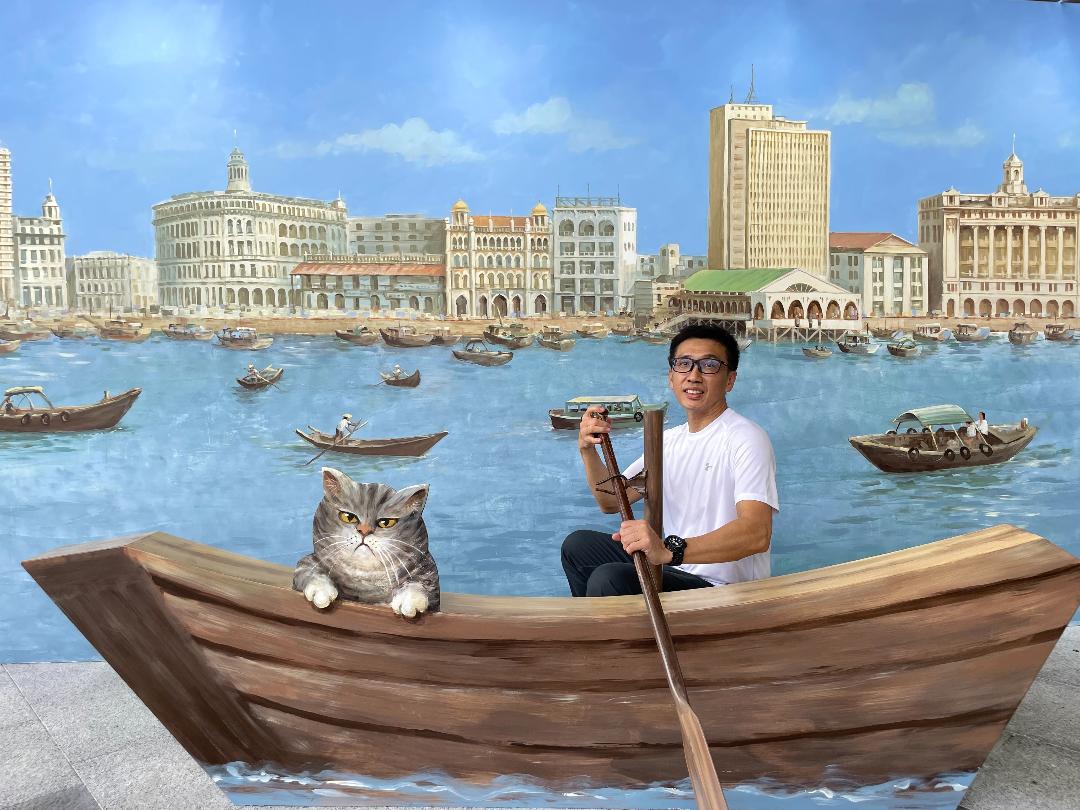
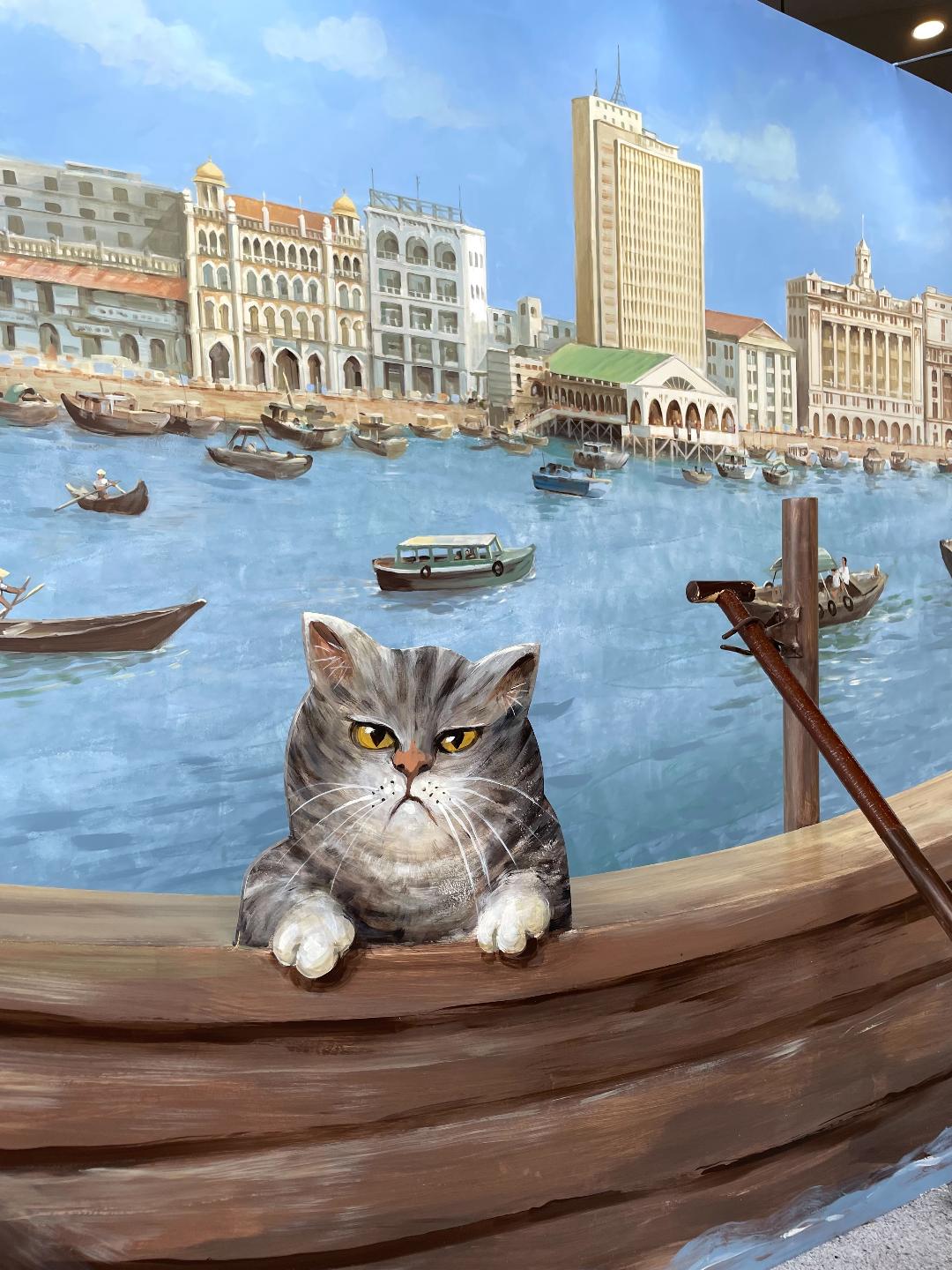
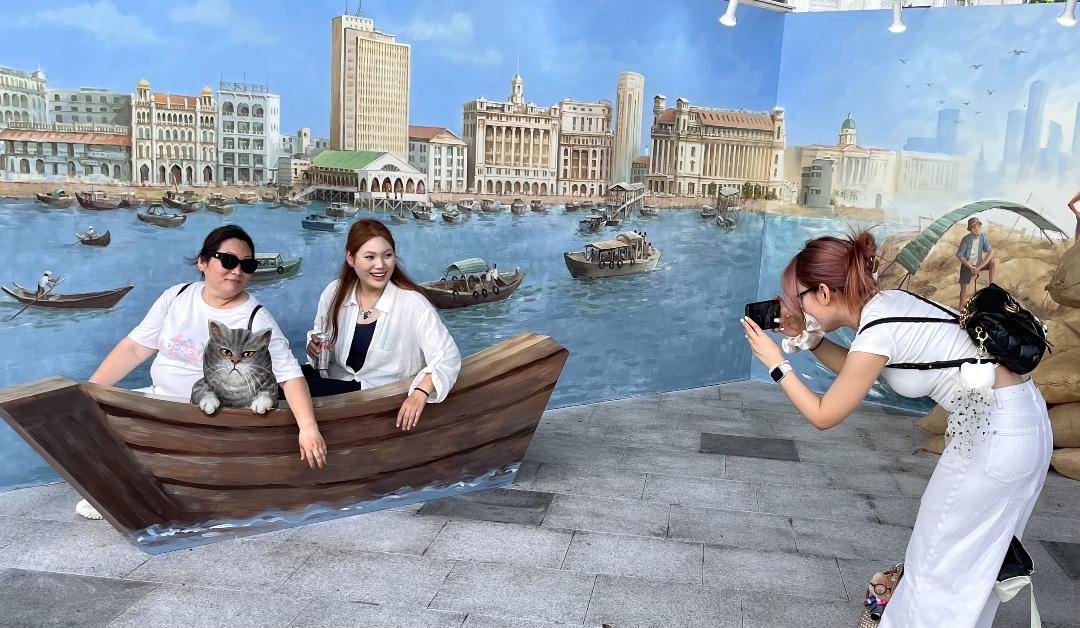
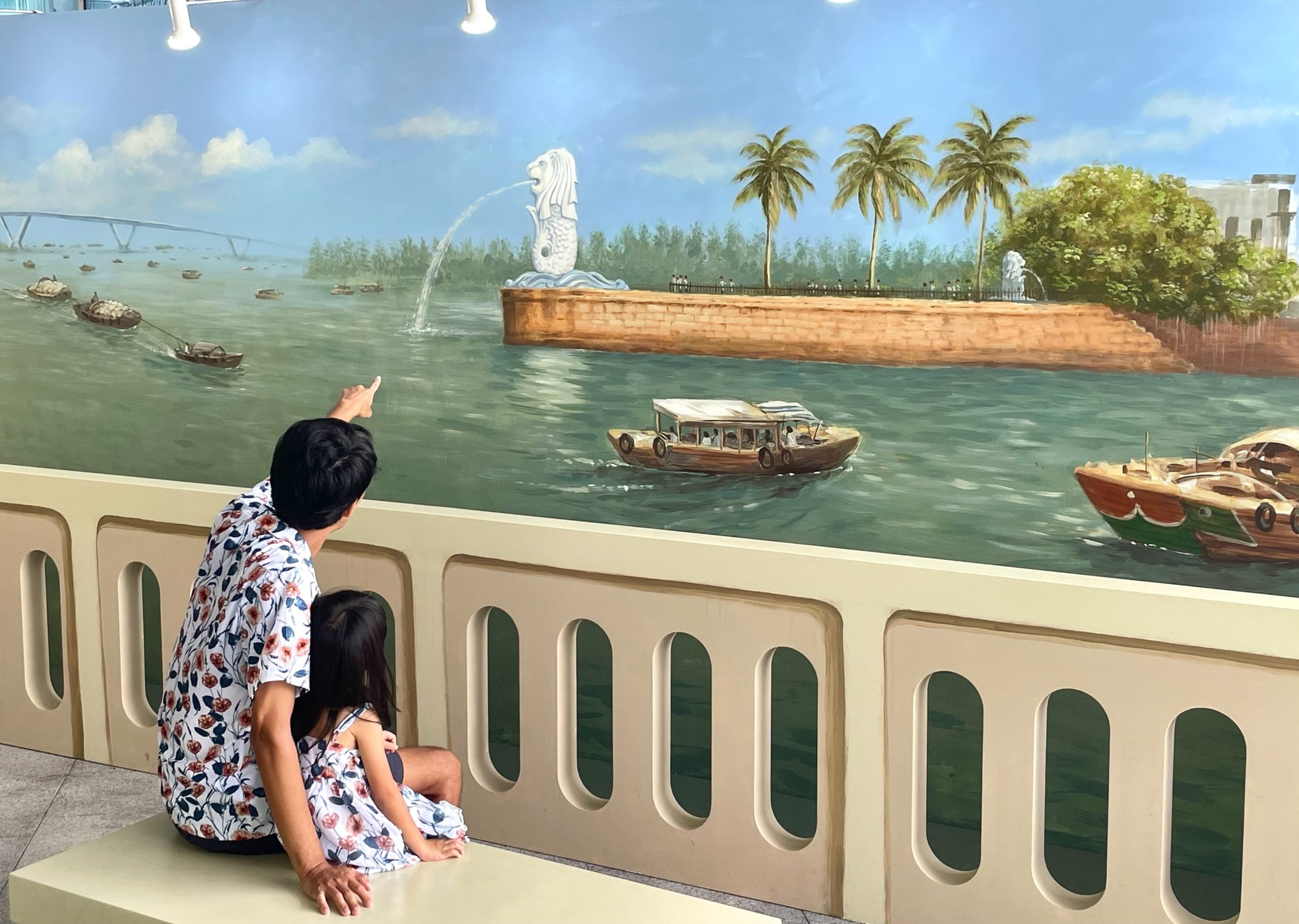
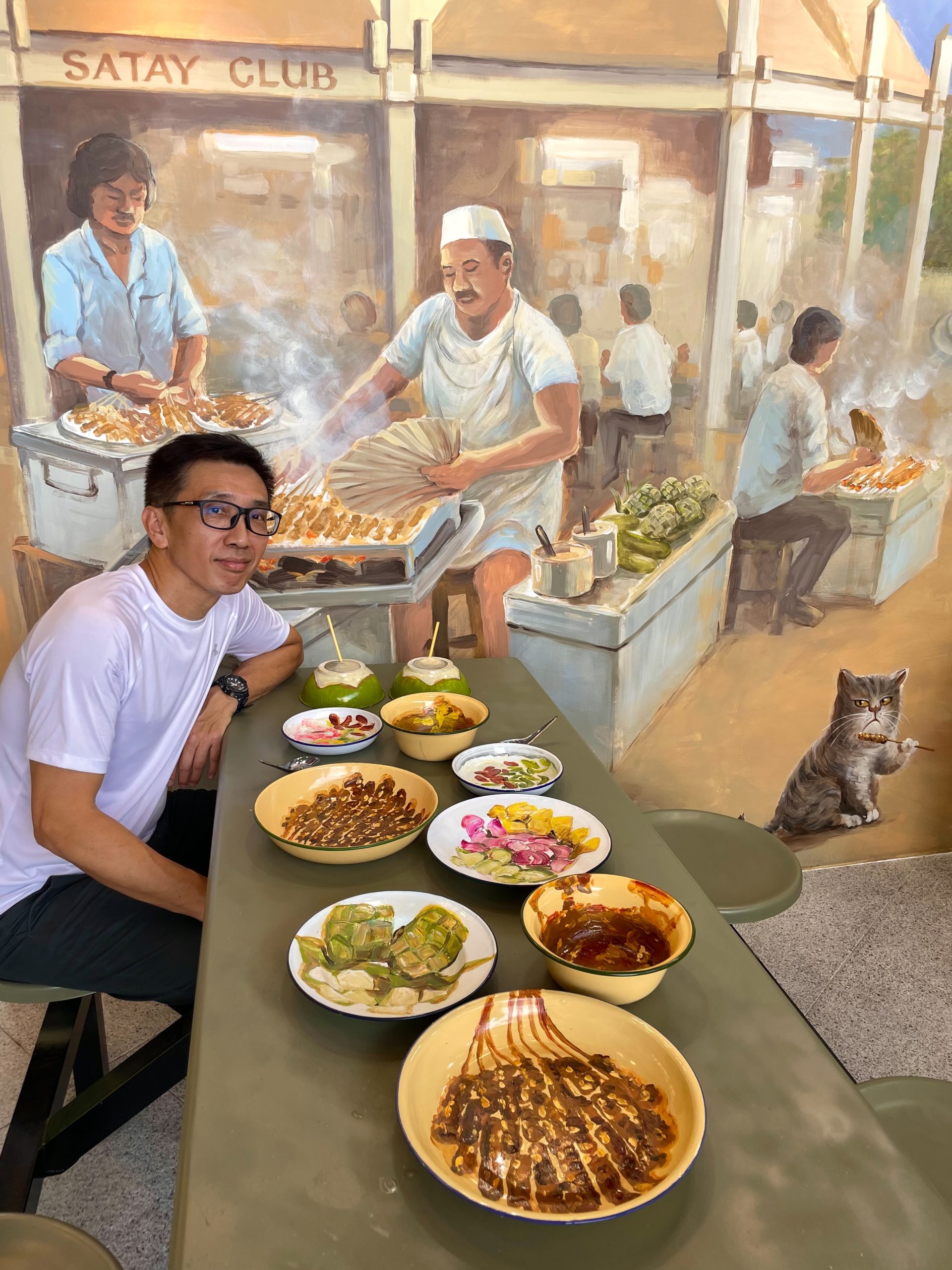
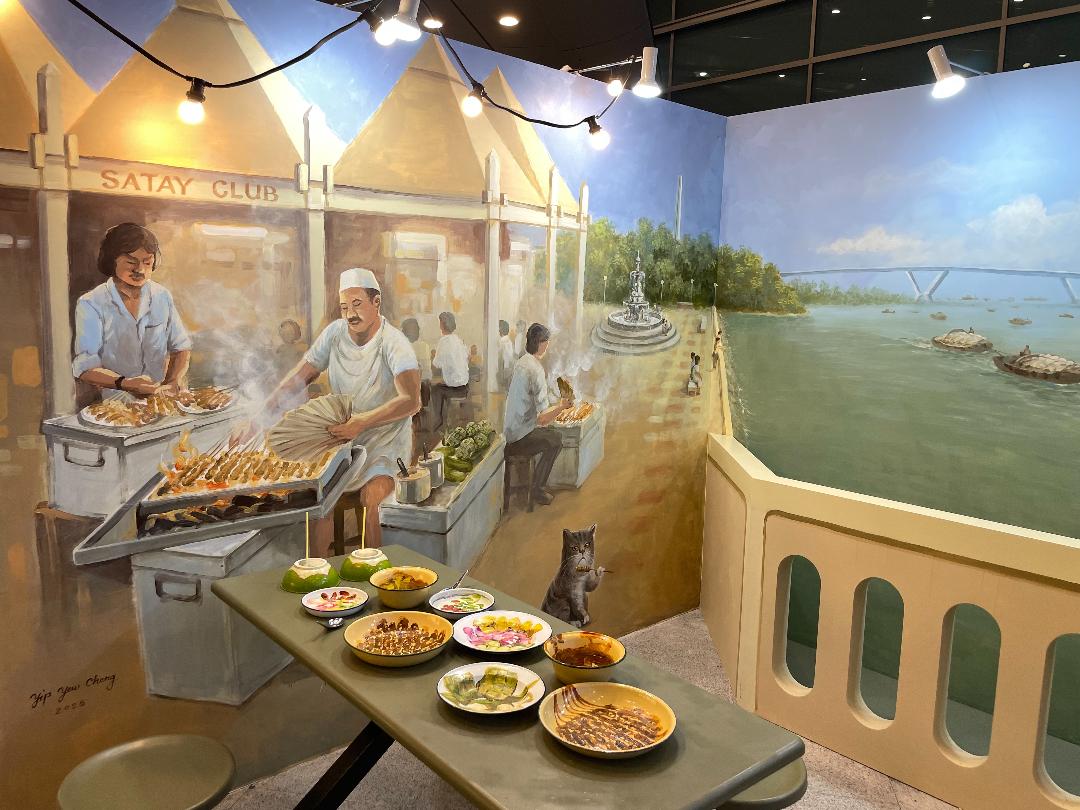
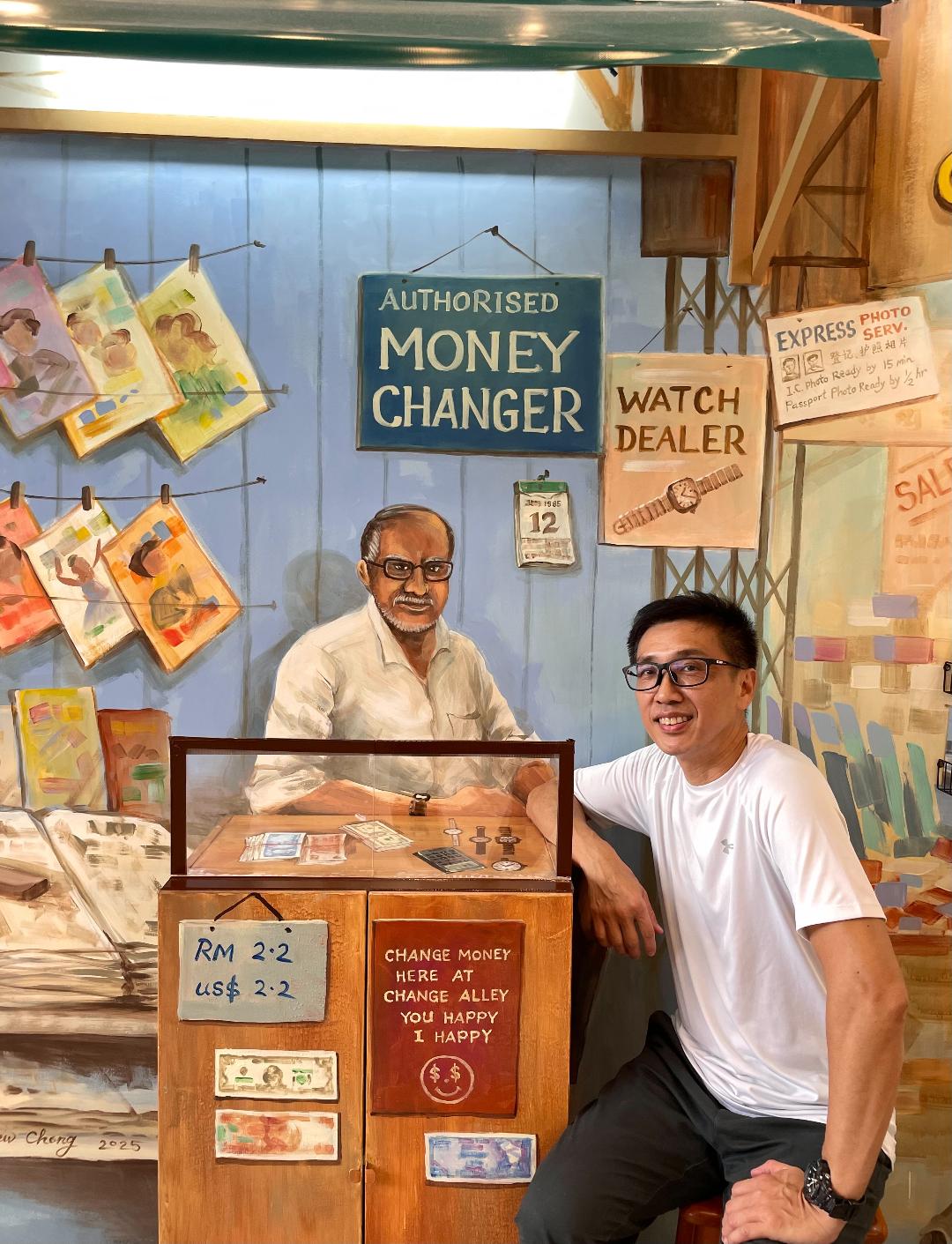
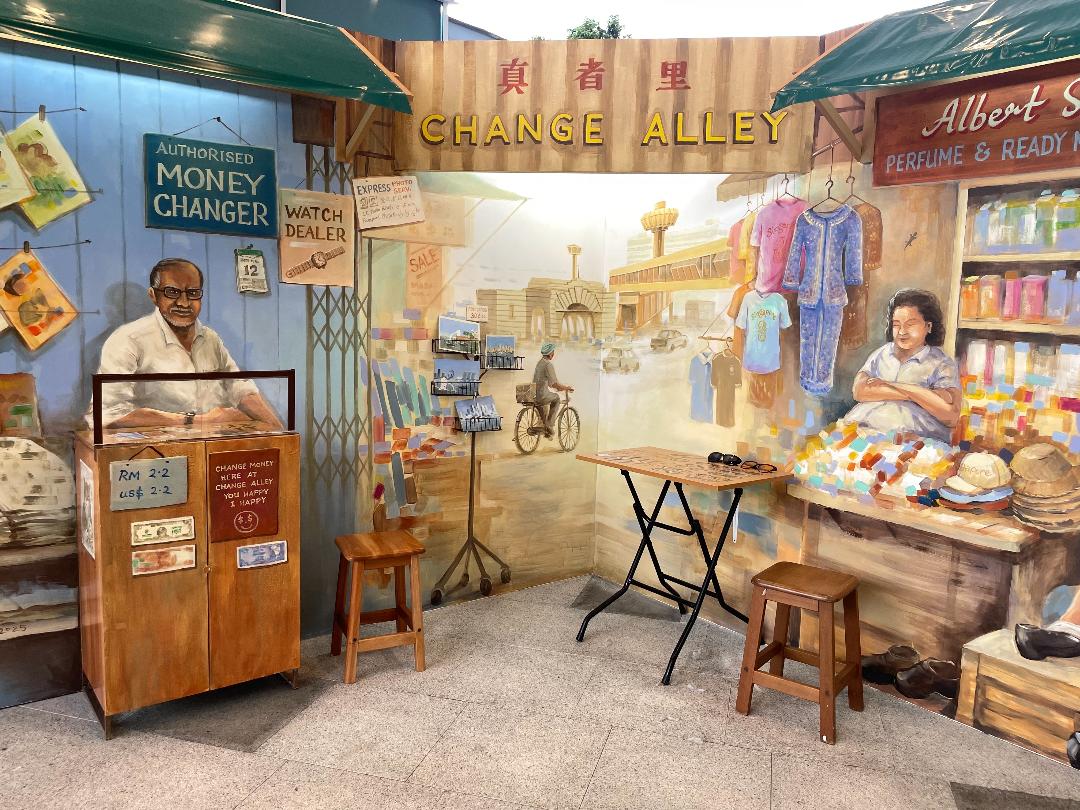
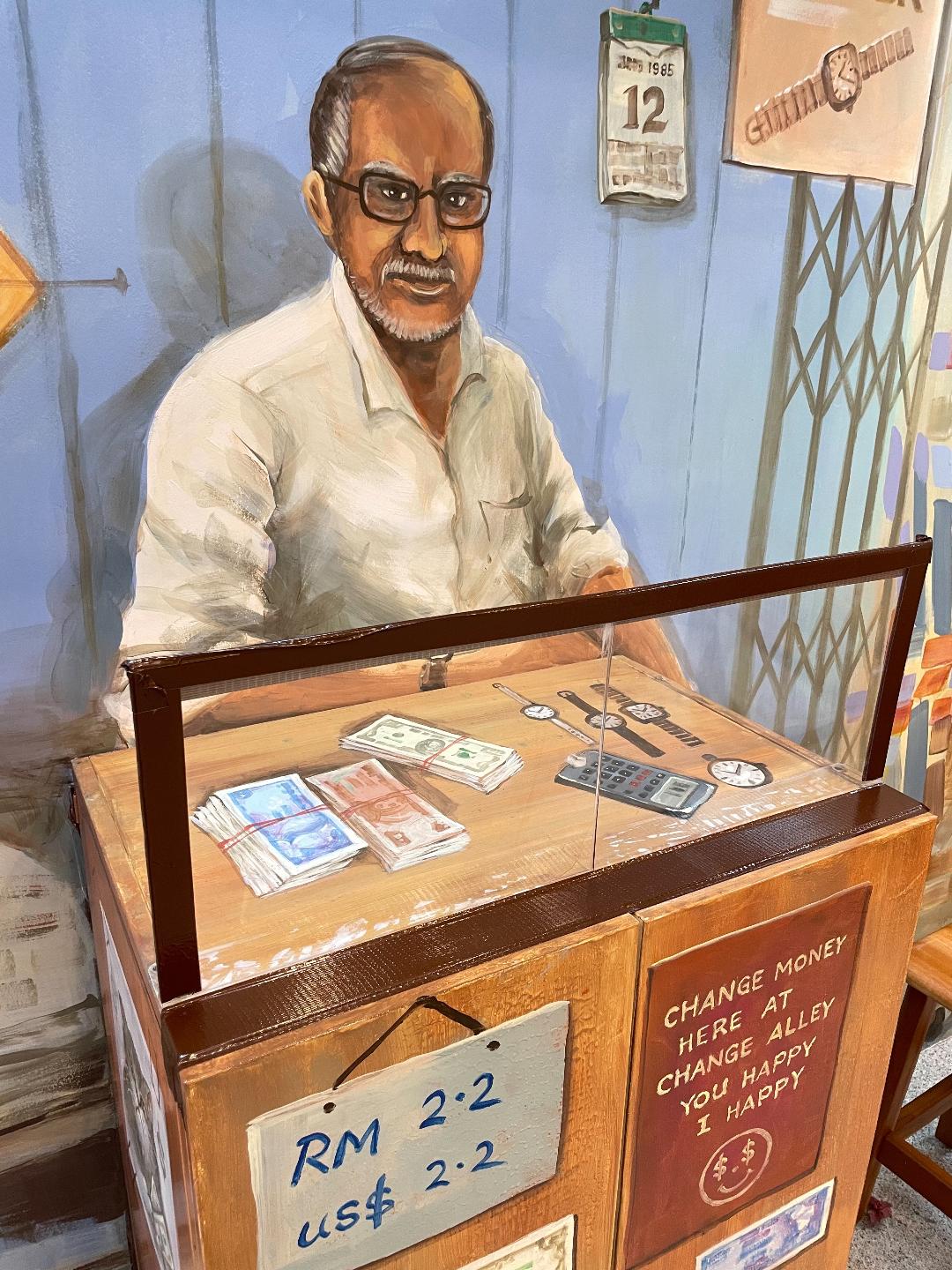
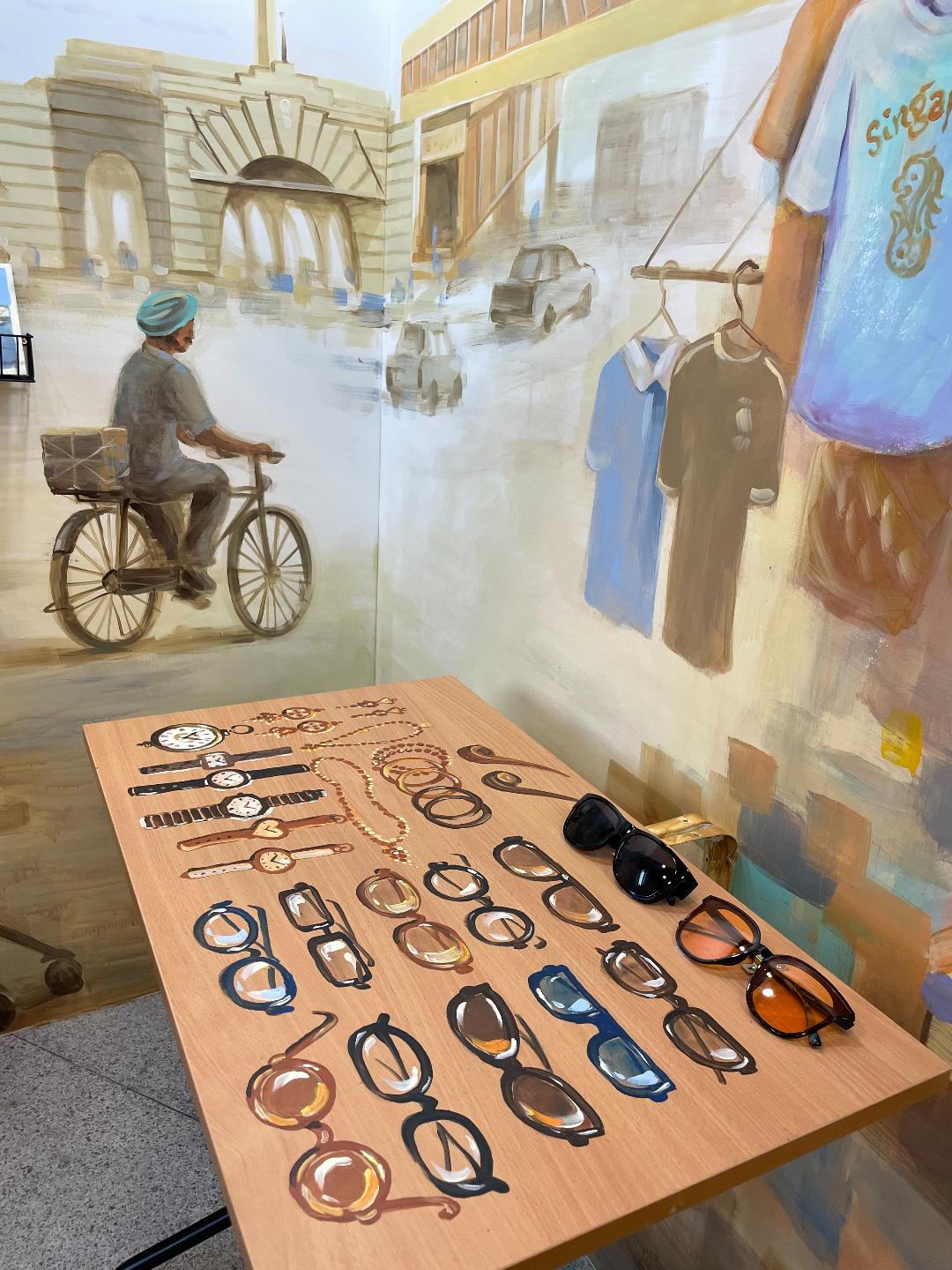
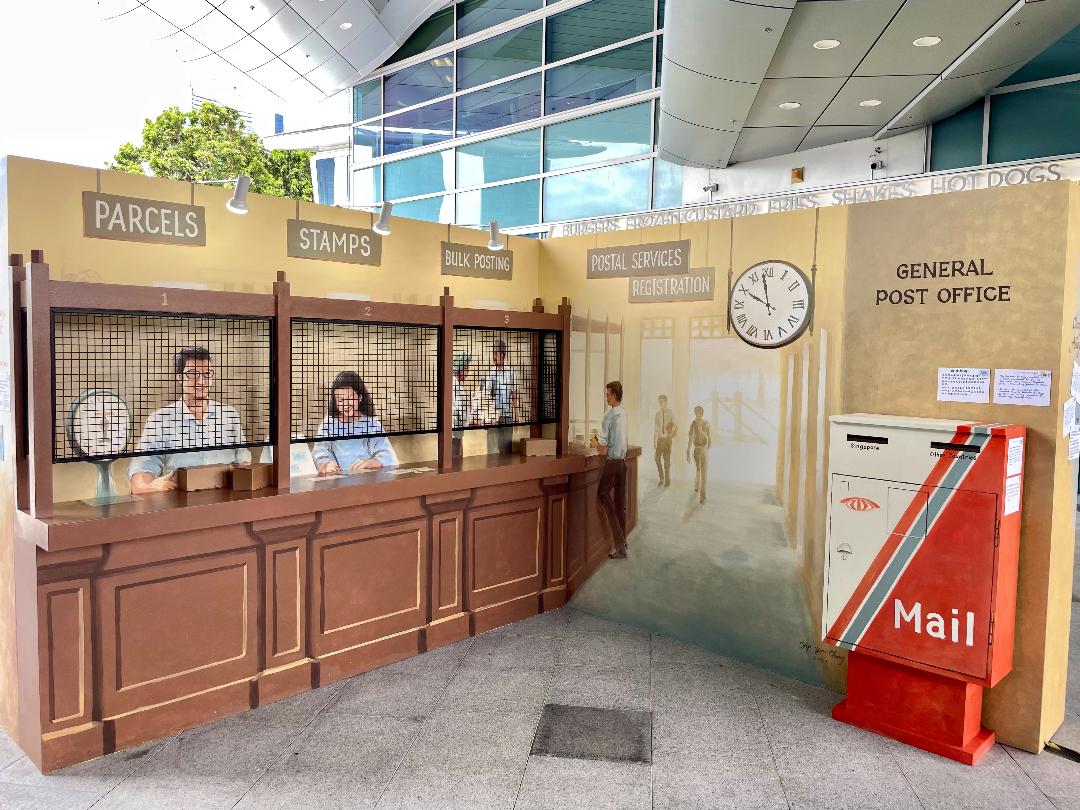
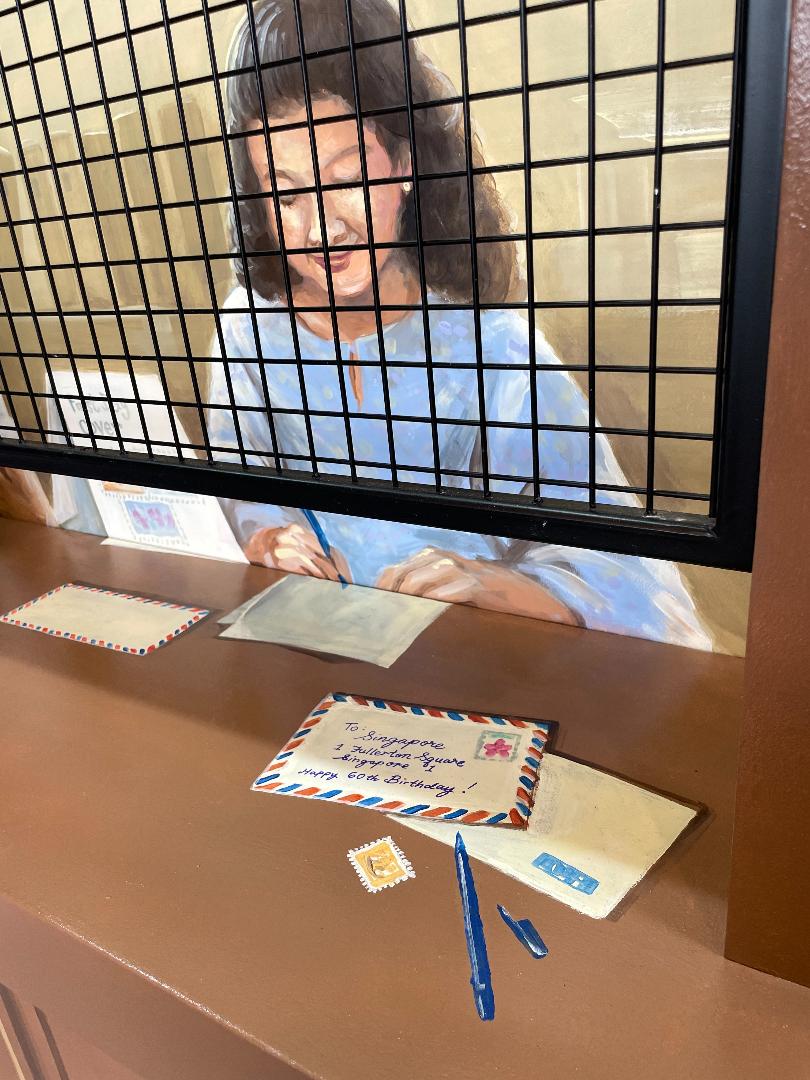
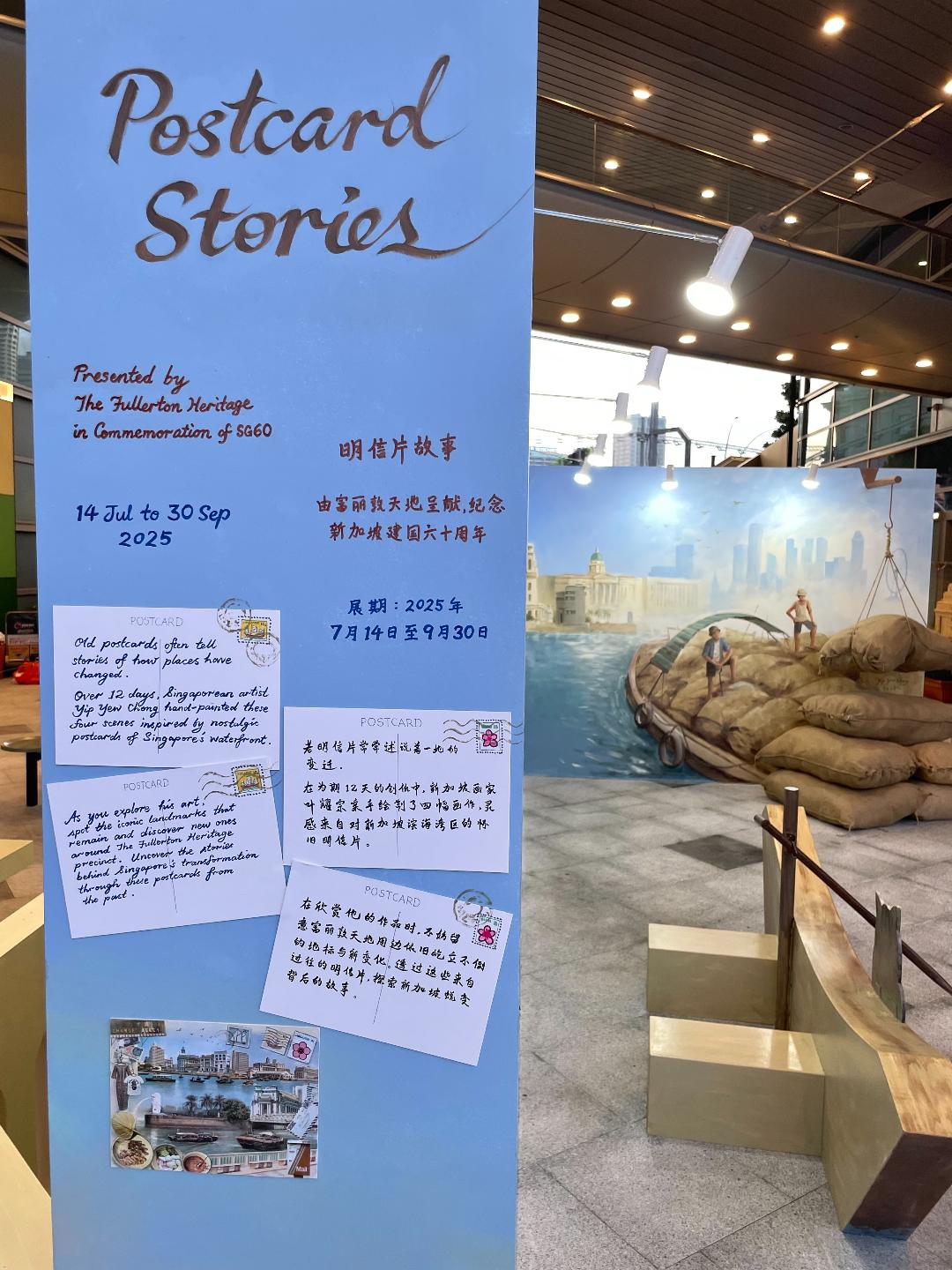
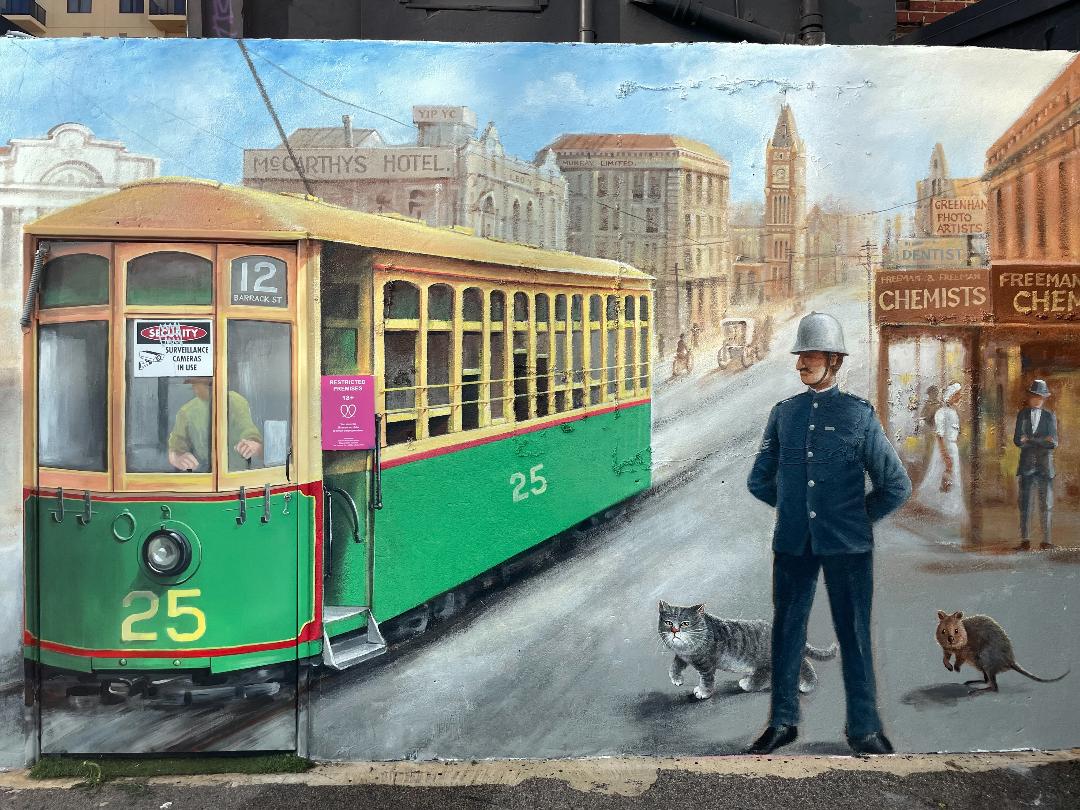
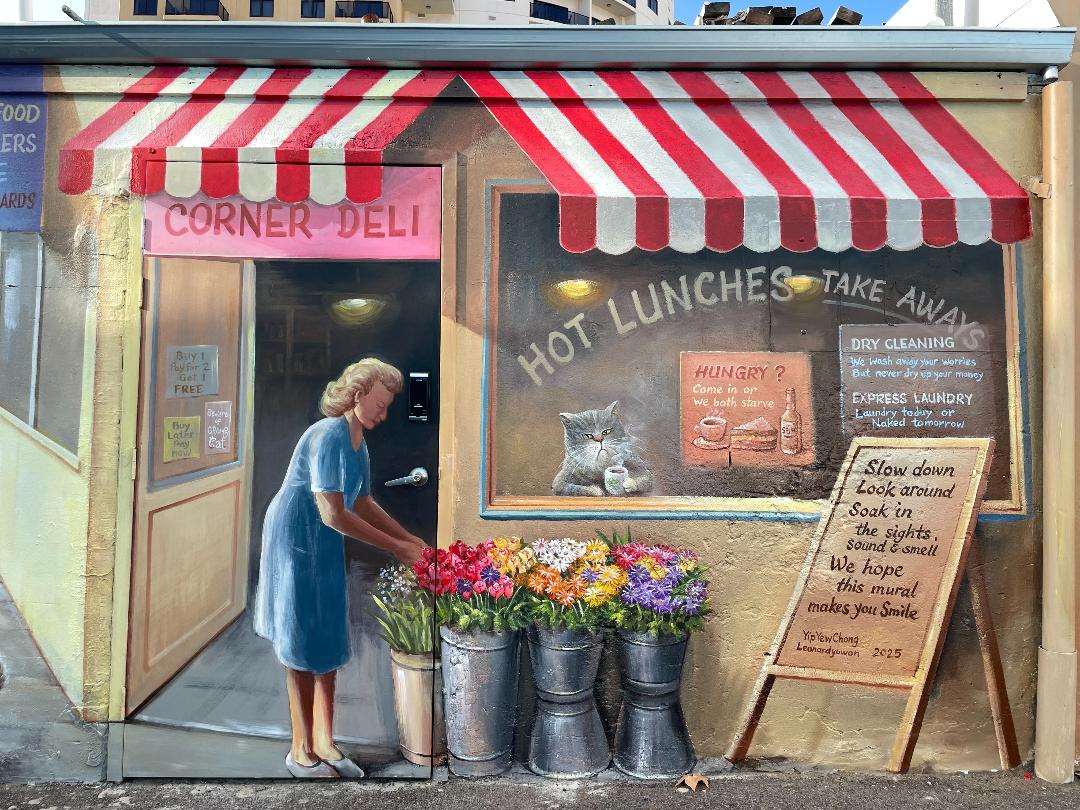
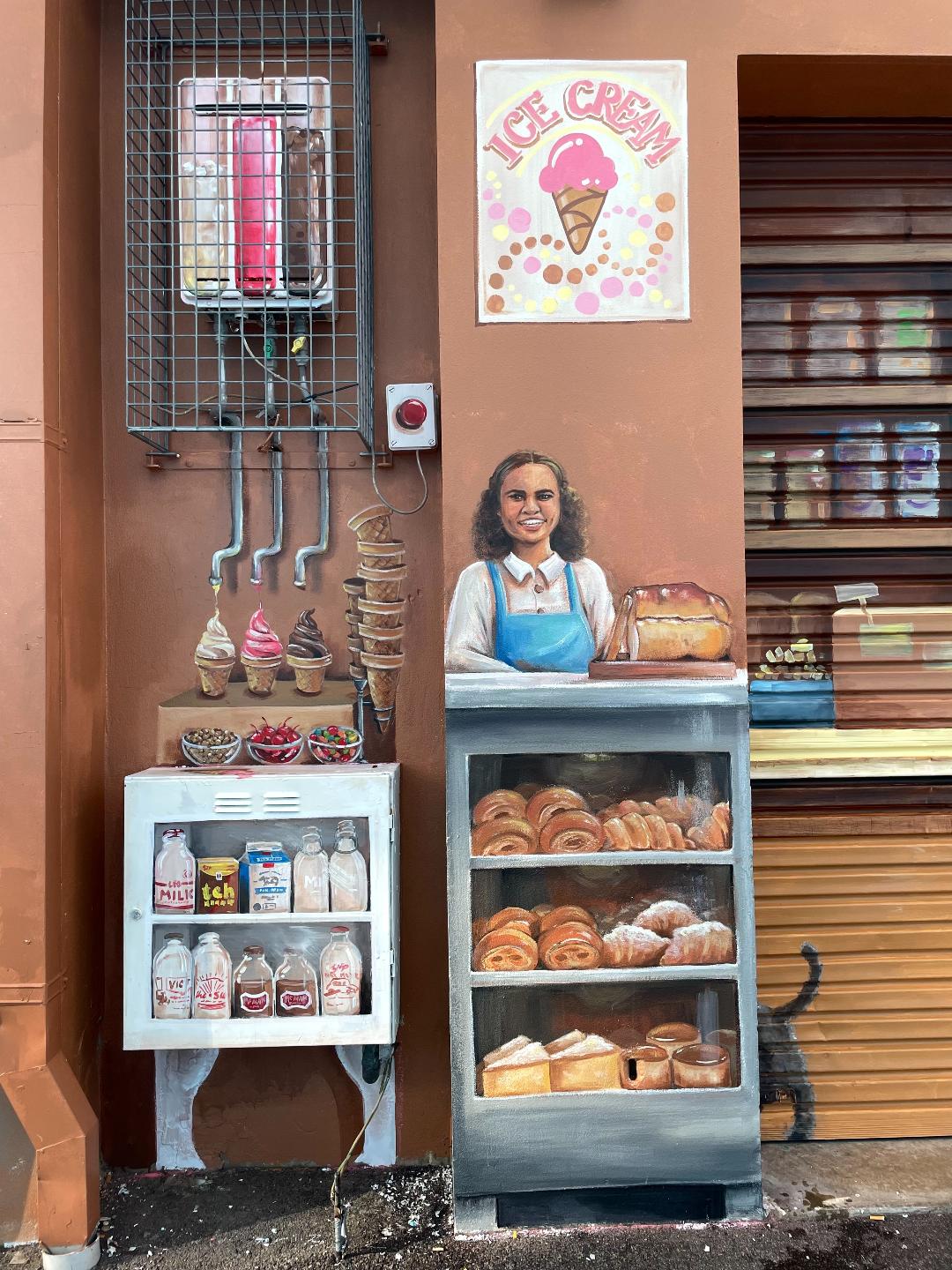
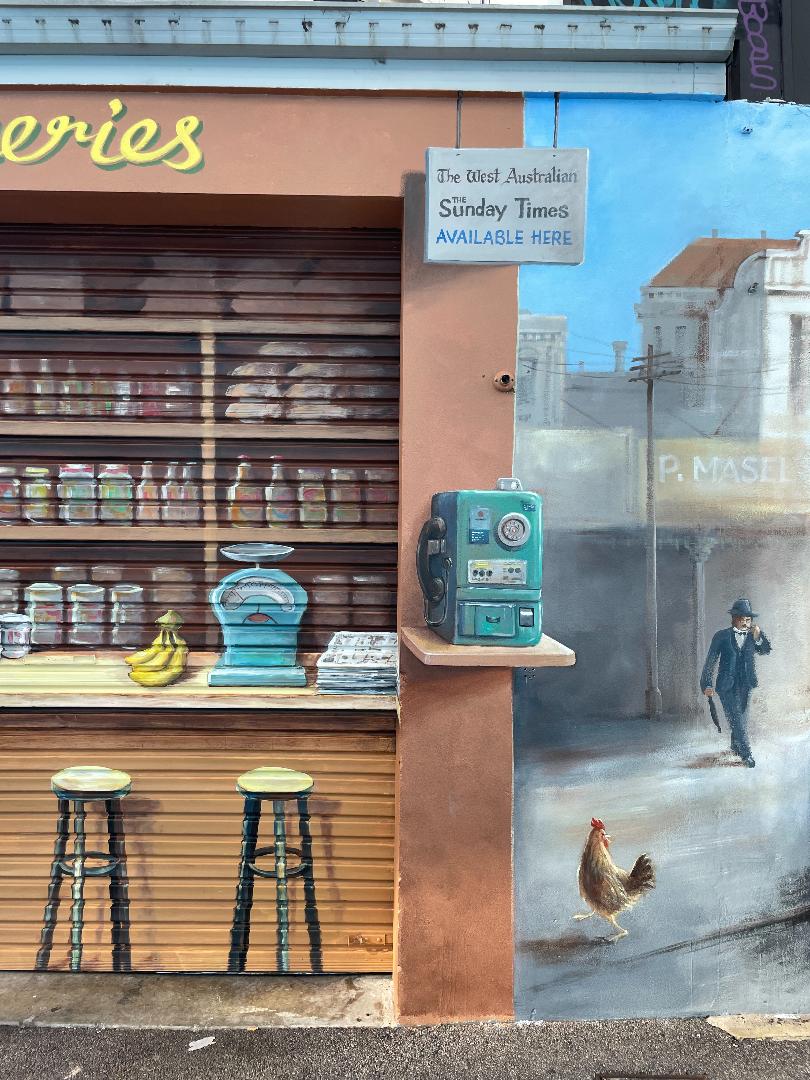
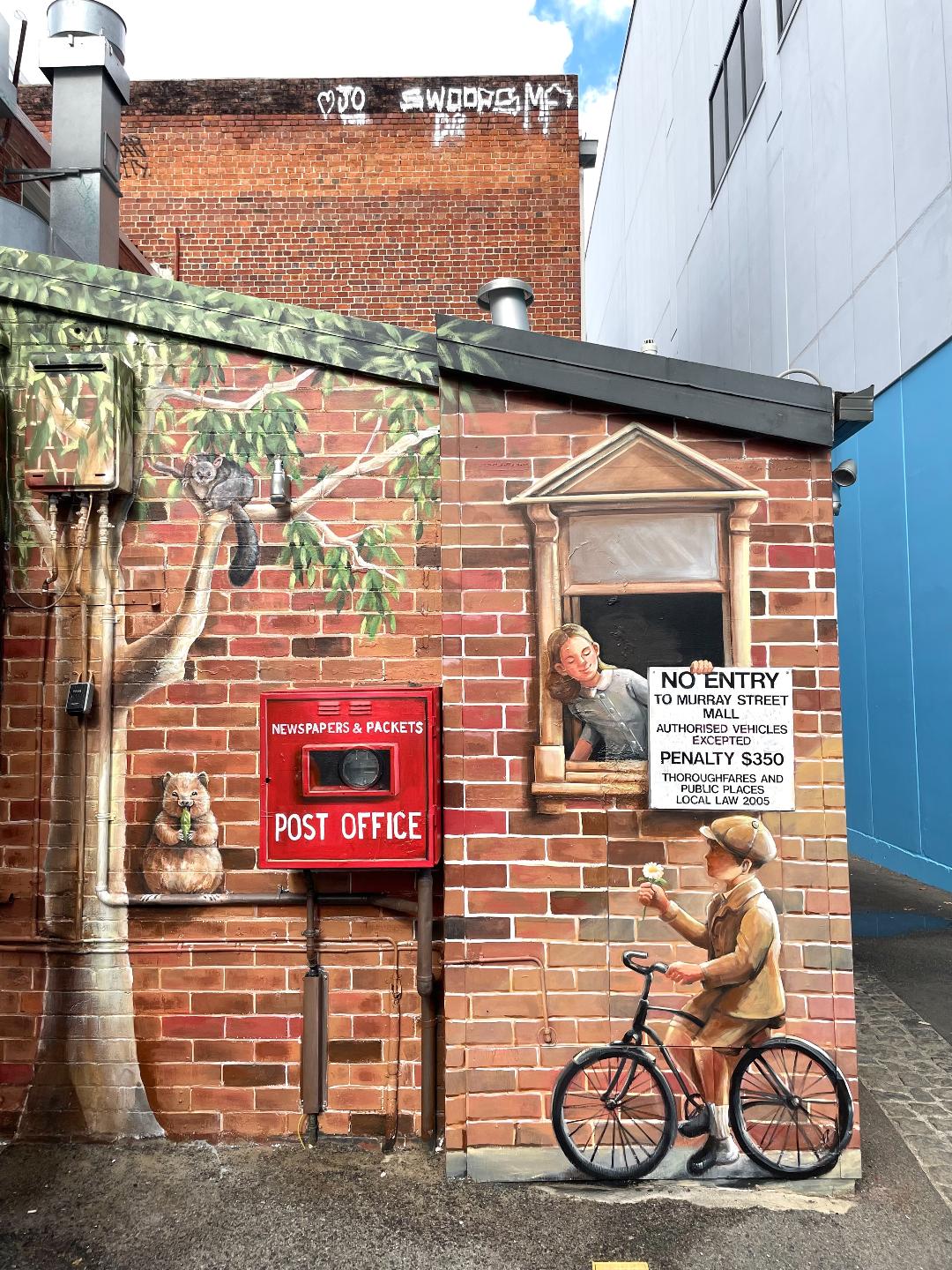
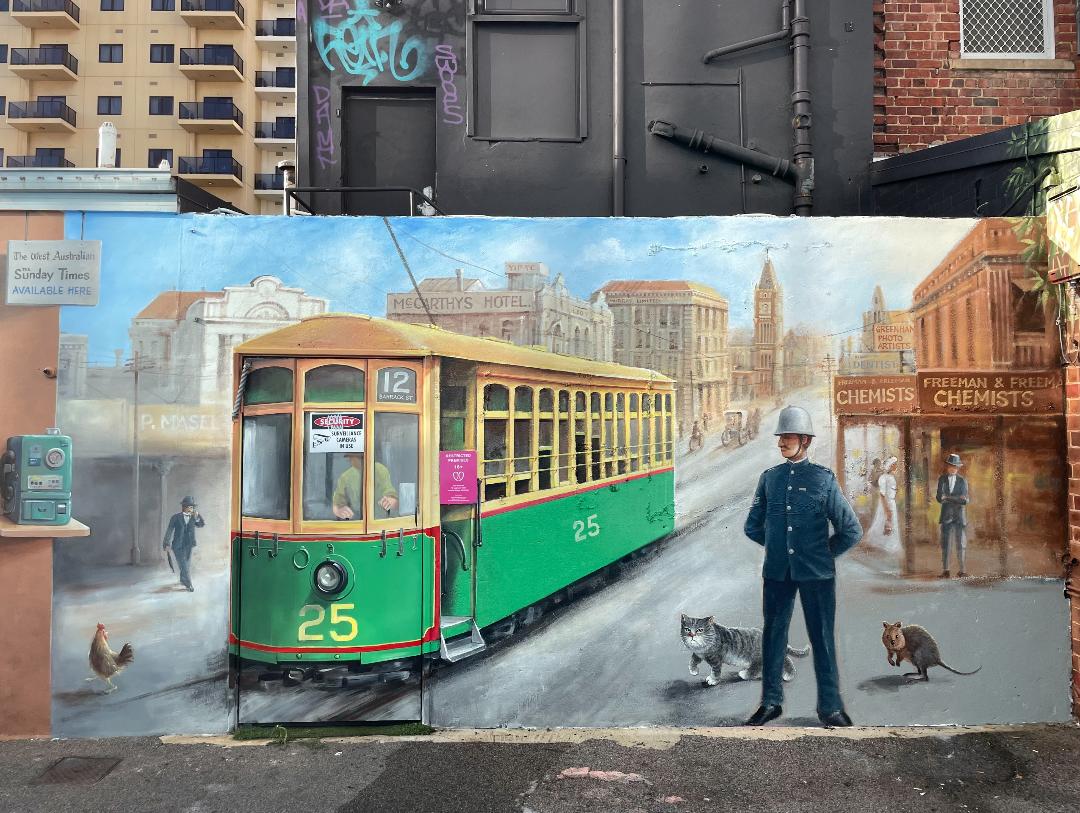
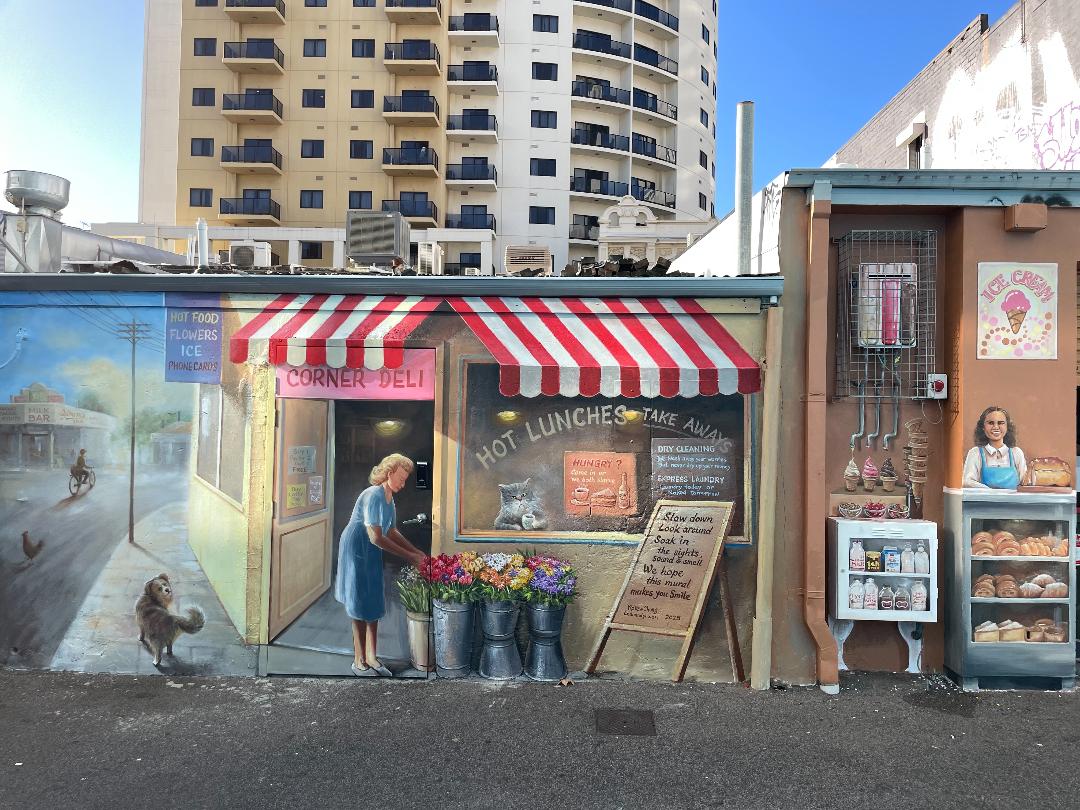
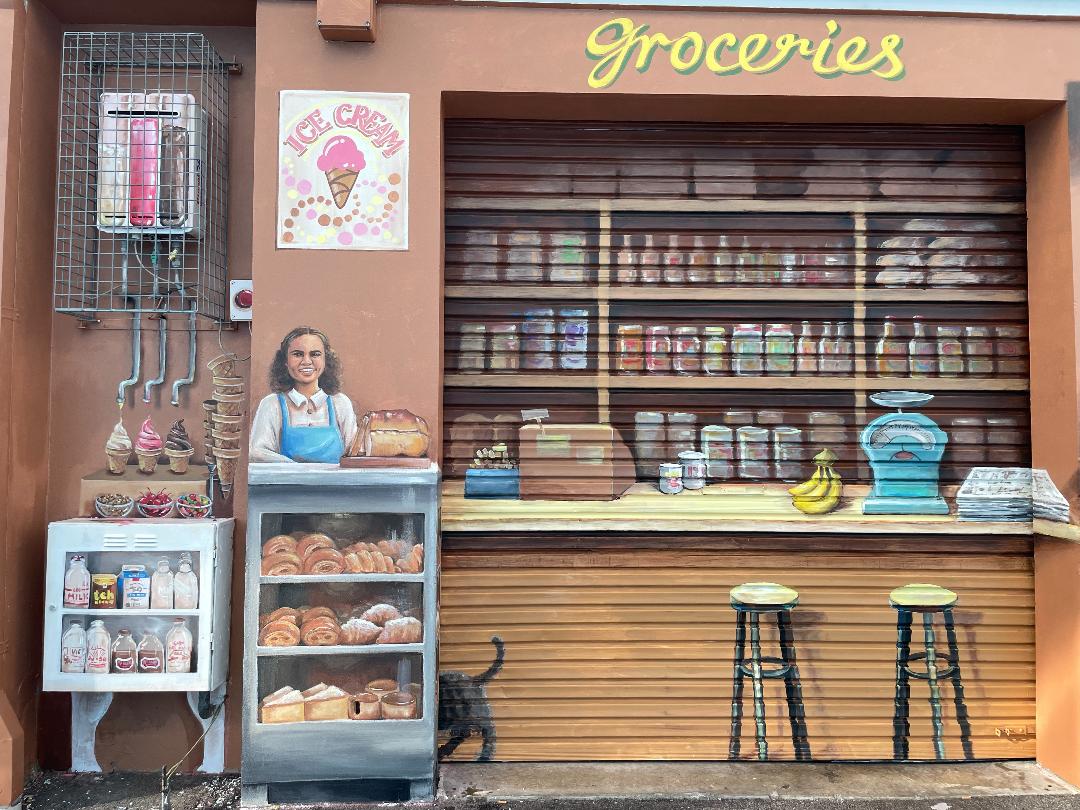
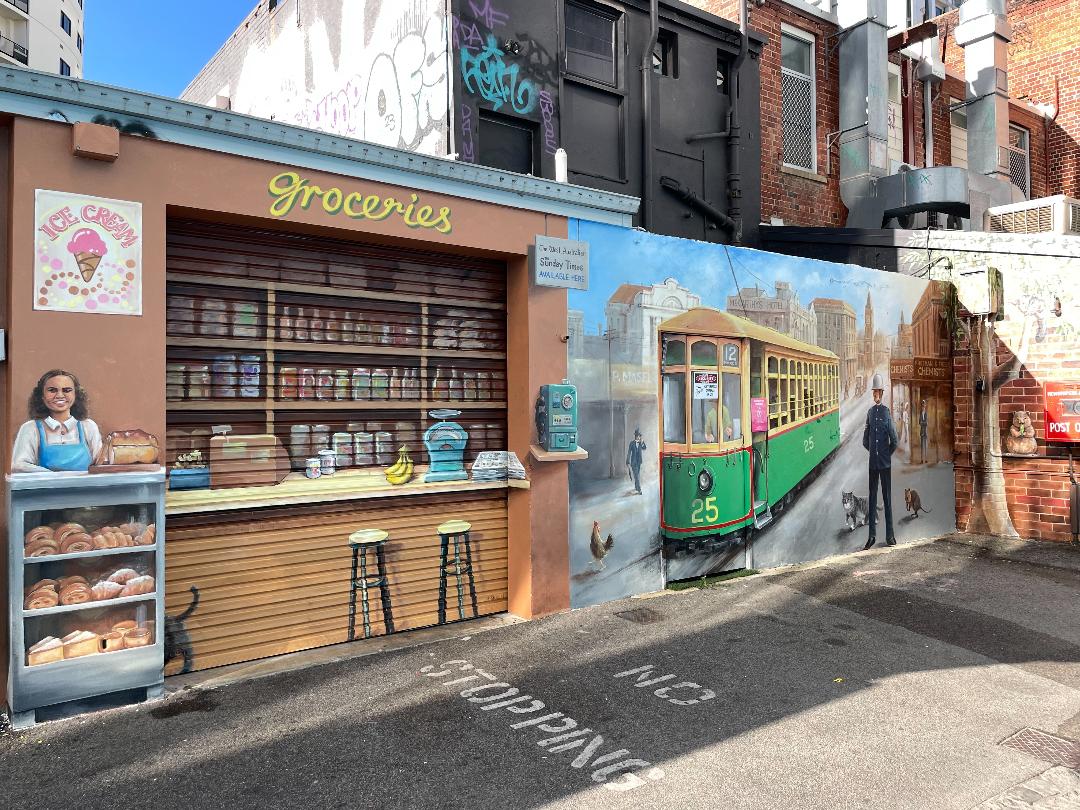


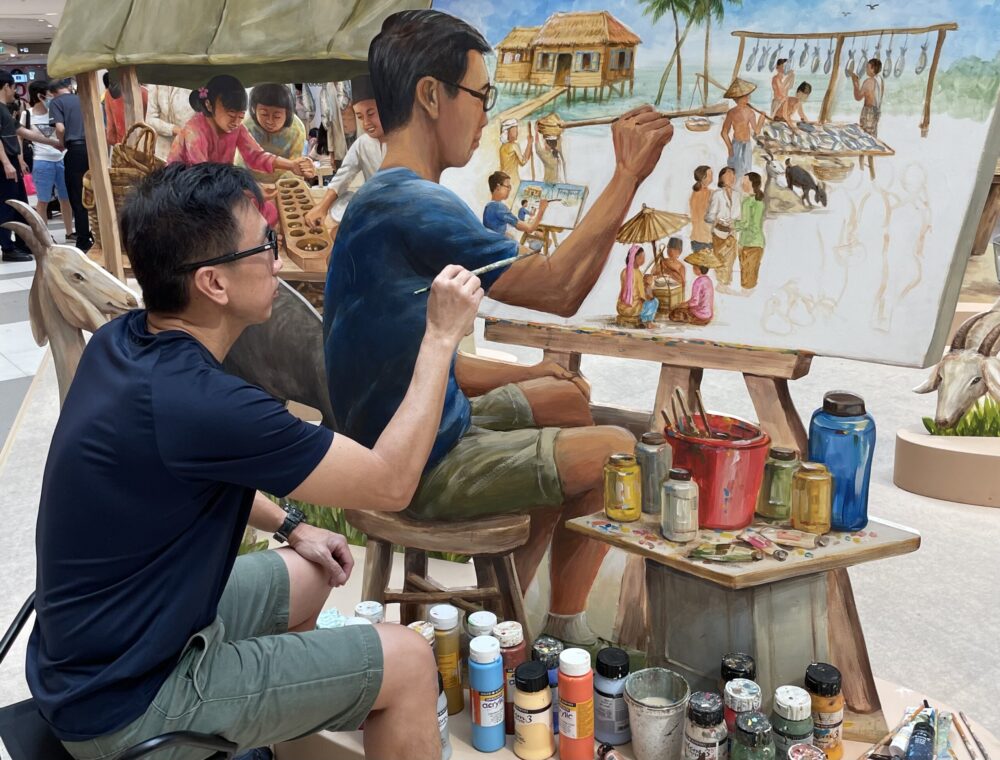


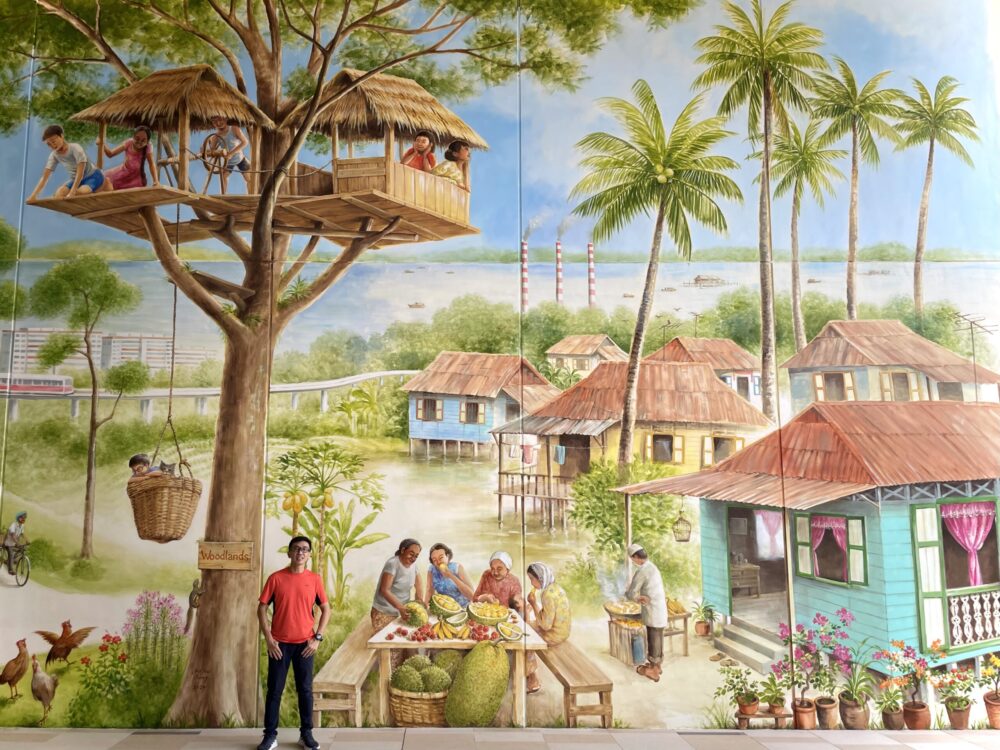


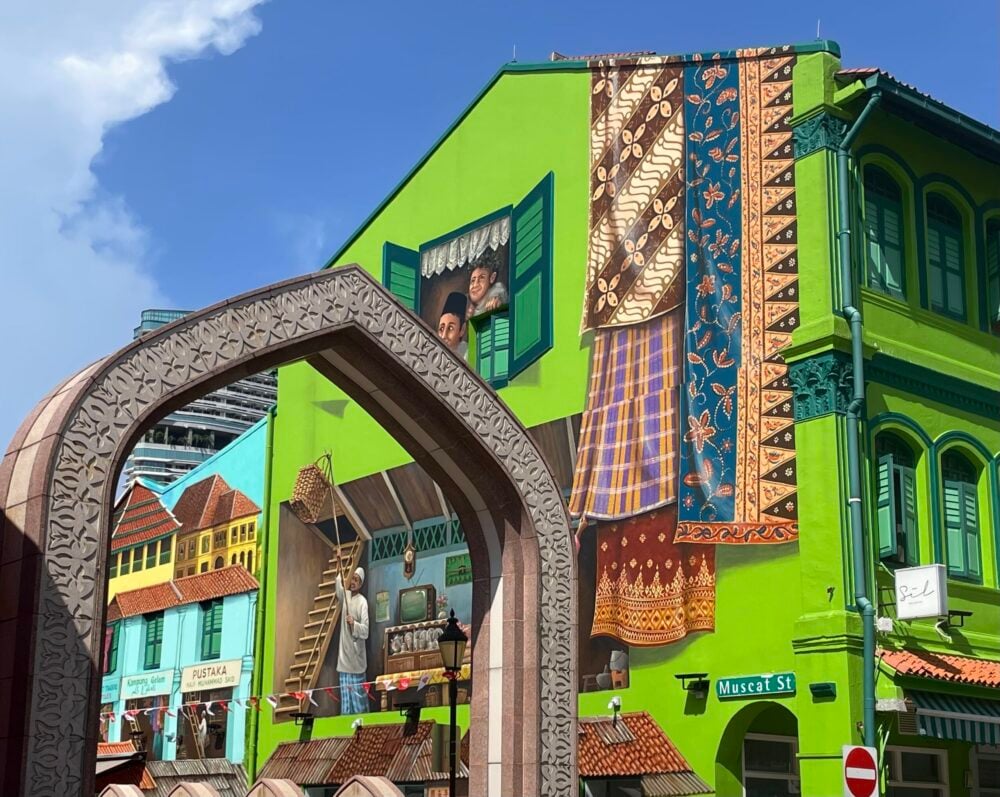


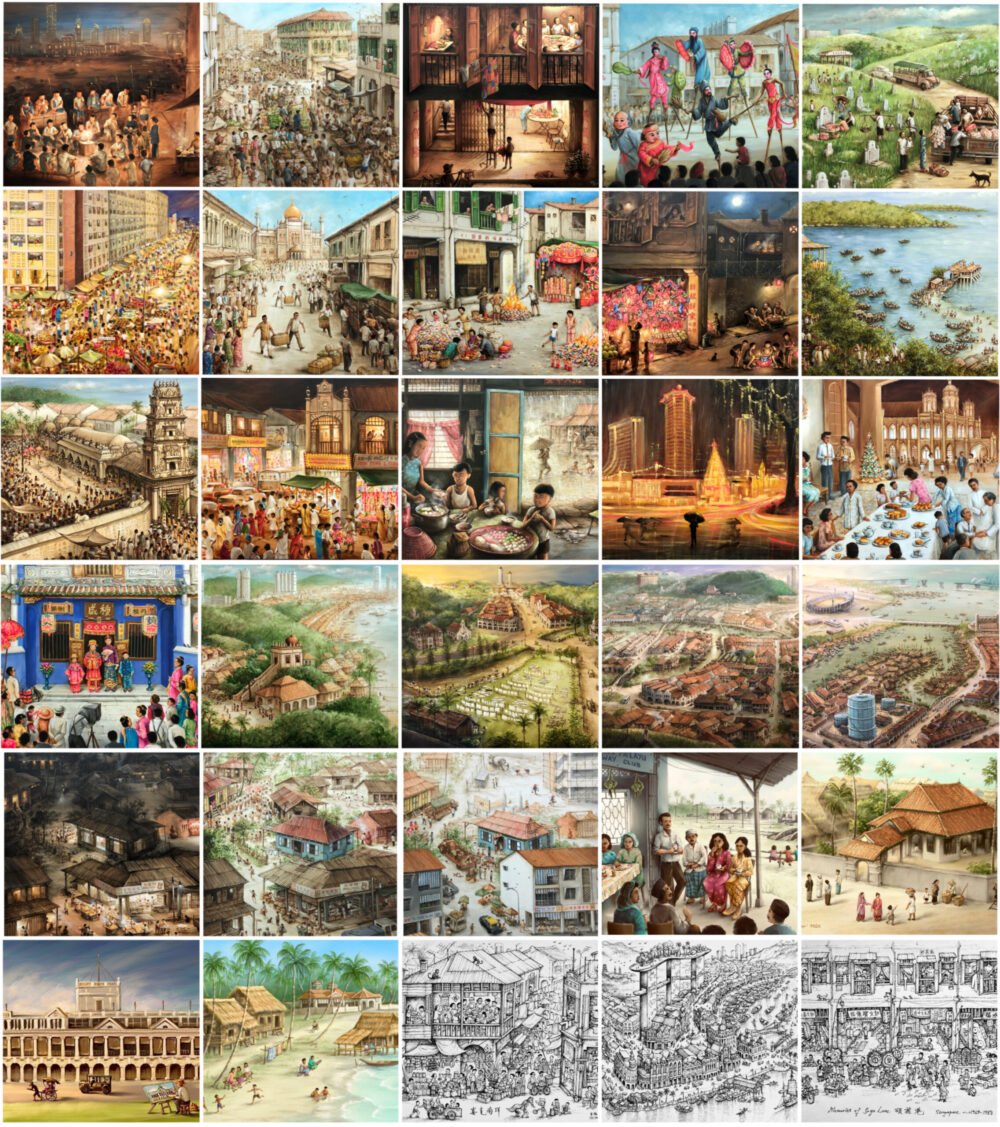


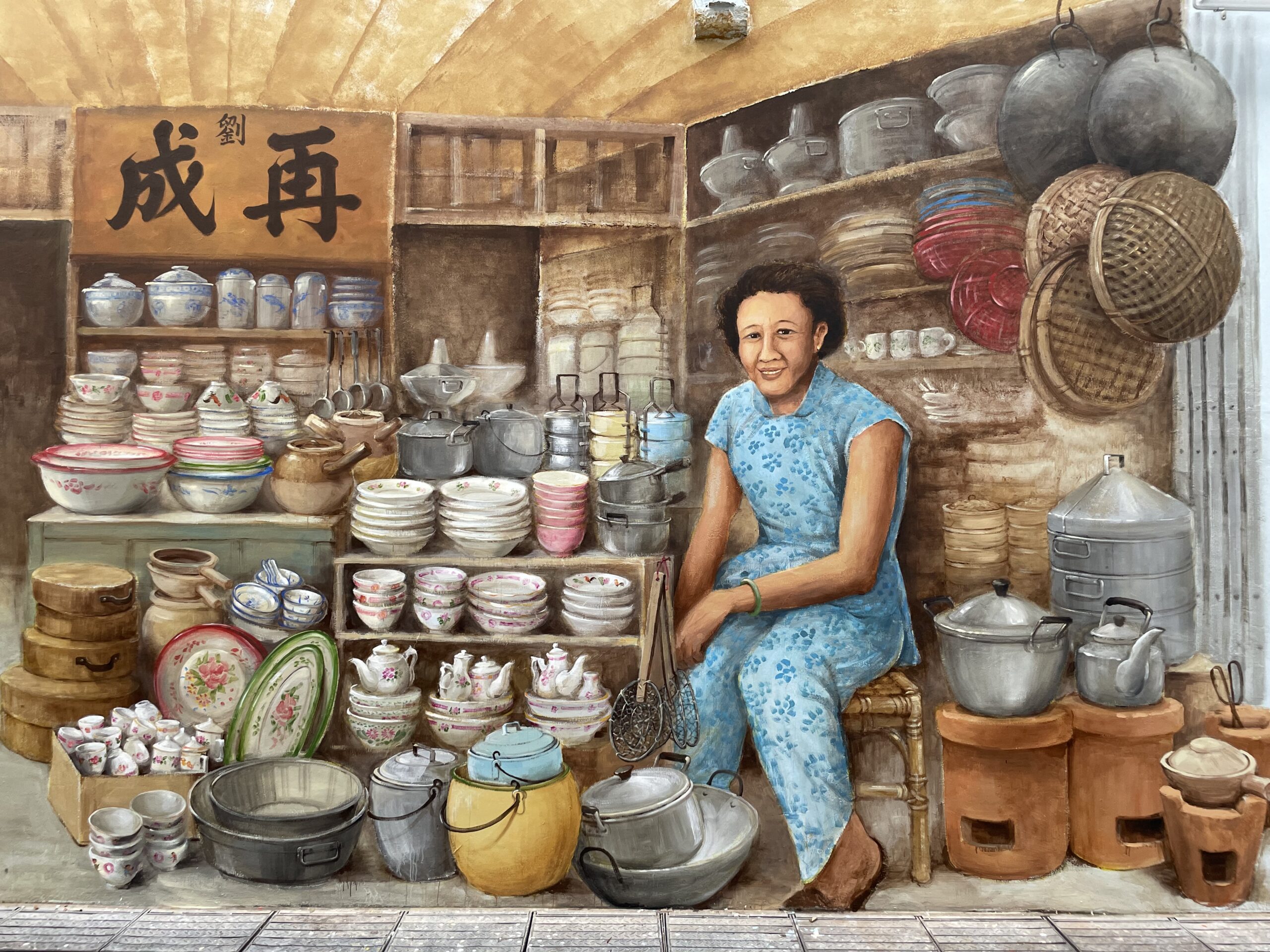
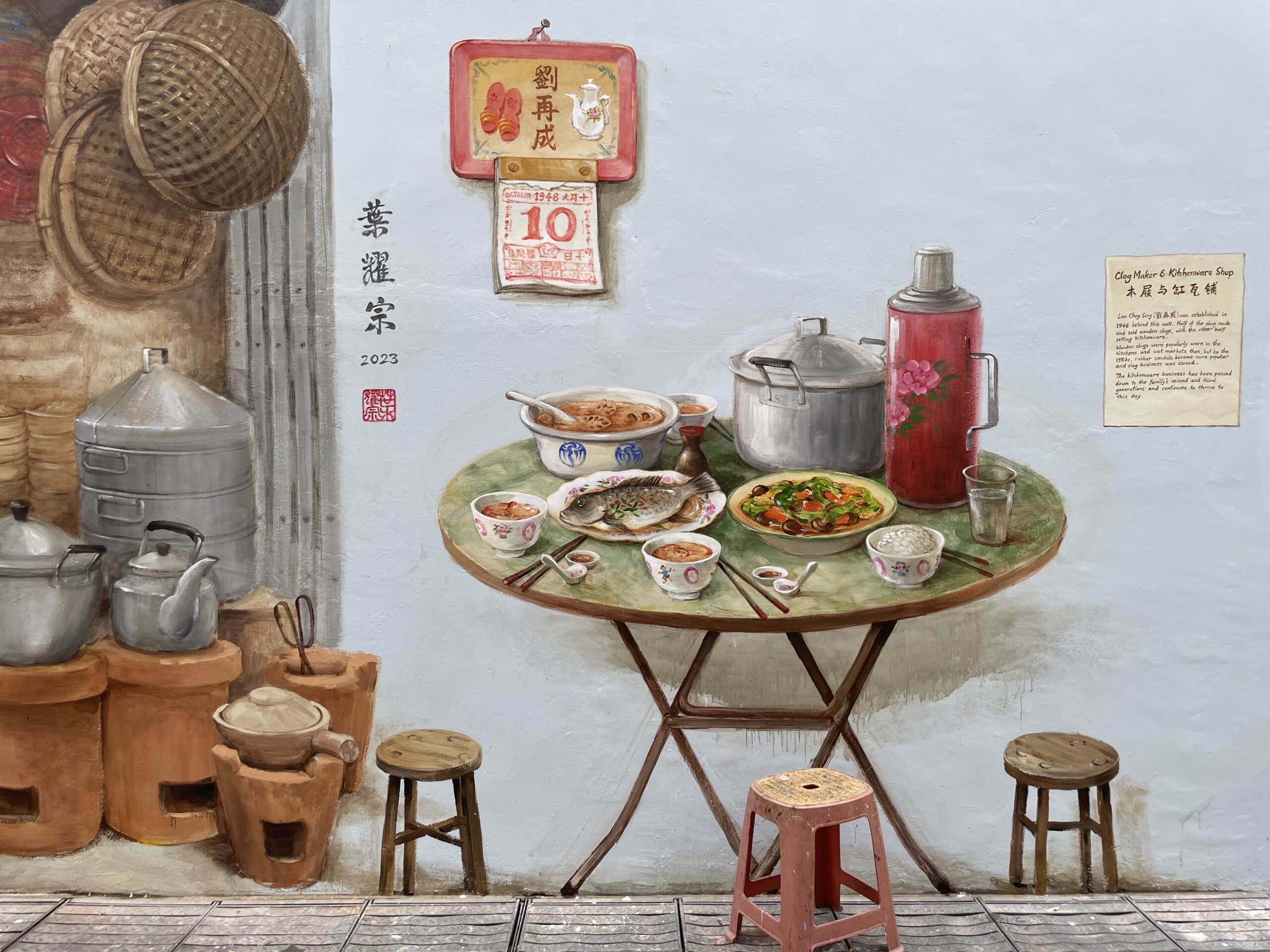


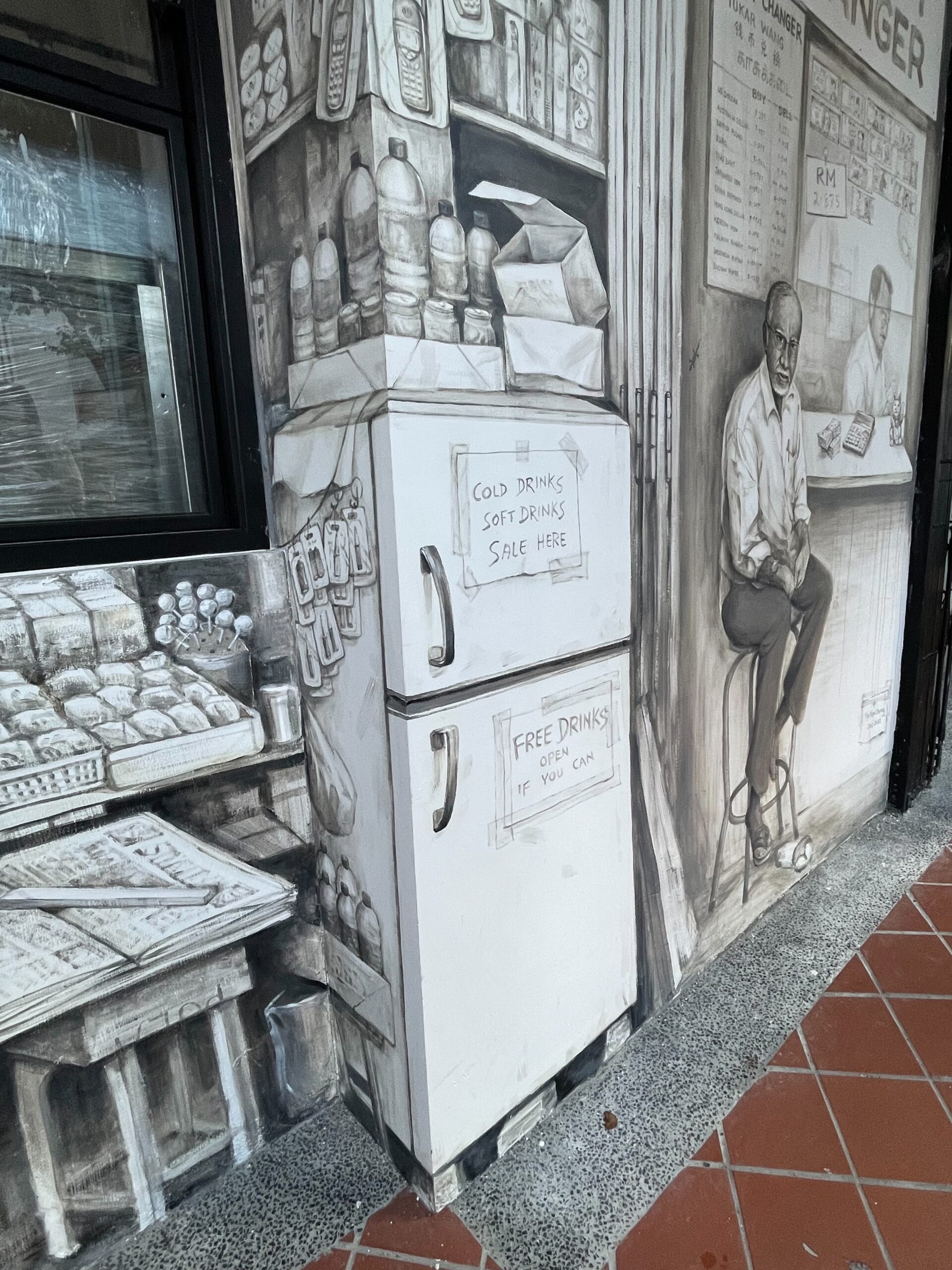


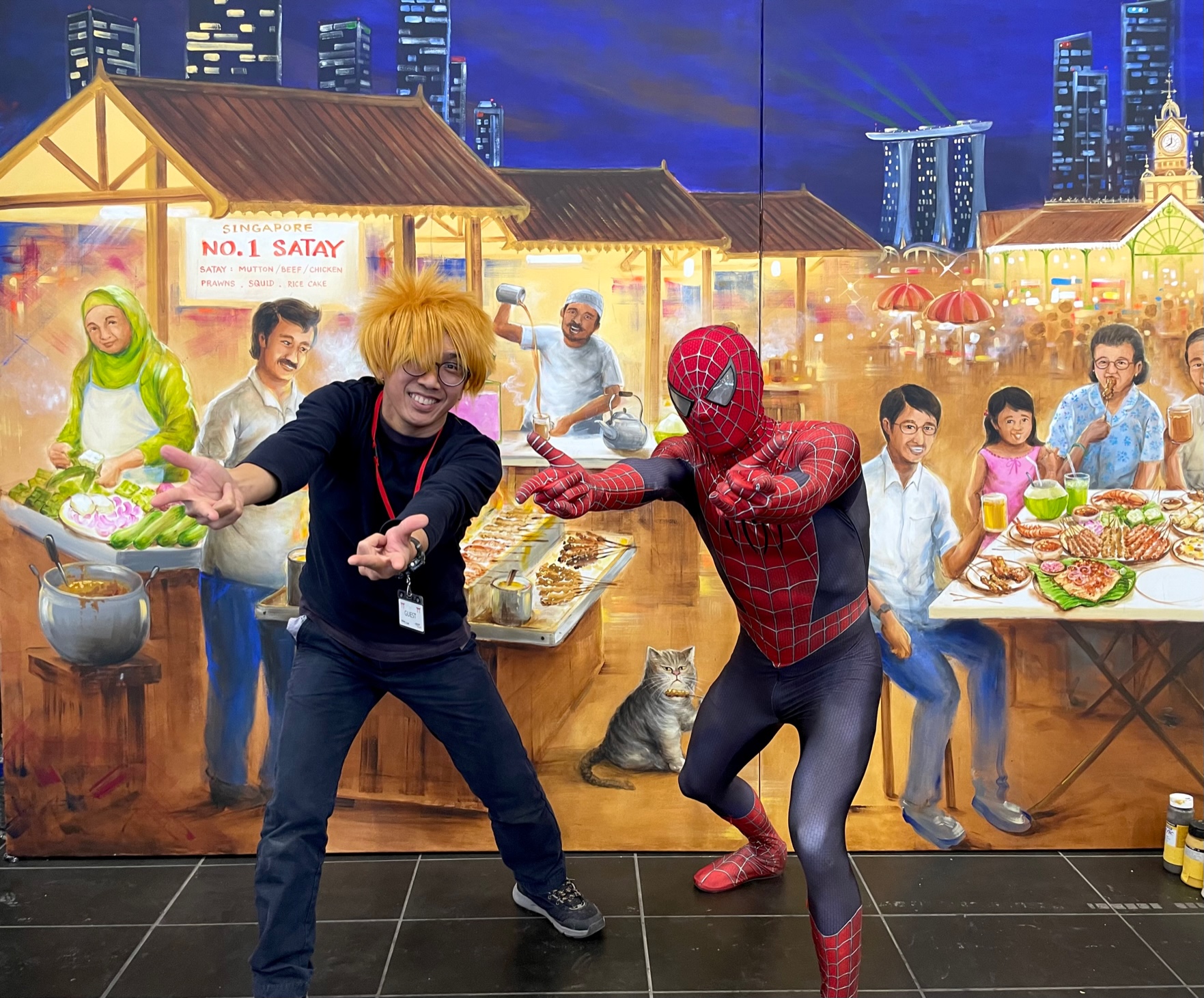


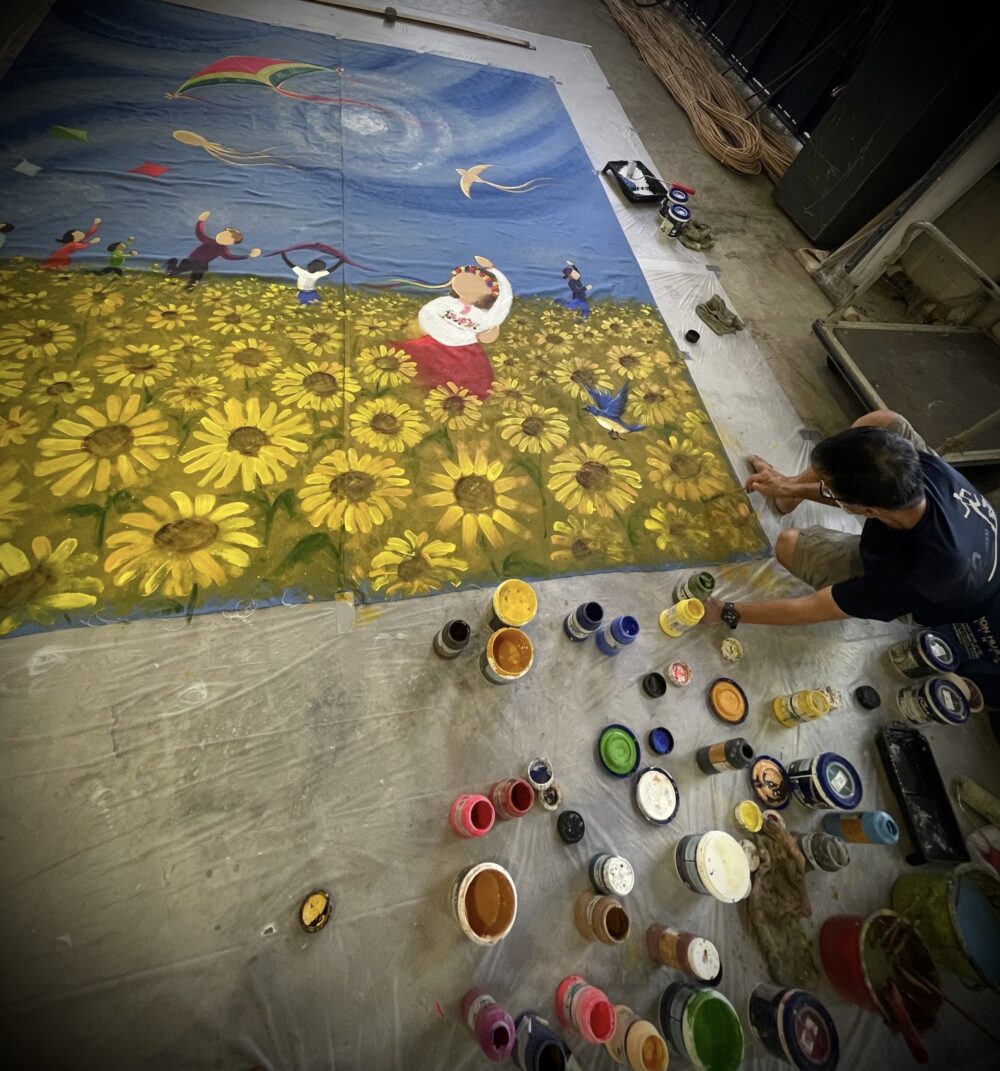


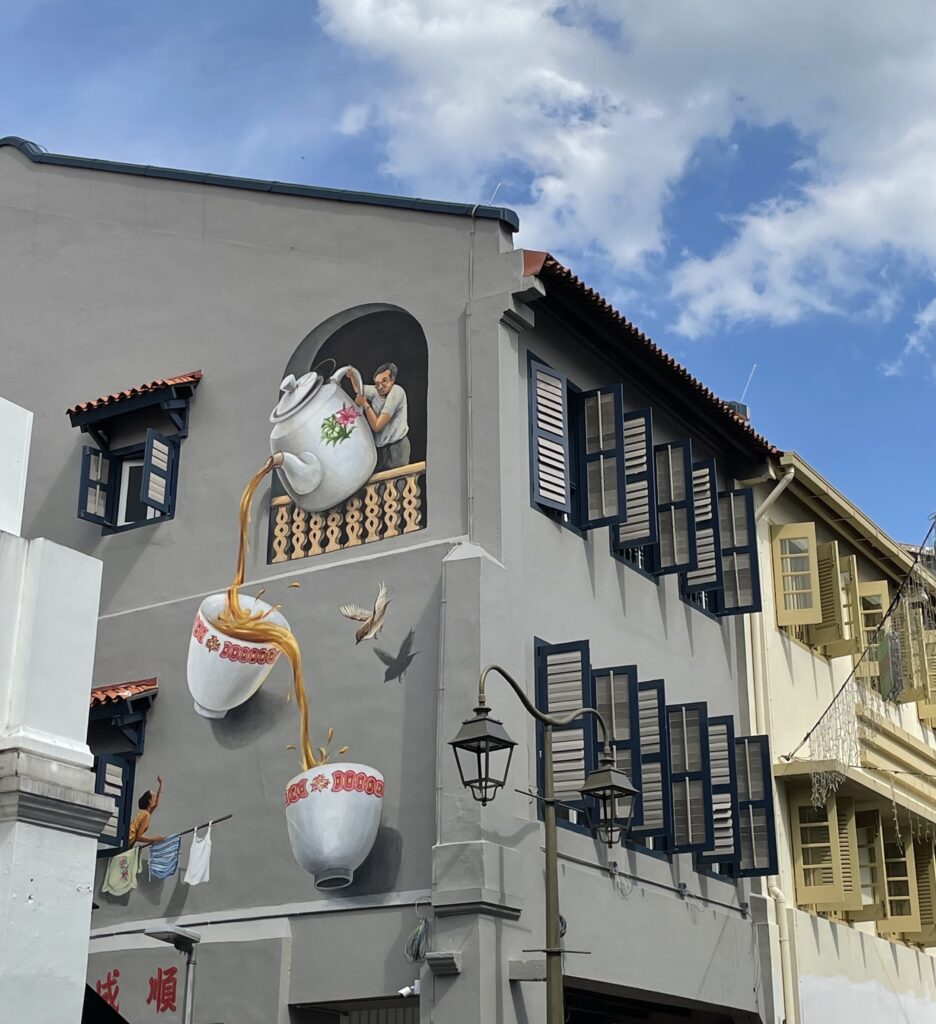


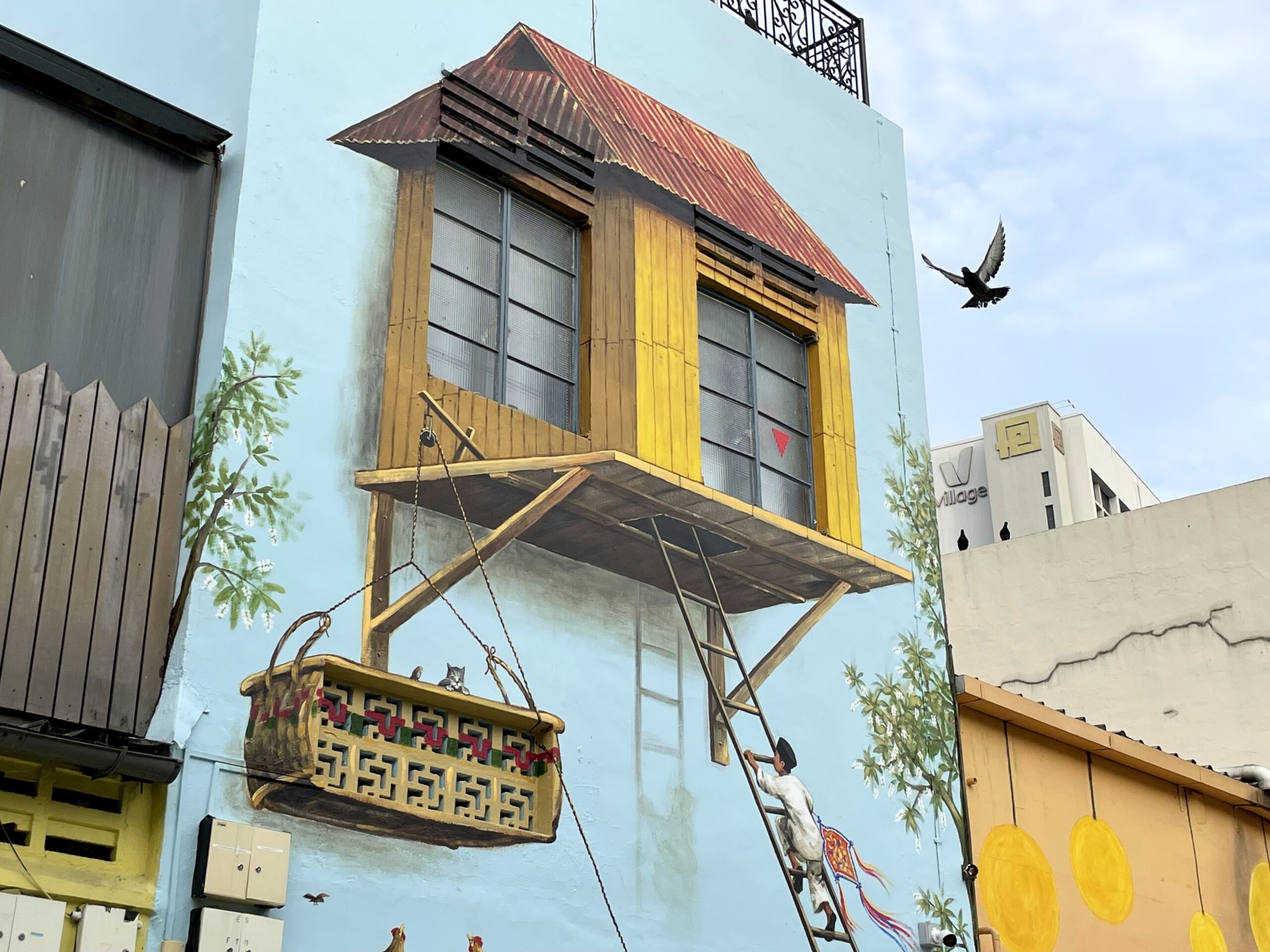
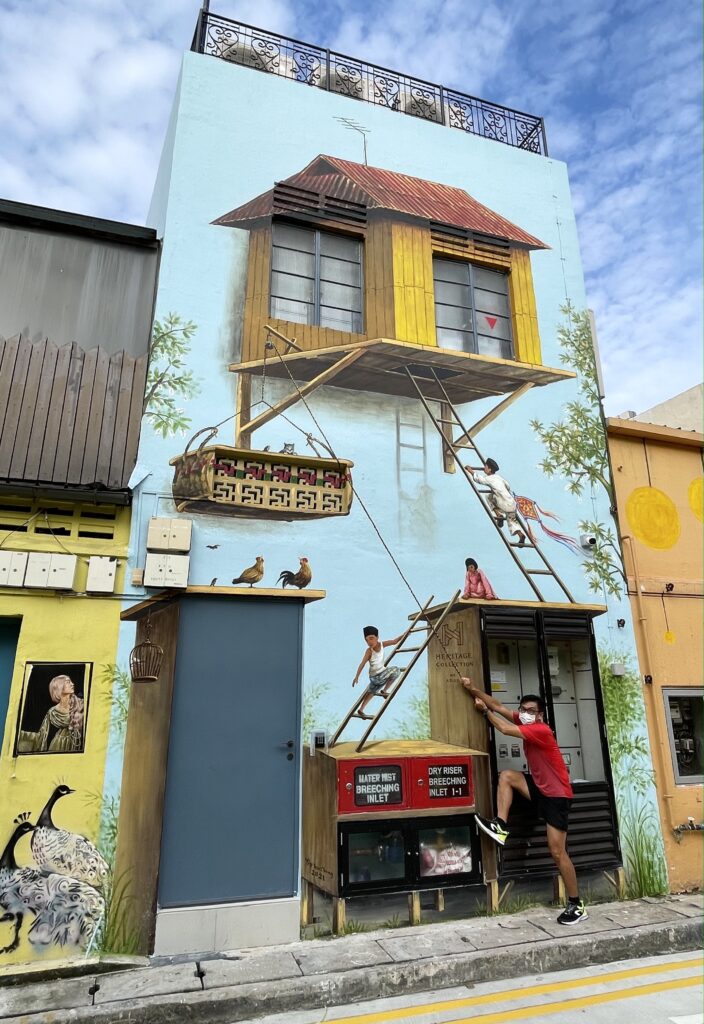
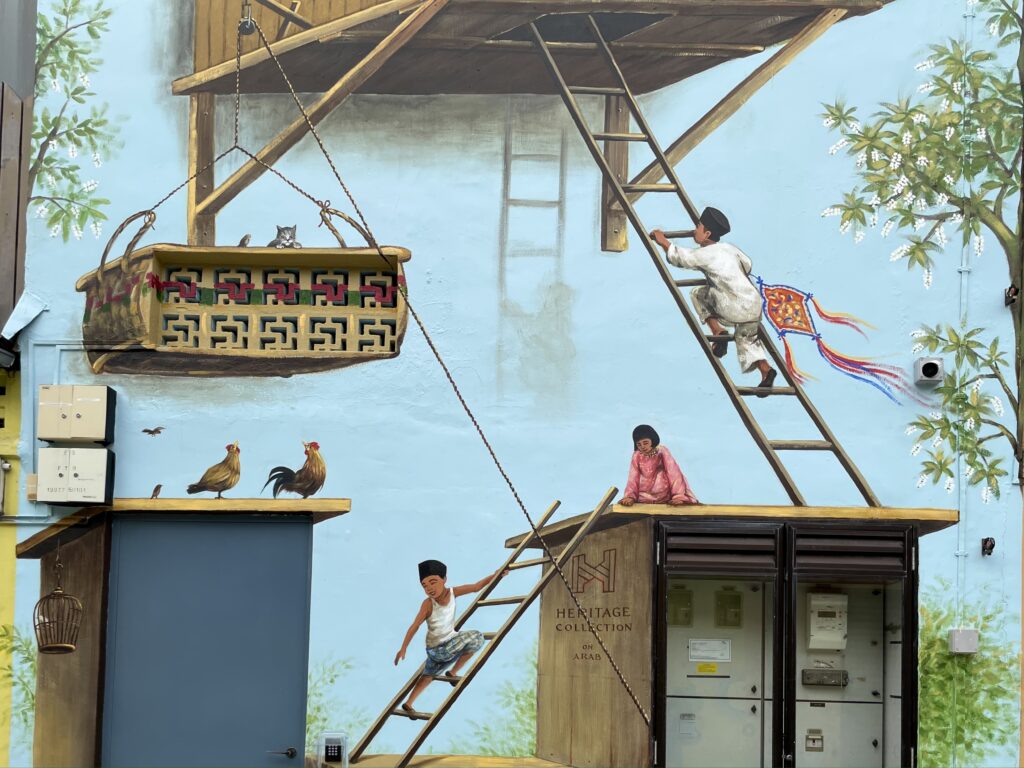


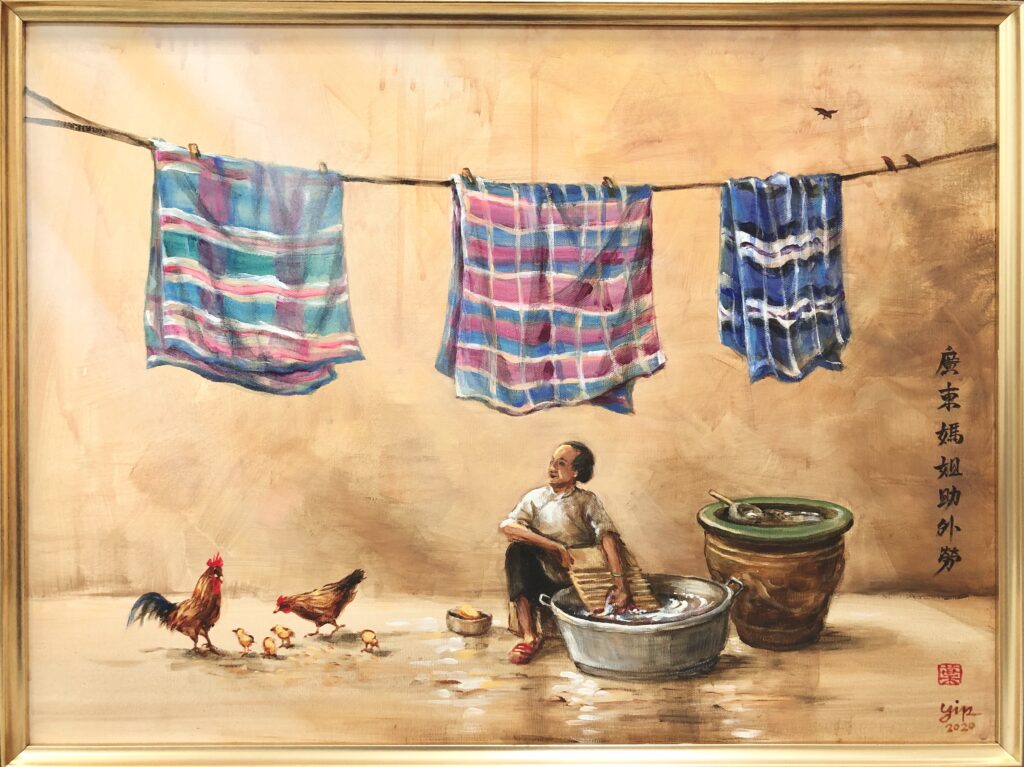


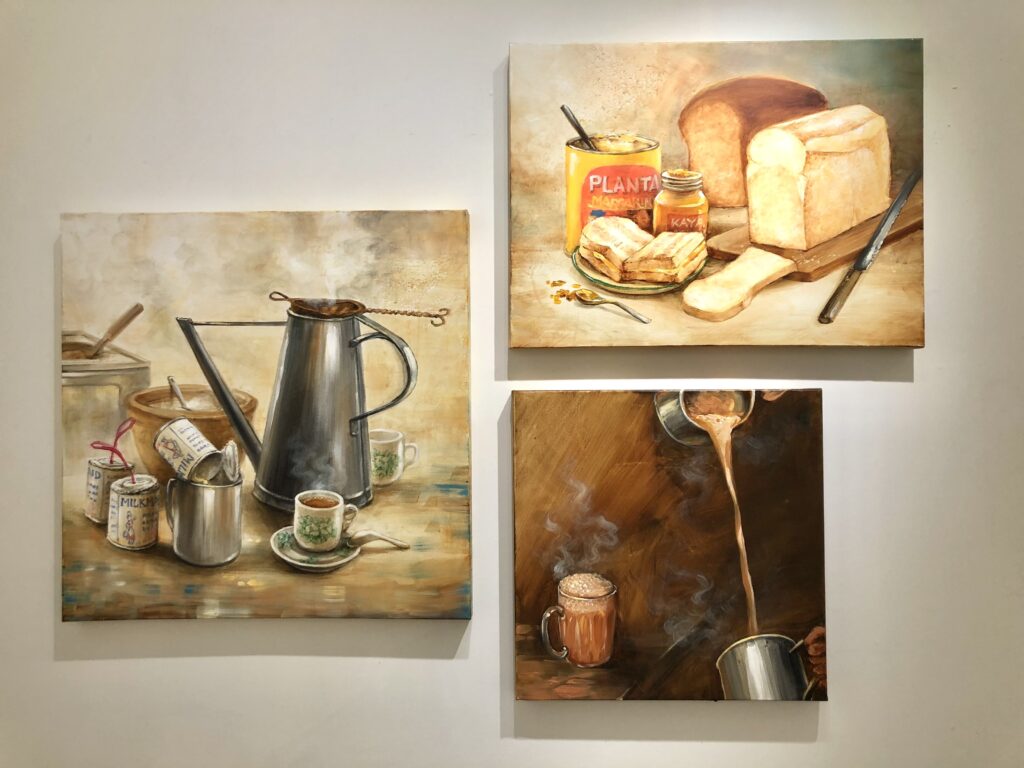


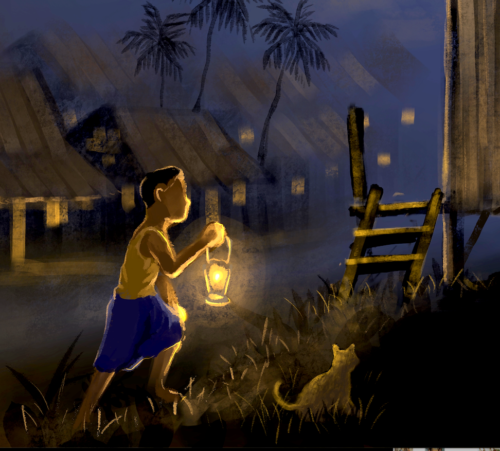


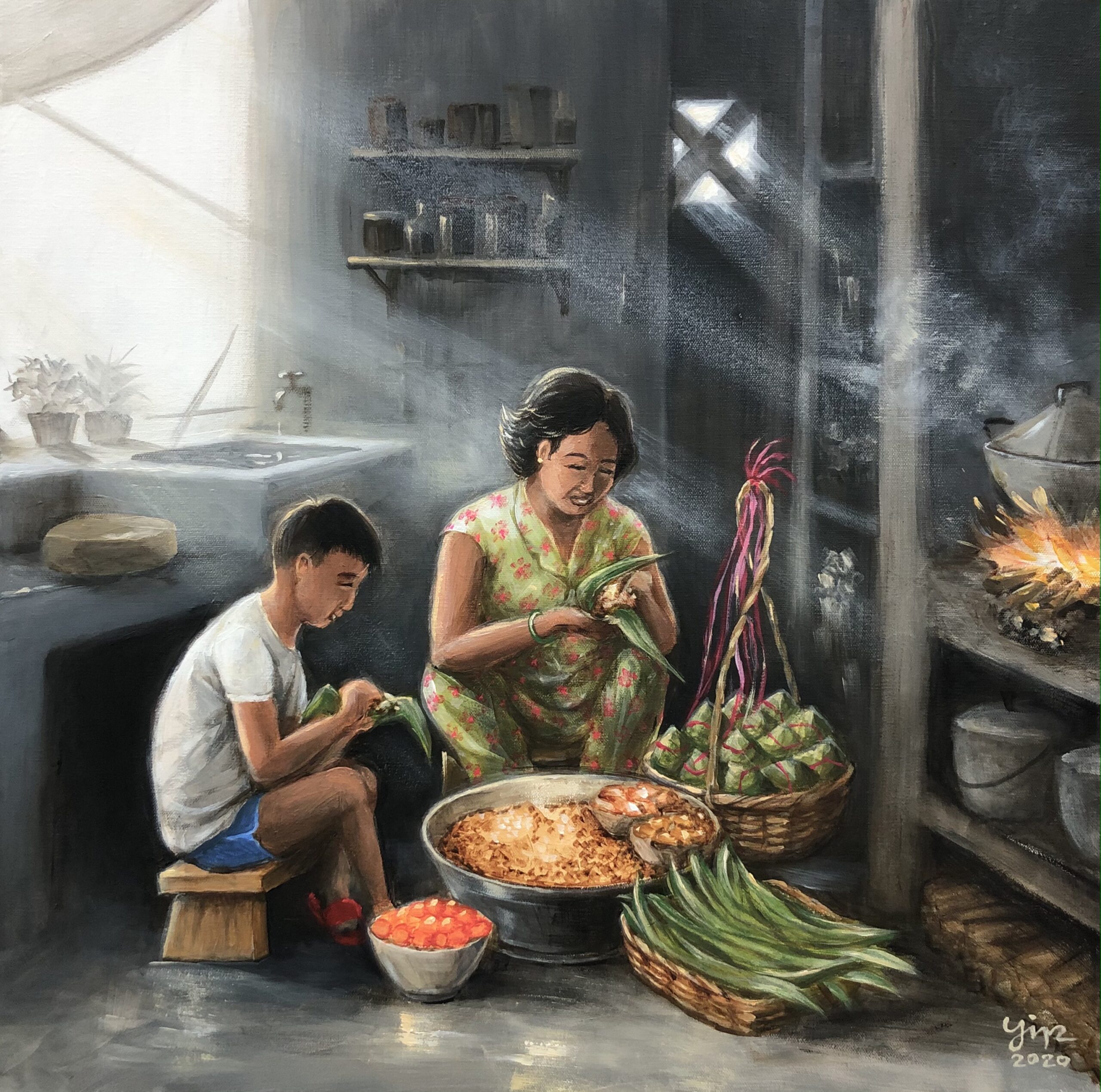
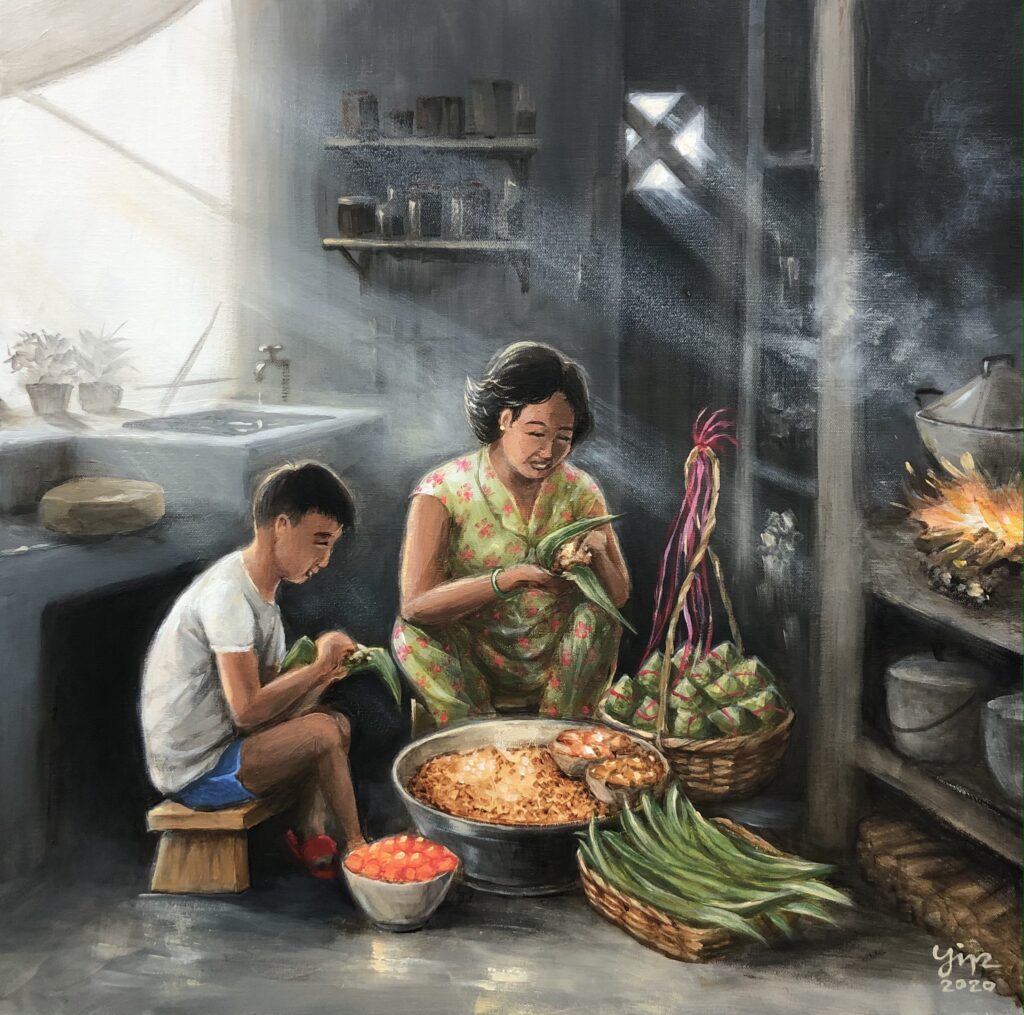

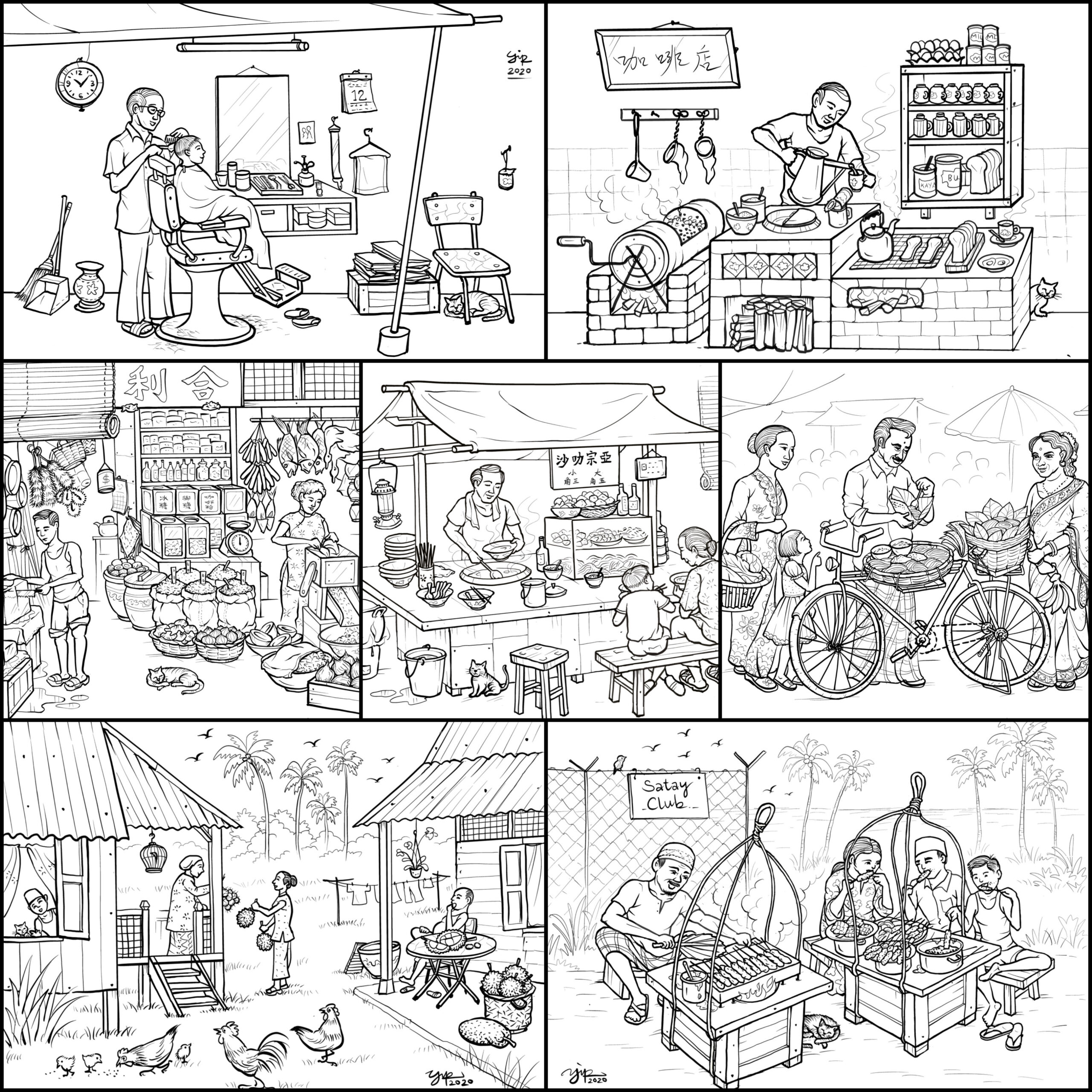


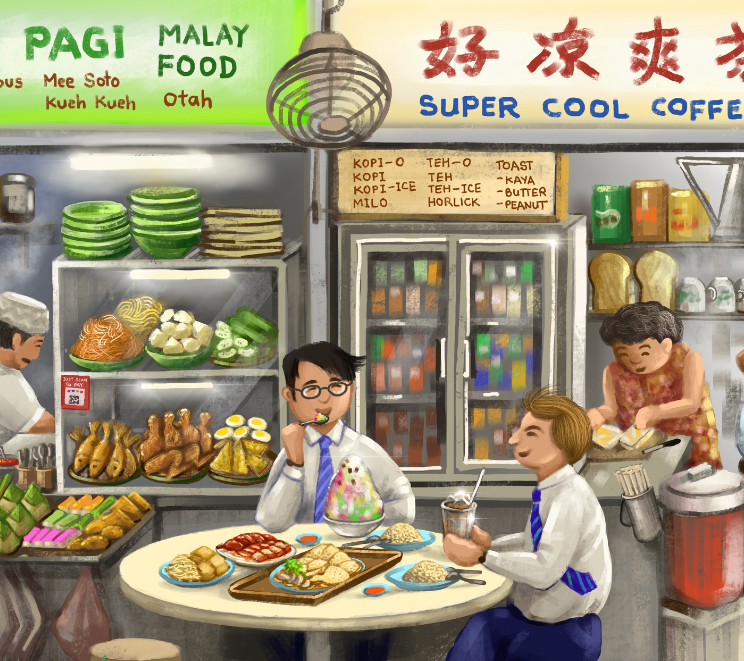


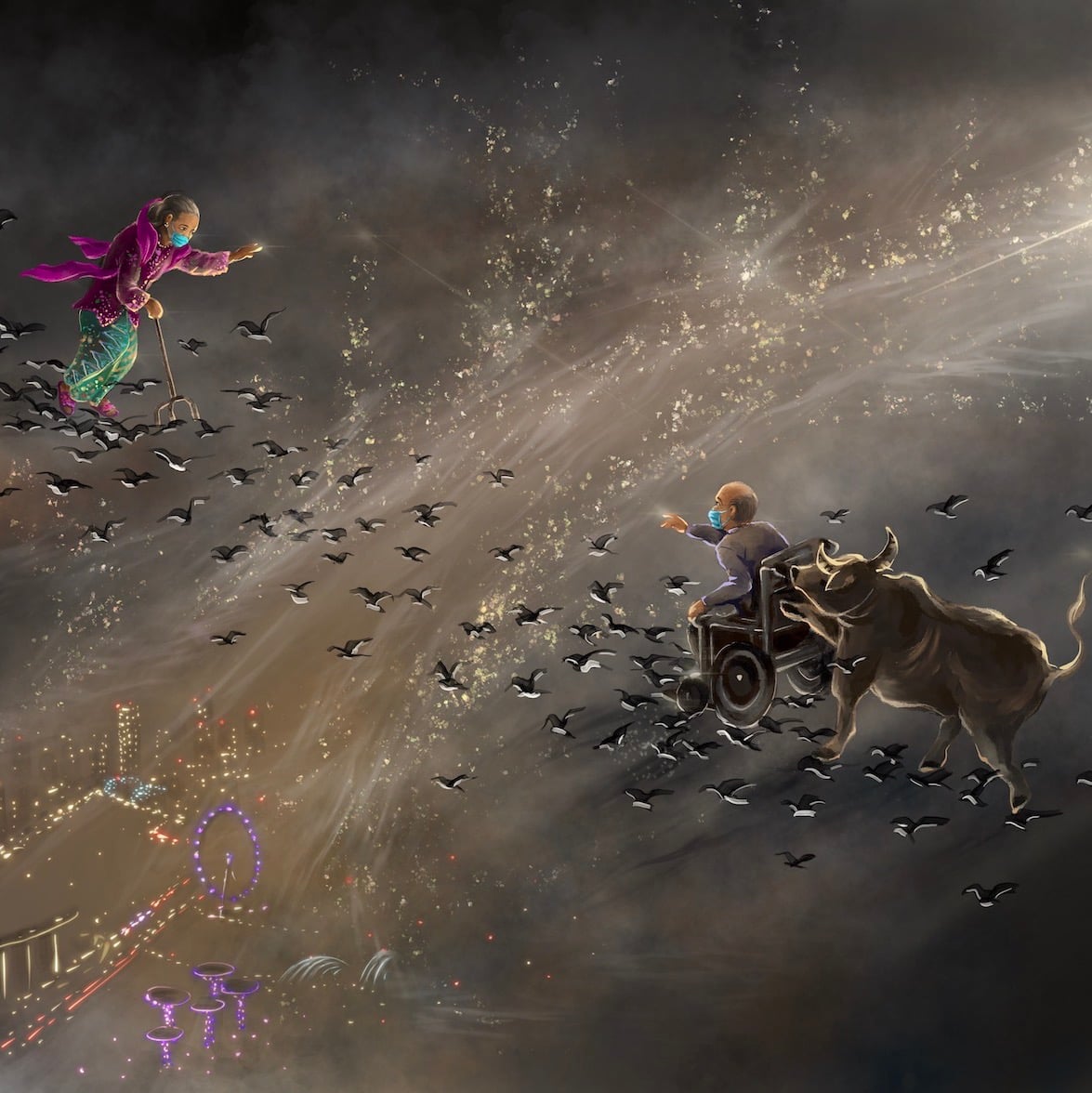

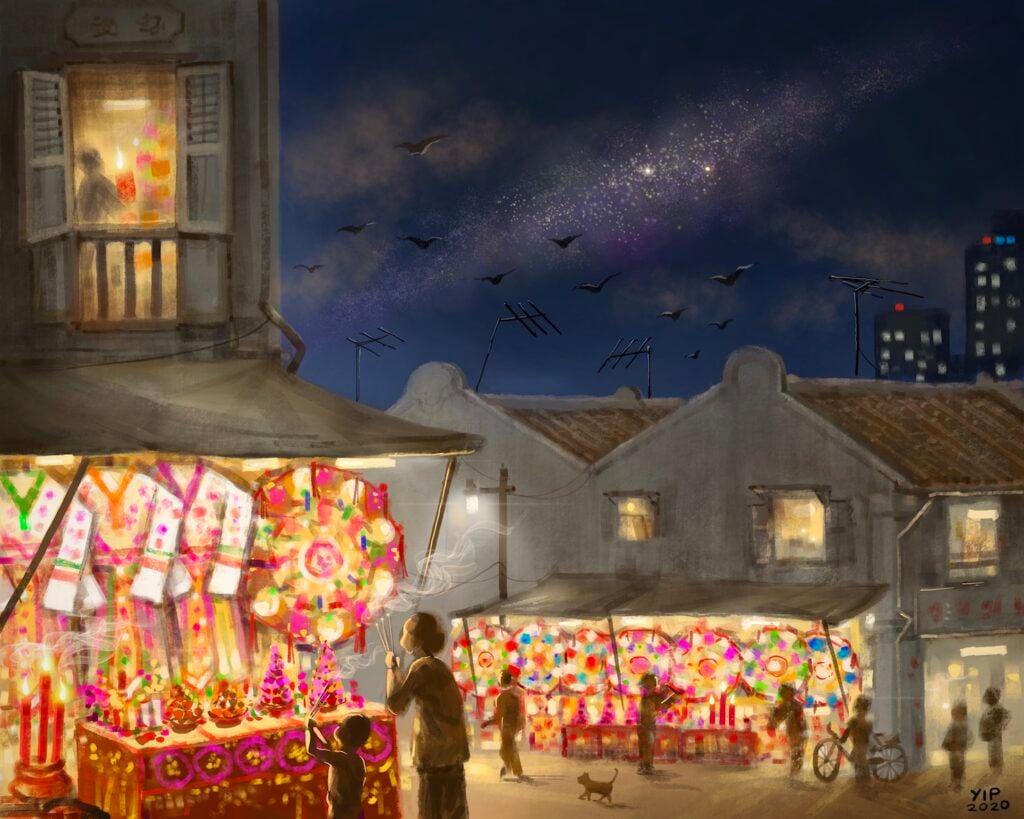
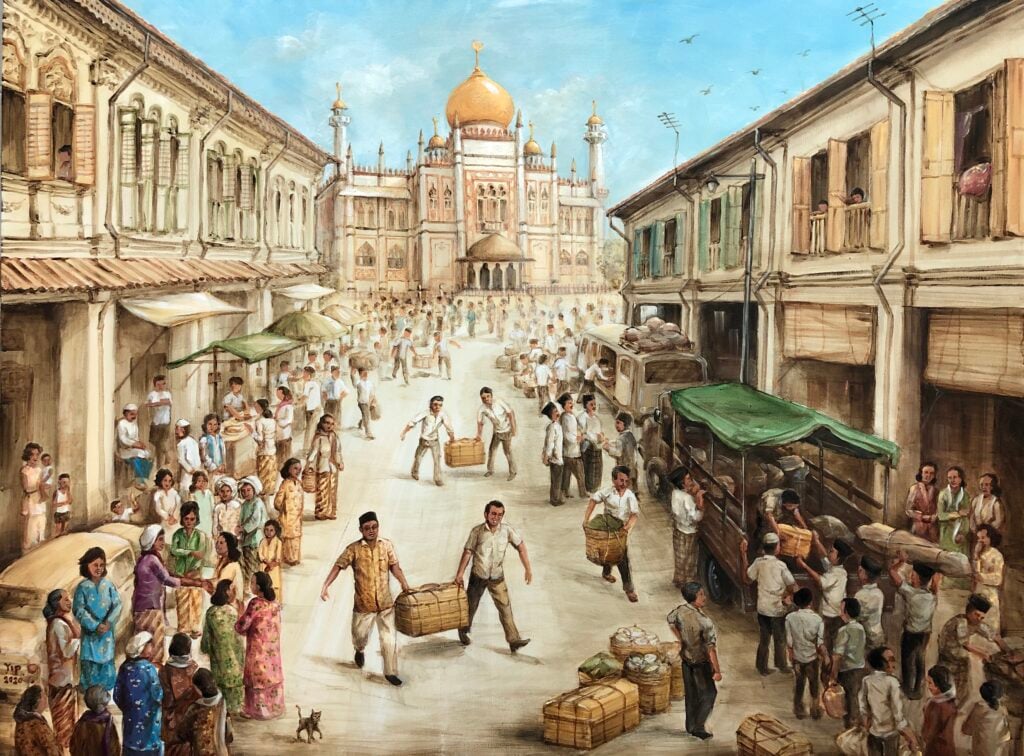


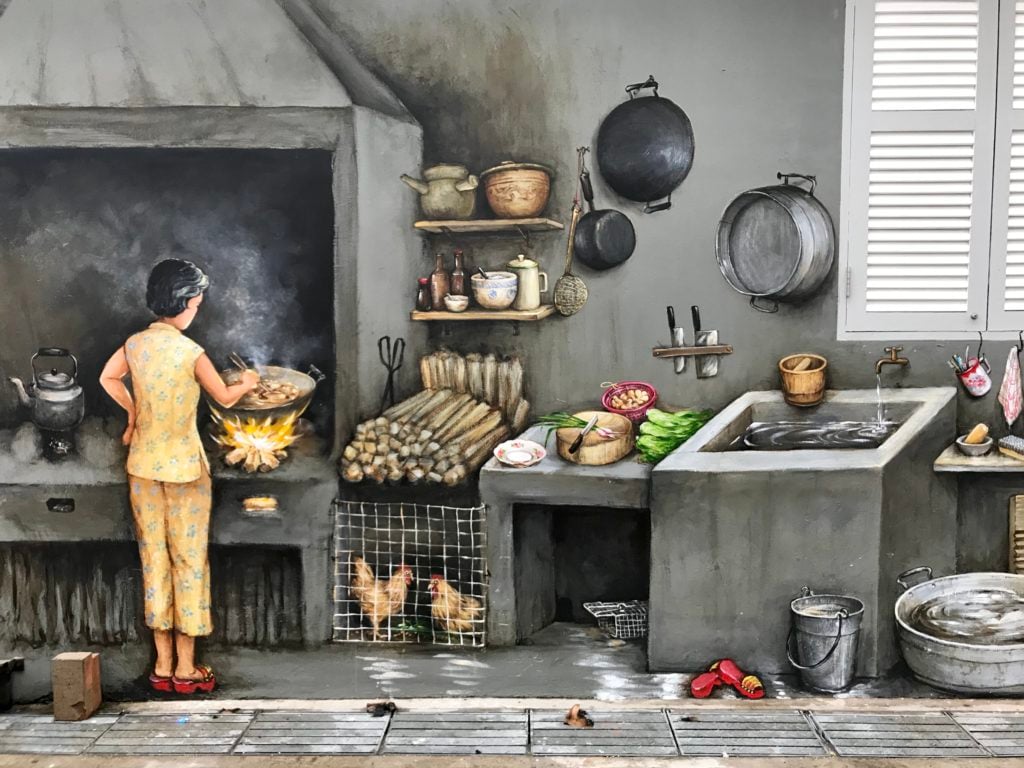


 . Had the police barracks right next to it been not demolished, it could have been a deterance